In 1800, Scottish industrialist Robert Owen doubled his workers’ wages, provided free child care and medical care, and cut shifts at his New Lanark cotton mills. In the years that followed, the mill produced spectacular returns. Naturally, he assumed his actions would inspire fellow manufacturers to follow suit. They did not. His investors, one set after another, eventually wrested back the mill and dismantled his reforms. He died bankrupt. When Emerson asked him in 1841 how many others in his position would follow his example, Owen replied: “Not one.”
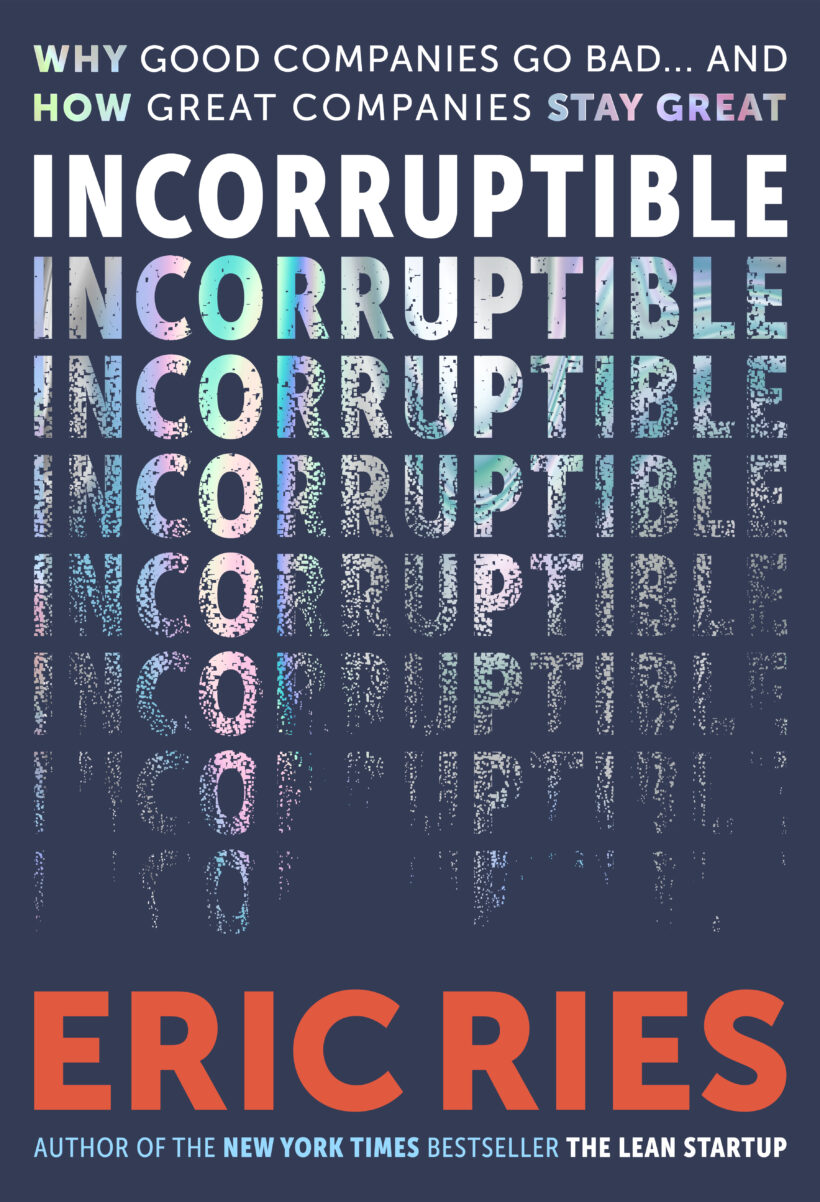
Some 225 years later, Eric Ries invites us into the Greek tragedy that is Silicon Valley. Owen would recognize it well. There is an early scene in his new book, Incorruptible, in which a founder has built something extraordinary. Investors circle. The board is captured. The founder is ousted. The company dies. The investors, having slaughtered their golden goose, are baffled by the lack of eggs.

Ries calls this “enlightened capitalism’s fatal flaw.” And it is the animating tragedy of his new tome. This book is more likely than even his first groundbreaking manifesto to change the way businesses understand themselves in the market.
When Ries’s The Lean Startup appeared in 2011, it gave a generation of founders a rigorous vocabulary for building products under conditions of radical uncertainty. In 2017, he brought his entrepreneurial discipline to the enterprise in The Startup Way. Now, Incorruptible arrives, a book Ries says he wishes he had written first. However belated, it is welcome.

The central argument is elegant and brutal: mission-driven organizations consistently out perform their purely extractive peers. They are consistently dismantled by their own investors the moment they achieve success worth dismantling. Ries names this force “financial gravity.” Like physical gravity, it operates whether you believe in it or not. Unlike Newton’s discovery, it has so far inspired no equivalent engineering solution in mainstream practice.
Until, Ries argues, now.
Incorruptible unfolds in three acts. The first, “The Shape of the Abyss,” is a controlled demolition. Ries walks through a graveyard: FedMart, Polaroid, Cadbury, Toys”R”Us, WholeFoods, Boeing. Each case study traces a familiar arc: a founding vision, a period of exceptional performance, a structural vulnerability, and then:extraction.
Organizations, Ries suggests rightly, are not simply the sum of their employees’ intentions; they are what he calls “super organisms.” Entities with emergent behavior that can diverge dramatically from any individual’s will. A CEO can sincerely believe in craftsmanship, but if employees see that stock price misses get people fired and quarterly beats get bonuses, the organization’s actual values will diverge from its stated ones. Reliably, invisibly, and always. Nobody set out to be Boeing. The force that aligns organizations is not leadership but the relentless pull of whoever controls the resources they depend on.

The Whole Foods story is the book’s most detailed post-mortem, and the most devastating. John Mackey knew cutting prices was the obvious move. He could not do it. The reason was not cowardice but structural: thousands of employees held stock options tied to their retirements. He had distributed economic ownership as an act of loyalty, and in doing so had created a constituency for the very short- termism he abhorred. When hedge fund Jana Partners took its 8.3% stake in 2017, and the infamous boathouse meeting with Jeff Bezos followed, it was not merely greedy bastards triumphing over conscious capitalism. It was a building designed without accounting for wind loads, which finally gave way.

On day one of ownership, Amazon cut prices by as much as 43%. What Mackey had known as necessary but structurally impossible was executed in a single afternoon.
The second act, “Escape Velocity,” is where the book earns its keep as something more than an eloquent and elegant diagnosis. Ries introduces “mission drive,” the discipline of ensuring that an organization only profits by fulfilling its mission. Devoted Health, the Medicare Advantage insurer cofounded by Todd Park, offers the clearest illustration: “The healthier we keep people, the more money we make.” Mission attainment and profit maximization point in the same direction by design.
Patagonia is, inevitably, the other extended case study. But here, Ries is more precise than the overused corporate parables that often attend the activist outfitter. Yvon Chouinard founded Patagonia as a climber who once hand-forged his own carabiners. His philosophy classes asking “What does it mean for an object to be of high quality?” sound eccentric in the retelling. Ries shows how they functioned as constitutional instruction, creating an organization capable of making mission-consistent decisions in the founders’ absence. When lender HSBC, during a near-bankruptcy restructuring, demanded Patagonia cease its environmental grants as a condition of their workout, CEO Kris McDivitt refused. The bank relented.
The third act gets directly into governance architecture: super voting shares, public benefit corporation status, board mission pledges, tenure voting, and steward ownership. Sounds dull? Reconsider. It is in exactly these arenas that the corruptibility becomes preventable. Costco’s “governance fortress” (interlocking super majority provisions that have fended off decades of activist pressure) gets the book’s most detailed treatment. Given the company has compounded at roughly 58 times the S&P 500 since its 1985 IPO, it’s the closest the book gets to a corporate design manual.

A bracing sidebar shreds the empirical foundations of governance “best practice”: mandatory quarterly reporting, annual board elections, majority-independent boards. Study after study, Ries shows, finds that these conventions, championed by proxy advisory firms like ISS, have destroyed rather than created value. It demands attention and, if a reader has not out sourced every last k-cal of critical thinking to the LLM de jour, prompts serious self-reflection. ISS has rated Costco—it of the 58-to-1 outperformance—at maximum risk of”share holder disenfranchisement.” So: less argument than prosecutorial exhibit.
The book is most personal and vulnerable in its account of the Long-Term Stock Exchange, Ries’s attempt to build a trading venue whose standards for listed companies would reward long-term thinking. A coalition of hedge funds made a midnight offer: abandon your principles, adopt”best practices,” and your problems disappear. Ries refused. His team voted unanimously to refuse. He spent the night on a bathroom floor.
The LTSE survived. But Ries is not triumphal. Financial gravity is enforced not only by bad actors but by good ones acting rationally under bad structures. The investment banker who offered to add loopholes, the hedge fund that launched a “technical attack by accident”–these were not cartoon villains. Merely organisms behaving in accordance with incentives. As we humans do.
This is the philosophical move that elevates Incorruptible above the genre of well-intentioned memoirs by misguided corporate piety. Ries is not arguing for better people. He is arguing for better institutions, the organizational equivalent of what Madison, in Federalist 51, called “auxiliary precautions,” the structural checks that protect a republic even when its leaders fail. Or consider Eero Saarinen, who believed a building’s concept had to be “repeated in every part of its interior so that wherever you are, inside or outside, the building sings with the same message.” For Ries, this is mission drive at its best: not culture as values on a conference room wall, but architecture that makes corruption structurally impossible. As Ries has said recently in interviews, he eschewed the term “culture” in this book. However genuine, culture lives in people who can be replaced. Architecture endures.

Robert Owen, Sol Price, and John Mackey all independently discovered that treating people well is also, usually, the more profitable approach. And they were all, in their way, destroyed by the discovery. Ries does not exactly promise his framework will break the two-century cycle. But he offers something Owen lacked: a theory of the mechanism, and a set of structural tools for fighting back.
The exceptions, he insists, are likely to become the rule. Whether you believe him or not, read the argument. Consider it a minimum viable product for a better capitalism.