In finance, private equity (PE) resembles kudzu—invasive, rapidly growing, and unencumbered by boundaries. It’s entangled in hospitals, schools, dental offices, accounting practices, lawn care, and even funeral homes. Wherever there is cash flow, Private Equity aims to sit in the middle of the transaction. Bain & Company, the consultancy that tracks the industry, counts roughly 32,000 companies worth $3.8 trillion that PE firms have bought but not yet sold, and EY reports PE contributes over $2 trillion to GDP.
Not surprisingly, PE has made acquisitions in the marine world, including several boatbuilders. Newport, RI-based pro-sailor, yacht manager, and economics major Jesse Fielding acknowledges, “PE is a powerful tool in modern finance, but I’m not sure about its usefulness in the world of boatbuilding, which is a small, hands-on, labor-intensive industry that’s not really scalable.”

The deal data shows where the money actually lands. In February 2025, Blackstone Infrastructure paid $5.65 billion for Safe Harbor Marinas and its 138 marinas. In August 2026, Safe Harbor agreed to buy MarineMax, the country’s largest boat retailer, for about $1.5 billion. The builder deals, by contrast, are measured in tens of millions. One figure from the National Marine Manufacturers Association explains the gap: pre-owned boats accounted for 79.7% of all boats sold in the U.S. in 2025. PE isn’t buying boatbuilding so much as the toll booths around it—the marinas, dealers, and brokerages that touch every boat, new or used.
Others, while understanding the observation, believe that PE in boatbuilding makes sense in selective cases. A good example is Carolina boatbuilder MJM, an innovative company. Their CEO Natascia Hatch told Worth, “PE saved my company by giving us the runway to develop models and bring serious operational efficiencies to the supply and build process. This has resulted in continuous improvements reflected in our new boat offerings…which have been very successful. We literally went from close-the-doors to a backlog of orders.”

PE encouraged MJM to diversify its workforce with significant increases in women in key roles. It also allowed them to bring in top yacht designers like Doug Zurn.
Universally, however, insiders in the marine industry question why PE would want to enter the boatbuilding world in the first place. At the recent Newport International Boat Show, an old canard often used to describe the wine trade was adapted: “If you want to make a small fortune in the boatbuilding business, start with a large one.”
The list of once-prominent boatbuilders that have gone under is long. Names like Tillotson Pearson, Allied Seawind, Shannon, Cape Dory, Owens, Penn Yan, and many more are no longer around. Each failure has its own story, but a common theme is undercapitalization that leads to a yard’s closure at the first recession or slump in orders. Just plain mismanagement is also a boatbuilding feature, not a bug. Someone can be a great visionary, a master of quality and innovation, but a poor businessperson. PE, with its focus on sound fiscal practices, lets boat builders concentrate on what they do best.
Even in the best of times, aspirational brands often only make 300 boats a year. Some well-known premium names, like Maine-based Southport, turn out fewer than 60. Well-regarded and privately owned Regulator boats only produce 250. Legendary Chris-Craft, a market leader now owned by Winnebago Industries, reportedly builds only about 650 boats a year, even after expanding production. By contrast, Tesla sold 1.6 million cars last year.

Michael York of Maine’s York Marine, who has made custom boats for decades in a high-wage, difficult-to-do-business state, was explicit. “Boatbuilding is a tough place to make money.” As a result, he builds one or two custom boats a year and mostly does restoration work.
It is easy to see boat construction is not a cash cow. Then, why is PE attracted to it? The main takeaway from industry vets is that someone in each investing PE C-Suite loves boats and yachting. As one industry insider told me, “If you’re attracted to a water-oriented lifestyle and want to pursue those passions, owning a boatyard or production facility is a great way to hang with people in this world.” His observation also makes sense: prior yachting knowledge means fluency in the lingo of boatbuilding. One doesn’t have to learn everything that goes on between the bow and stern.
Even more interesting is an observation from a top player in a global marine technology group who suggests PE wants a toehold in the yachting world for its customer contacts. He believes, “There is an incredible amount of wealth behind yacht ownership, and getting to interact with these affluent owners is a hidden extra to any investment. These relationships can often lead to other transactions.”
Another source offered a more emotional take: “You have no idea how powerful the lure of the yachting lifestyle is. We’re talking about relatively tiny amounts of PE capital compared to, say, AI investing. Boats are where the enjoyment leverage is an unlimited X-factor return.” Love of the water is certainly not new. The ultra-wealthy have been attracted to yachting since Phoenician times.

How is the track record of PE in this industry? As one salty wag put it, “PE in the boatbuilding world is like marriage. Some may last 50 years and, while there will be hard times, they are survivable, but some are a disaster from the first few weeks.” Shortly after PE acquired a company he wouldn’t name, “They fired all the retail dealers and tried for direct-to-consumer sales. They shuttered several domestic factories and relocated them to low-cost, offshore sites. They let go of people who have long relationships with key customers. It basically ended the brand.”
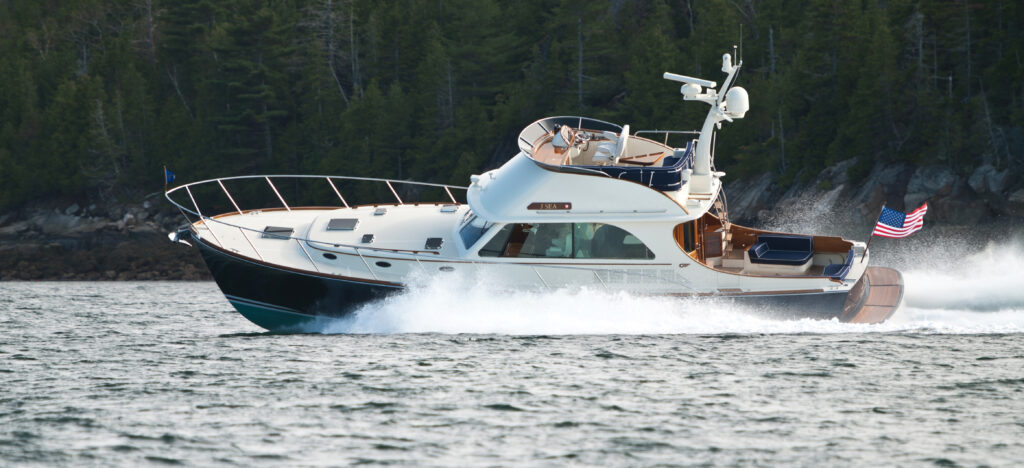
On a more positive note, if one company is unabashedly happy with its PE investors, it might be the Bentley of the yachting world, Maine’s legendary Hinckley Yachts.
The company’s hundred-year history began with a family boatyard in Southwest Harbor, Maine. From these humble beginnings, it evolved to offer quality recreational boats, including the flagship of all cruising yachts, the Bermuda 40. Over the years, Hinckley added design services, maintenance, plus brokerage.
Worth asked Gavin McClintock, Hinckley’s CEO, what made PE want to partner with Hinckley. He responded, “My two decades of marine experience, investing in and ultimately managing a portfolio of boatyards and marinas, is a background that will now help shape Hinckley’s focus on world-class facilities and service. I saw a great opportunity.”

Since the marine industry is in his blood, he told Worth, “We will continue to handcraft the industry’s most iconic boats in Maine and leverage our exacting standards to offer boat owners an unmatched experience through service, slips, storage, and brokerage.” Hinckley owners, with their often substantial seven-figure investments in these top-of-the-line boats, are counting on these yards to maintain and upgrade their crafts to the highest standards. McClintock has decided to use some of the $40 million invested over the last two years (with another $20 million this year) to expand its current facilities and find new ones along the East Coast. Anyone who has ever owned a boat knows maintenance and continual upgrades are integral to ownership.
Hinckley now operates service yards in Maine, Rhode Island, New York, South Carolina, and Florida, near affluent destinations such as Newport, the Hamptons, and Palm Beach.
McClintock continued, “For boat owners, these better facilities mean better protection, more precise work, and boats that retain their condition and value season after season. They also help us attract and retain the industry’s most skilled technicians. We’re approaching the company with the stewardship this iconic brand deserves. We’re planning for the next 100 years.”
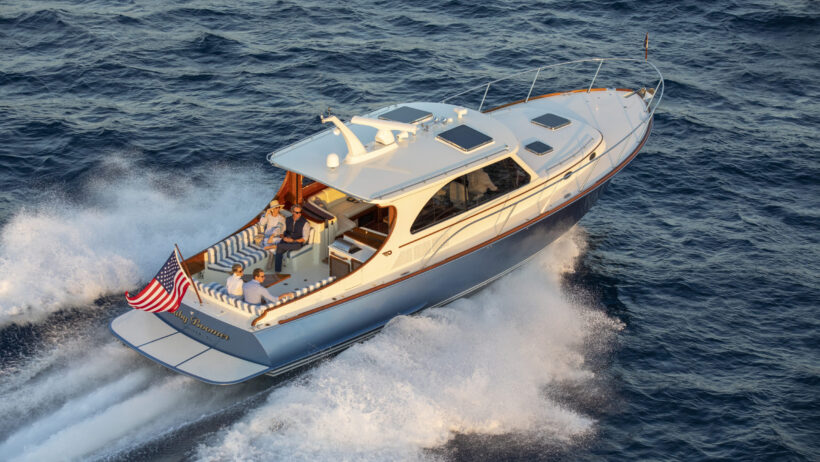
Expansion of the product line is also a top priority. Hinckley’s PE is solidly behind the brand for this expensive undertaking because, as with so much technology these days, the rate of change is relentless. McClintock’s goal is to meet this challenge. “On the product side, Hinckley has introduced Picnic Boats 39 and 41, with the first 45 now moving into production.”
They are building on the success of the 39, named Best New Boat Overall at the 2025 Newport International Boat Show. All models feature state-of-the-art yachting technology. Hands-off joystick docking is one example. Another is remote monitoring called “On Watch,” so you can identify problems anywhere.
As the land meets the sea on Maine’s long, rugged coast, so too does one of America’s most venerable boat builders meet the world of PE. To keep this heritage brand going, it needs capital and modern management to develop new models, improve existing facilities, and acquire new ones. The boatbuilding industry is watching and hoping this works out.
Hinckley embraces this responsibility as they inherit the legacy of 400 years of Maine boatbuilding.