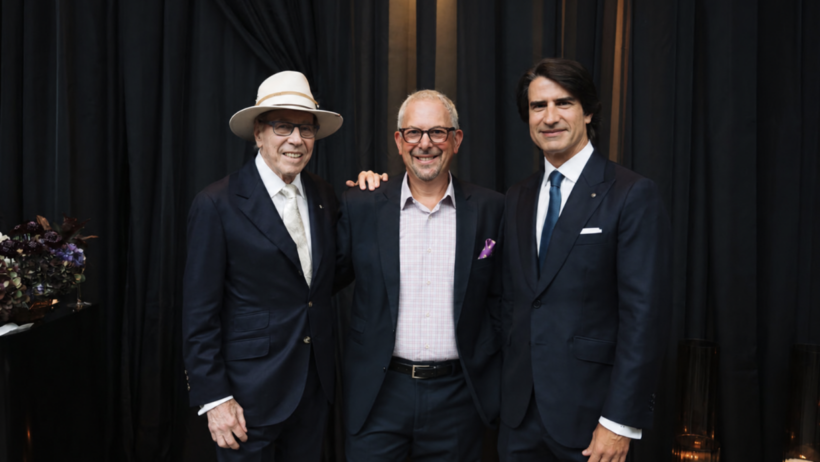
At 94, Isadore “Issy” Sharp still has the energy and curiosity of the entrepreneur who founded Four Seasons over six decades ago.
I spent a couple of hours with the founder of Four Seasons at the Toronto home he shares with his wife, Rosalie, before joining him the following evening for a celebration marking the company’s anniversary. The home itself tells you something about the couple. Rosalie is colorful in both personality and dress, and her paintings fill the walls with that same sense of life. Issy, meanwhile, talks about the company he founded in 1961 with the enthusiasm of a founder describing his next venture rather than a man looking back on six and a half decades of achievement.
That may be because Sharp never set out to build Four Seasons in the first place.
His first hotel was essentially a real estate deal. It was only after the second and third properties that he began to see the possibility of creating something different. He was not interested in building the biggest hotel company, he wanted to build the best.

What followed was not a perfectly plotted journey. Financial pressure surrounding the company’s early expansion forced Sharp to reconsider the wisdom of owning the real estate underlying every hotel. Four Seasons increasingly shifted toward management contracts, allowing other investors to own the physical properties while Four Seasons operated them and protected the standards associated with its name.

What began partly out of necessity became one of the foundations that allowed the company to grow. Looking back today, Sharp says he would not change the difficult decisions or obstacles along the way. They are inseparable from the company Four Seasons became.
That evolution also forced the company to define its unique position in the market that focused on experience.
Buildings can be copied, marble can be purchased, restaurants can be redesigned, beds upgraded and spas expanded. Sharp realized early that the more defensible competitive advantage was service, and that delivering exceptional service consistently required something more powerful than an operating manual. It required creating a culture that empowered all employees to deliver the highest level of guest service.
The organizing principle became remarkably simple: the Golden Rule. Treat others as you would want to be treated.
At Four Seasons, that principle is more than a slogan. It informs whom the company hires, how people are trained and, perhaps most importantly, how much authority employees are given to solve problems.

Sharp rejects the idea that 99% customer satisfaction is good enough. In hospitality, the one guest whose experience goes wrong matters enormously. The person who encounters that problem, whether a housekeeper, engineer, server or front-door employee, needs to feel responsible for solving it rather than passing it to someone else.
“You praise in public, and you support in private,” Sharp told me, describing a culture in which employees are trusted to use judgment and are supported when that judgment does not produce the perfect outcome.
That becomes considerably harder when a company grows from a handful of hotels to roughly 140 properties around the world.
Alejandro Reynal, who has led Four Seasons as CEO for nearly four years, describes the company’s approach as “intentional growth.” Every new property has to add something to the portfolio and make sense for the guest, while preserving the principles on which Sharp built the company.

The challenge is not to make every Four Seasons identical. Each property needs to reflect its location and community while operating with what he describes as a Four Seasons overlay. The physical quality, service standards and values should be recognizable, but the experience should feel authentic to the destination.
That balance between consistency and individuality may be one of the more difficult challenges in global luxury. Scale naturally encourages standardization, while luxury increasingly demands personalization and a sense of place. Four Seasons is attempting to deliver both.
It also makes choosing the right ownership partners critical. Four Seasons may operate the hotel, but someone else is committing the capital required to build and maintain it. Reynal says the right partners need to share the company’s long-term perspective and willingness to continually reinvest in the product.
Sharp has a more ominous way of expressing the danger of doing otherwise: “Compromise is the seed of destruction.”
A two percent compromise may be invisible, but then comes another three percent and eventually, the guest notices. For a brand built on consistency, a series of individually rational compromises can ultimately undermine the promise itself.
The same discipline has guided Four Seasons beyond hotels.
Branded residences initially emerged partly because they could improve the economics of hotel development. They have since become a major business in their own right, with Reynal saying approximately 70 percent of projects currently in development include a residential component. The company is also expanding standalone Four Seasons residences in markets where a hotel may not make economic sense.
Then came the Four Seasons Private Jet and, more recently, Four Seasons Yachts.
Sharp does not view these as diversification. To him, they are extensions of what the brand already represents. Reynal describes the strategy as building a luxury ecosystem in which customers can stay with Four Seasons, live with Four Seasons and travel with Four Seasons.
There are plenty of other opportunities to put the Four Seasons name on something. Reynal says the company turns many of them down. Hotels remain the core business, with residences and travel experiences extending the relationship in ways that are natural to the guest.

Technology could now extend that relationship in a different way. Luxury hospitality has always depended on remembering what a guest likes, anticipating a need and creating moments that feel personal rather than programmed. Historically, much of that knowledge resided with individual employees or within systems and processes developed over repeated visits. Artificial intelligence creates the possibility of making far more information available at the moment an employee needs it.
Four Seasons is already experimenting with tools that can prompt employees with guest preferences and other information. Reynal sees the opportunity as combining the “emotional intelligence” of Four Seasons employees with the artificial intelligence and data available to them.
That distinction matters as the goal is not to use technology to remove people from hospitality. It is to give people better information so they can deliver the kind of personalized service Sharp envisioned decades before AI existed.
The evening after my conversation with Sharp, I joined him, Reynal, Four Seasons leadership, longtime guests and employees for the company’s 65th anniversary celebration. Among those being recognized was an employee who had spent 50 years with Four Seasons.
It was a striking reminder that companies rarely sustain cultures for six decades through slogans alone.

Four Seasons has changed enormously since Sharp opened his first hotel. Its ownership model changed. Its geographic footprint expanded. Residences became a major part of the business. Guests can now experience the brand in the air and at sea. Technology is beginning to reshape how the company understands and serves them.
Yet the underlying proposition has remained remarkably consistent.
Build an exceptional physical product, choose partners who are willing to protect it, hire people who instinctively want to take care of others and give them the authority to do so. Never allow incremental compromise to erode the standard.
At 94, Sharp believes Four Seasons may be entering its greatest era. After spending time with him, what struck me was not simply his pride in what Four Seasons has become, it was his continuing belief in the principles that got it there.
Sixty-five years later, Four Seasons is still growing. The more interesting accomplishment may be how much of what mattered at the beginning has never changed.