Markets reward patience. As investors, we often struggle to give them time. At Satovsky Asset Management, helping people stay with a sound plan when they feel the urge to change it is central to our work.
Most conversations about wealth start with interest rates, earnings, elections, or the next correction. I like to bring the conversation back to something closer to home. When the market moves and you look at your portfolio, what will you do next?
Financial planner and author Carl Richards gave us a name for the difference between the return an investment earns and the return its investors actually capture. He calls it the behavior gap. When we buy, when we sell, and when we abandon a plan can all affect how much of an investment’s return we keep. Over decades, those decisions compound.

What the Data Shows
Morningstar has measured this gap every year for more than a decade. Its 2026 Mind the Gap study covered nearly 23,000 U.S. mutual funds and ETFs over the 10 years ended December 31, 2025. The funds returned 9.9% a year. The average dollar invested in them earned 8.7%.

That’s a shortfall of 1.2 percentage points a year, or about 12% of the funds’ annualized return. Across the industry, Morningstar estimates that the timing of investor cash flows had an impact of roughly $3.8 trillion over the decade.
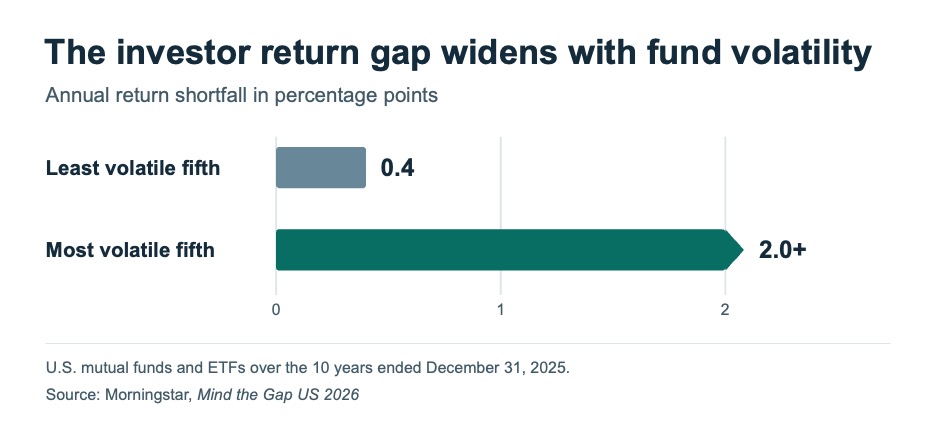
The gap widened with volatility. It was about 0.4 percentage points a year for the least volatile funds and more than 2 points for the most volatile. Early investors in spot bitcoin ETFs trailed their own funds by nearly 14 points a year. They tended to buy after rallies and sell into declines.
Morningstar points out that even steady monthly contributions can create a gap. What stands out to me is the broader pattern. Investors who followed simple, systematic approaches generally captured more of what their funds earned than those who reacted to market moves as they happened.
Why Smart People Do It
I think about founders, executives, physicians, and other people who have built careers by spotting problems and acting quickly. That instinct serves them well in much of life. In investing, it can make patience feel like inaction. A 20% decline feels like a problem you should solve. A soaring asset feels like an opportunity you’re about to miss.

Behavioral finance gives us terms for what’s happening, including loss aversion, recency bias, overconfidence, and herd behavior. In the moment, it feels simpler. Fear and excitement can take hold before we’ve had time to think. With a phone full of alerts and a brokerage app that executes in seconds, there’s very little between the feeling and the trade.
A concentrated stock position, a business sale, an inheritance, a divorce, or the loss of a spouse can add another layer of pressure. Suddenly, a plan built to last decades can feel like something you have to reconsider by Friday.
How I Help Clients Close the Gap
I put more stock in a decision-making process we’ve agreed on in advance than in any forecast. Morningstar’s findings point in a similar direction. Trade less in response to headlines, put contributions and withdrawals on a schedule, keep the portfolio broadly diversified, and automate routine tasks such as rebalancing.
In my work with clients, I focus on three things.
- Start with what the money is for. Before we talk about the portfolio, I want to know what it needs to do. Is it there to pay for a child’s education, help you step away from a business, or support a cause you care about? That purpose gives us something concrete to come back to when markets get noisy.
- Make decisions when things are calm. We write down the investment policy and agree on when to rebalance. When the market drops, we can refer to a decision we made with clear heads.
- Have someone you can call. Sometimes the most valuable thing I do is slow down a decision. A conversation can give us time to revisit the plan and ask what has actually changed before placing a trade.

What Behavioral Coaching Looks Like
When I founded Satovsky Asset Management in 2007, I wanted our work as an independent investment adviser to help people prepare for a future none of us can predict. The hardest part of investing, in my view, is staying with a good plan when every instinct tells you to leave it.
A lot of that work happens away from the markets. I might help a founder decide what “enough” looks like before selling a business. I might help heirs prepare for the responsibilities that come with an inheritance, or help a couple agree on shared goals while they have the time and space to talk them through. Those conversations make it easier to decide what to do when the pressure is on.
The Return That Matters
I think of the behavior gap as a mirror. It shows us what we did with the returns the market offered.
None of us can control interest rates, elections, or the next correction. We can build a plan worth keeping, decide how we’ll respond under pressure, and choose people who will tell us the truth when we need to hear it.
The greatest risk to your wealth may be how you respond when markets test your plan. That response is also one of the few things you can shape.
Disclosure
Satovsky Asset Management, LLC is registered with the U.S. Securities and Exchange Commission as an investment adviser. Registration does not imply a certain level of skill or training. This material is for informational purposes only and is not investment, tax, or legal advice. Investing involves risk of loss.