At Techonomy 26, I asked a room full of executives, investors, and founders to raise their hands if they thought the hyperscalers were doing a great job marketing their AI services. One hand went halfway up. Then it came back down.
Martin Whittaker, CEO of JUST Capital, sat next to me. He had just finished presenting a year of polling on what Americans, institutional investors, and corporate leaders actually think about AI. He didn’t look surprised. “That kind of tells you what you need to know,” he said.

The technology itself is popular. People use it, they’re impressed by it, and they can see how it helps. It’s a better Google. What soured is everything around it, and what soured it fastest is the data center. It is the first physical object the AI economy has produced that an ordinary person can point at. Everything else is just text in a window. The backlash was the building you can see from the highway that was driving up you electric bill.
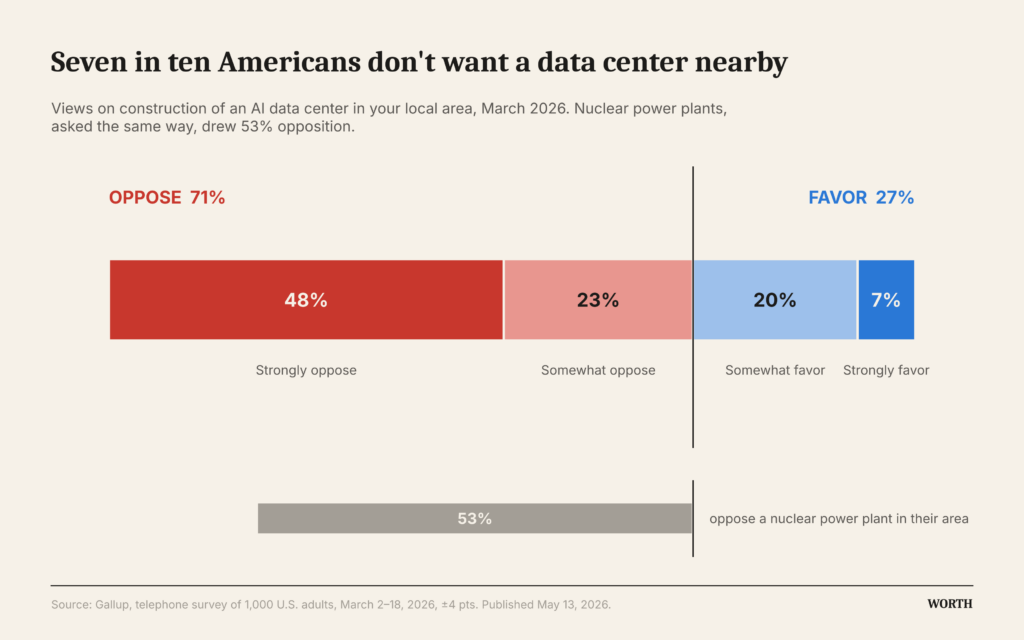
JUST Capital’s polling in August found 47 percent of Americans opposed to a data center in their community, 39 percent in favor, and 13 percent undecided. Gallup had put local opposition at 71 percent in May, a number Whittaker noted was worse than any nuclear plant has ever polled.
The instinct inside the industry is to treat this as NIMBYism. Build somewhere else. Offer the county a better deal. Whittaker’s data says that reading is wrong. When JUST asked people how they felt about a data center ten miles away rather than next door, the numbers barely moved: 49 percent opposed, 37 percent in favor.
“It wasn’t a NIMBY effect so much as what it represents,” Whittaker told me. “People had just the greatest sense of opposition, even if there wasn’t a data center in their town or their region.”
You cannot cite your way out of a symbol. For many people, the data center symbolizes an AI economy running on their electricity bill. Among opponents in JUST’s poll, 34 percent cite rising utility costs and 22 percent cite environmental impact. They are not imagining it. A Bloomberg analysis found wholesale power prices near some data centers up as much as 267 percent in five years. Cornell researchers estimate operators pay for roughly 38 percent of the infrastructure costs their growth creates. The rest lands on the rate base. The public is co-financing the buildout, and it has figured that out.
JUST’s National AI Monitor, which tracks public sentiment on AI across several dimensions, scored the technology positive on work, customer experience, and community in September. The environment was the one category underwater, at minus 12. Water, power, and grid strain put it there.
Then came the midterms, and here the story gets more complicated than the headlines. NBC’s exit poll found 56 percent of voters calling AI and data centers a crucial or major factor in their vote. That sounds like a lot until you see the rest of the list: government corruption at 90 percent, cost of living at 89, the war in Iran at 74, immigration at 73. AI finished last of the five. Brent Buchanan, who runs the Republican polling firm Cygnal, says his post-election survey put AI at “literally the bottom option at one percent of what drove their vote.”
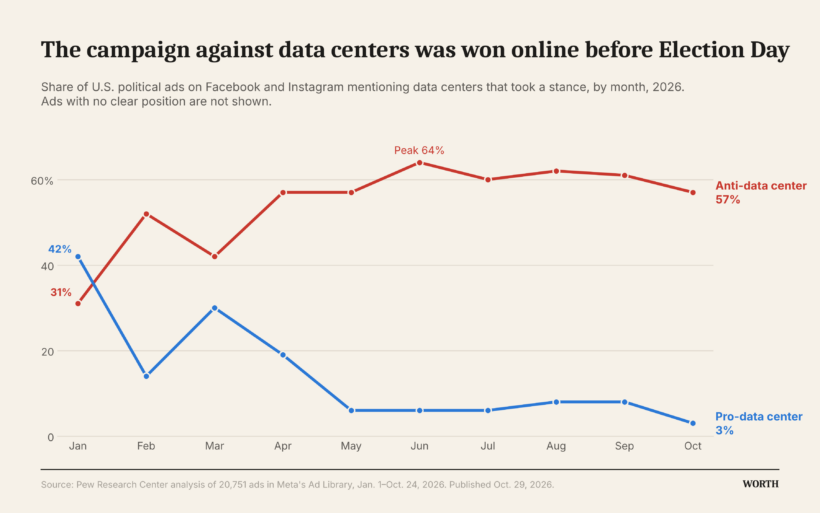
And yet. Of 41 local data-center measures on ballots in ten states, every reported result but one went against development. Data Center Watch counts 32 of 34 winning gubernatorial candidates supporting stronger regulation, and a dozen backing outright moratoriums. Georgia, Ohio, Texas, and Kansas all elected governors who campaigned on a pause. Campaigns spent more than $380 million on television ads mentioning data centers, with Democrats outspending Republicans three to one on the subject.
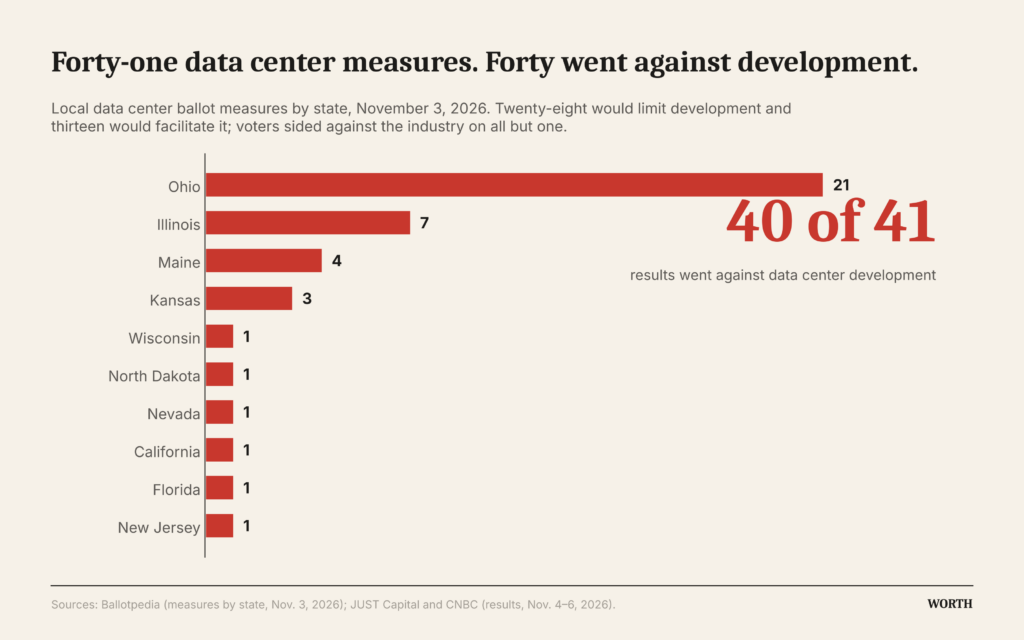
That is the finding that should worry the industry. The backlash isn’t about salience. Nobody walked into a voting booth thinking about GPUs. But when the question gets asked directly, with a data center on the ballot and a name attached, the industry loses almost every time. Buchanan’s focus groups called the buildings “soulless” and wondered why anyone needed more of them when the current services seemed to work fine. That is not a messaging gap. That is a consent gap.
The new Congress knows it. Rep. Yassamin Ansari says the “Democratic agenda on day 1 needs to be a pause on advanced AI development.” Sen. Ed Markey has suggested executives “plant new forests for all of the subpoenas we’ll be printing.” The Data Center Coalition’s Dan Diorio is already warning of “real world consequences.” Morgan Stanley is telling clients to expect a state-by-state patchwork of restrictions. Moratoriums on data center builds won the day.
The problem for the Democrats is that they now own the economy they ran against. ING estimates AI-related investment accounts for 37 percent of U.S. GDP growth. The four largest cloud companies plan $720 to $740 billion in capital spending this year. Pull that out and the recession writes itself. Nobody in this fight can afford to win.
Which is why the most important number in Whittaker’s data is the one that has gotten the least play. Only 16 percent of Americans want AI development stopped. Forty-three percent want it slowed to run on existing capacity, and 24 percent are happy to see it continue at full speed. More importantly, 51 percent of opponents say they could still change their minds.
“If those involved in the data center value chain can invest in communities, provide them with some economic interest going forward, that was the number one thing,” Whittaker said. In his own newsletter he put it more bluntly: “The thing most likely to move them is direct participation in the upside.”
The investors agree. When JUST surveyed institutional investors– the pension funds and endowments that own the market and think in decades- their priority for AI profits was reinvesting in the workforce. “It’s not out of some sort of feeling of workforce largesse,” Whittaker said. “It is enlightened self-interest. What’s healthy for capital markets is good for investors.”
The industry’s opening bids are in. Amazon and Microsoft have dropped the non-disclosure agreements that once governed data-center negotiations with local governments. Amazon has pledged $1 billion over five years to host communities. OpenAI published a framework of community commitments and asked for “clear rules for how the industry builds.”
Whittaker’s advice to the hyperscalers was simple, and he was careful to say he was speaking from the outside. “Get into, I don’t know, Omaha, Nebraska, or you name it, Main Street America, and really try and get a sense of what matters. How can we make sure this is going to land well?”
Here’s what the moratoriums supporters get wrong. We are going to need these data centers. Not for chatbots. For everything. Payments, logistics, hospital records, the grid that is supposedly being strained, the weather models, the defense systems. Within a decade, the entire economy will run on this infrastructure, and most of it will have nothing to do with a language model. A country that cannot build data centers is a country that has decided to rent its future from someone who can.
The answer is not a pause on building, it is building better. Build the power before the building. Put the host community on the cap table. Publish the water and electricity numbers before the county asks. Pay for the grid upgrades you cause.
The industry has spent two years asking the public to trust it. The elections show they don’t.
The boom needs a reboot.