In 1997, a management consultant named Tom Peters published an essay called “The Brand Called You,” arguing that every professional ought to think of themselves as a marketable identity, complete with a value proposition and a distribution strategy. At the time it read like a provocation. It reads now like a prophecy. LinkedIn in 2003, blogging platforms by mid-decade, Kindle Direct Publishing by 2007, a TED stage in any city with a dimly lit auditorium and an aspiration toward virality. Once the cost of publishing a leadership philosophy dropped to zero, everyone who had ever managed a team, survived a layoff, or read half of Sun Tzu had one. Two decades on, we are drowning in frameworks and no wiser for it.
Jeffrey Pfeffer, the Stanford organizational behavior scholar, made the case bluntly a decade into this onslaught: the leadership development industry had grown into a many-billion-dollar business built largely on feel-good bromides that no one could show actually worked. That was 2015. Since, the industry has professionalized further. And only gotten worse. The Harvard Business Review case study became its own genre of soft fiction with a replicable template: a firm, a challenge, a consultant, a triumphant chart. The implicit pitch was never subtle: hire the person who wrote this, and the story could be yours too. Gartner supplied the scaffolding for the rest of it, a quadrant or a maturity model or a set of pillars for every occasion, never entirely falsifiable. A pillar is, of course, not a hypothesis. This is productized expertise, the framework as merchandise. It has made an entire class of managers fluent in the language of transformation and no better at the conversations that transformation requires.

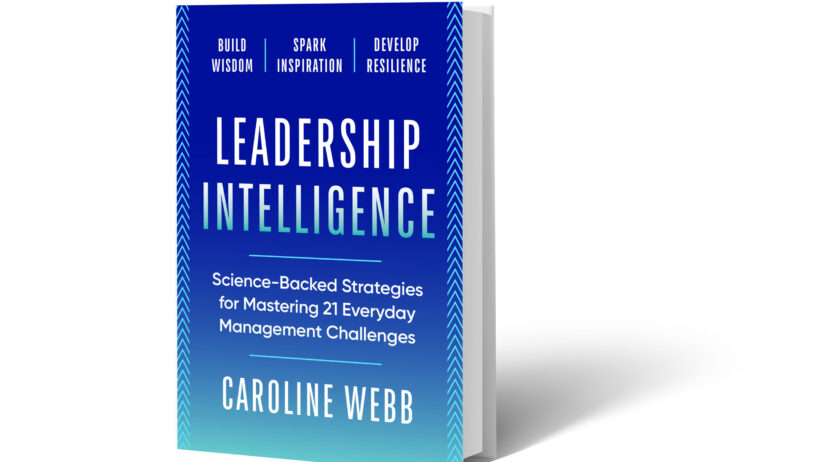
Caroline Webb’s Leadership Intelligence seems to have been built by someone allergic to, well, all of that. Odd, given she came to her platform in the midst of the industry’s insidious formation. Webb spent the 1990s as an economist at the Bank of England before joining McKinsey, where she became a partner and helped build the firm’s leadership practice over twelve years, and she has spent the years since running her own coaching practice. Her first book, on the science of a good working day, was itself an attempt to replace vibes with mechanism. This one is more ambitious and more disciplined at once: twenty-one chapters, each opening not with an overplayed parable but with a plainly stated challenge. Like: How to disagree well, how to hand someone a layoff notice with something resembling dignity, how to keep a team’s nerve in a crisis. And each closing with a named, repeatable technique built from a specific body of cited research, footnoted at the back for anyone who wants to check her homework. If folks still do that.

Webb organizes the whole system around three “double unlocks” tied to how the brain processes information, reward, and threat. When each is applied to the concrete challenges of real-world leadership, what you get is an elegant kind of curation: she chooses problems that are common but felt as unique to the humans suffering through them, and then, from a vast amount of atomized research, she plucks the most essential findings to create better conditions for action. Somehow, all of that coheres. One can almost forgive her for seeking a blurb from Daniel Pink.
For those unfortunate business travelers and desperate managers who have consumed too many drab business books, Webb’s tone will be appreciated almost as much as her advice. She’s simply too busy being useful to bother with posturing. Her bet, it seems, is that honest usefulness shall triumph, and that the manager who admits she doesn’t yet have the answer, but has a reliable method for finding it, will triumph too. Twenty years in, that shouldn’t feel radical. It does.