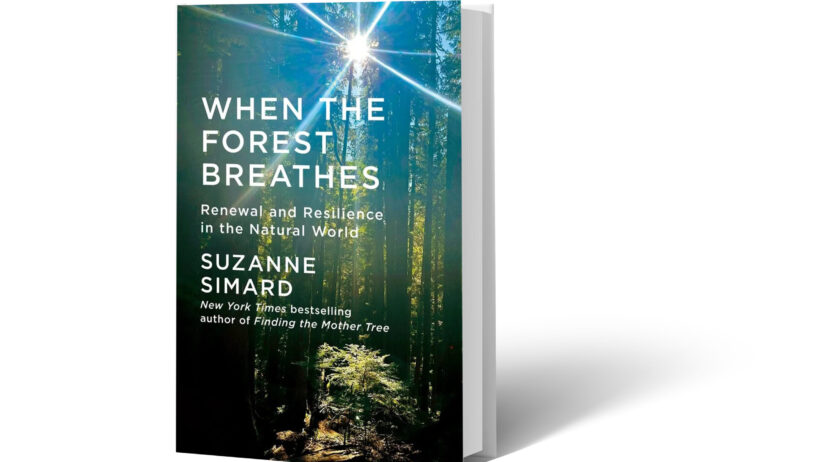
Among the Secwépemc, whose territory covers the Interior British Columbia valleys where Suzanne Simard grew up, mourning has a shape. For a year, the bereaved withdraw from public gathering and public speech. Rather than perform their grief for the community, they simply step outside its ordinary business. When the year has closed, they return. Such an architecture of grief built on a cycle of seasons opens the space required for the trauma of loss to become neither an event to endure nor a permanent condition to manage.
Simard did not invent this practice, but her new book When the Forest Breathes is organized on exactly this logic: grief handled well requires a cycling through seasons. Simard learned to see a forest this way from the Splatsin people who share her home valley, and from a grandfather who took only what the family needed and left, in his words, a forest still standing behind him. It is a smaller claim than “Indigenous wisdom will save the planet,” the kind of banner-headline Simard’s publicity has occasionally reached for. It is also a truer one. Specific knowledge, developed over specific centuries, by people whose relationship to that land predates every timber company’s stump count.

Decades ago, when Simard began telling new stories of old trees, it was not the timber companies she was up against. In 1997, she published a paper in Nature demonstrating that Douglas fir and paper birch trade carbon back and forth through shared fungal threads, a finding the journal’s editors nicknamed the “wood-wide web” and the forestry establishment labeled a heresy. She was told, by more than one colleague, to find other work. Her international bestselling book Finding the Mother Tree turned that vindication into one of the rare forest-science books to sell in the millions. When the Forest Breathes is a difficult sequel. Where Finding the Mother Tree had a plot–young scientist takes on a skeptical establishment, a shape as old as fiction–When the Forest Breathes has a cycle, and cycles resist narrative momentum What do you do with an argument once you’ve won it… but the clearcutting continues anyway?
Simard’s answer runs on two parallel registers. In one, she and her team at the Mother Tree Project spend years testing what happens when logged sites retain some fraction of their old overstory instead of being flattened by clearcut reflex. It’s large, muddy, collaborative science, testing what the retained elders do for carbon storage, biodiversity, and a forest’s odds in a hotter, drier future. In the other, she is watching her own daughters become adults, watching her mother die, and in a most devastating thread, mourning Amanda Asay, her graduate student, killed in an avalanche mid-fieldwork.
A dying elder tree, in Simard’s telling, does not simply vanish from the forest’s accounting. It opens a gap in the canopy that feeds the seedlings that have been waiting in its shade for exactly this light, for years, sometimes decades. The tree’s death might be seen as an interruption of the forest’s story. To Simard, it is the mechanism of its unfurling.
You want to criticize this. You want to say this is sentiment dressed as science. But somehow Simard altogether avoids such a trap. She is so delicate with these two registers, so frugal, keeping them in relation rather than in metaphor. The Secwépemc bounded-mourning year and the fungal carbon transfer are two independently earned observations that happen to, when set beside each other, rhyme. The industrial forestry model she’s spent a career opposing has no year of silence built into it, no gap left open for what comes next. It offers only the immediate, total harvest, followed by a replant schedule designed to erase the idea that anything was lost at all.
But so very much was.
The contemporary case for the book, though Simard never states it so baldly, is that we have lost the capacity for bounded endings across every register she writes in. We grieve on a bereavement-leave schedule and are expected to have “moved on” by the time the out-of-office expires. We extract from a landscape until a spreadsheet says the yield has dropped, then walk away from what’s left, calling the walking-away efficiency rather than abandonment. We have grown so estranged from the mechanisms of a living system that we require someone like Simard to stand at the tree line and translate it back to us, an ecologist as tour guide to a country we used to live in. We are a civilization that has forgotten how to let something end well, whether that something is a life, a stand of old growth, or an extractive arrangement with the planet that has clearly finished paying out.
Without a space for grief—nay, without a shape—we make things much more dangerous for a person, and for a hillside. The Secwépemc do not grieve forever but for a year. Silent for seasons, then reaching for speech again. The forest does not mourn its mother tree forever, either. It feeds on her for exactly as long as it takes to grow past needing her. Both traditions, in their different registers, are making the same argument Simard has spent thirty years trying to get her own field to hear: an ending handled with enough attention is the essential precondition for new growth. How does a forest survive its oldest tree falling? One can imagine the Secwépemc asking. By having already grown what comes next in her shade.