

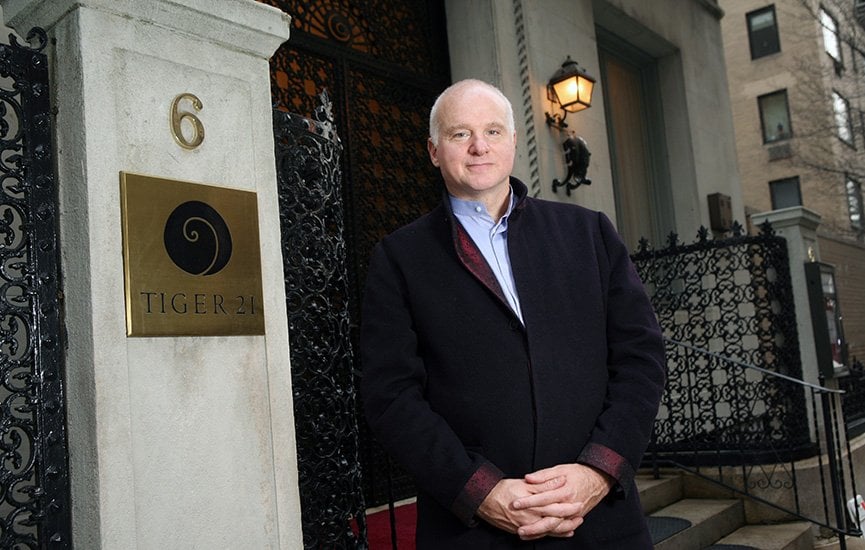
Tiger 21, the “learning community” for high net worth entrepreneurs, recently conducted a survey of the investing habits and economic outlook of its 450 members. Worth spoke with Michael Sonnenfeldt, Tiger 21’s founder and chairman, about how some of the world’s most successful job creators feel about the markets, the global economy and the U.S. election.
Q: What are your main takeaways from this survey of your members?
A: The one most resonant for me is the relationship between private equity and public equity, because private equity has now grown from 10 percent of a portfolio to over 20 percent, and public equities have come down. That’s the most fundamental shift in high net worth wealth creators’ portfolios.

What’s the rationale for that shift?
Tiger 21 is a microcosm of high net worth wealth creators, as opposed to the wealthy. Why that’s important is because they have mostly created wealth by building companies either that they’ve owned or in partnership with others. Since 2008, where there’s been a clear shift away from complicated investment products, it’s been back to basics. And then combine that with a low or negative interest rate environment. Those two things say to people who are generating less income on their financial resources than they expected, it’s time to roll up our shirtsleeves and dig in.
Could you give me a couple examples?
A printer who sold his paper printer and invested in digital printing. Someone who built a fleet of taxicabs and sold the fleet very profitably and now has an investment in Uber.
That also sounds like they’re abandoning twilight industries and investing in new technologies.
My point is, it’s not so much that our members have abandoned public equities, it’s that they’ve eschewed hedge funds and fixed income and increased their exposure on the private equity side.
Any standouts on the public equity side?
The two widest-held public equity securities are the Vanguard and S&P ETFs. Then under that you have, interestingly enough, Apple and Berkshire Hathaway. All of a sudden, you see Amazon and Google up there. So people are still focused on financial services, health care and technology as places to invest. The story is not so much the death of public equity as the rise of private equity instead of hedge funds.
And the explanation for that?
There’s very little [return from] fixed income and hedge funds are down, so you’re just forced to reach for risk.
Is the flight away from hedge funds about low returns, high fees or some combination of both?
There are some areas within the hedge fund world that remain attractive, but hedge funds as an industry have a correlation to interest rates—they don’t do well in low interest rate environments. There are all the stories about [investors leaving hedge funds because of] high fees and disinterested asset aggregators, but it’s really more a reflection of the potential of hedge funds in a low interest rate environment.
Is this a permanent shift away from hedge funds?
If you’re delivering high returns on a net basis, people are going to be less sensitive to fees. But as a whole, the hedge fund industry is going to struggle delivering higher returns until we have higher interest rates—and I don’t mean one or two percent. And even then it will take a long time for people to come back to a category they have largely abandoned.
What about real estate?
Real estate remains king. It’s the most tangible understandable income-producing asset. When you own a building or a piece of a building, you can go kick it, you can see it, you can feel it.
I was surprised to see that only about two-thirds of your members use financial advisors—I expected that number to be higher.
Our members are people who have thoroughly enjoyed creating their wealth and therefore want to be more involved in certain aspects of maintaining their wealth. We have a focus to help our members become the CEOs of their own investment company. We don’t mean that they become self-investors, but that they approach understanding their role more like a CEO. Some CEOs are very hands-on, and others are great delegators; think of the parallel between self-managing and using outside managers.
Does Tiger 21 have a recommendation on whether to use advisors or not?
We are totally agnostic. Whichever you’re doing, let’s give you the tools to figure out what’s working well and what the benchmarks are that will allow you to determine whether this manager is working well for you. There are a lot of people who call themselves wealth managers and used to be brokers. But when commissions went out the window, they started calling themselves asset allocators, and they just don’t have that expertise. “Wealth managers” is such a broad category, with a range of expertise. Our members want to tap into world-class managers, but those managers have to have specific expertise—as opposed to giving their entire portfolio to one manager.
How do your members find and choose wealth managers?
Our practice is to try to aggregate the collective weight or buying power of 450 of the most successful first-generation wealth creators. When our members get together in our group, a typical conversation would be, “I’ve had a terrific track record with manager X…” You’ll go around and see what’s happening, what’s working well for you and what’s not. If it turns out to be a manager or an investment that sparks interest, then we’ll say, let’s get that manager in [to meet].
We tend to amplify the power of great managers and have exactly the opposite effect with bad managers. A great manager gets involved with Tiger; it’s not uncommon to go from one member to 30 or more members, who are either investors or clients. Conversely, when somebody brings a story about an investment or a manager that’s been either incompetent or unsuccessful, we provide an environment where a member can come to grips with whether what’s gone on has been bad and reasonable or bad and unreasonable. And when it’s the latter they can jettison that manager. Those managers often blame Tiger 21—that goes with the territory.
From your members’ perspective, what’s been the impact of the election on the investment climate and economic prognosis?
One of the most extraordinary experiences I’ve had in many years was sitting in my Tiger 21 group discussing the election. People had voted on both sides of the aisle, but because of the confidentiality and trust that we’ve been able to build among members, both sides were talking respectfully and listening. People who’d voted for Hillary were getting great comfort that all the people who voted for Trump weren’t voting for [Trump’s most controversial proposals]. It gave many members a sense that the meaning of the election was not that the world had come to an end, but that there was some underlying message around economics and the working class that had been lost in the hysteria of the election.
Why was that meaningful to the wealthy entrepreneurs who are your members?
The issue of whether the middle or working class has been sacrificed to the god of globalization and how to restore it is a story of entrepreneurs, who have created basically all the jobs outside of the government over the last few decades. The only way to address this jobs issue other than infrastructure, which is quite important, is creating an environment where entrepreneurs can flourish.
For more information, visit tiger21.com.