Most companies treat AI like a hyper-efficient photocopier. The C-Suite has taken standard corporate output that takes time to create—memos, thread summaries, deck outlines—and told employees to automate it al with AI. The documents get created faster, and the sheer volume has skyrocketed. Need a 2×2 grid in a McKinsey-style PowerPoint deck to satisfy leadership? A model can spit one out in seconds. But behind all this speed, why does the actual work feel so useless?
Jaime Teevan has a theory. As Microsoft’s chief scientist and technical fellow—and a key force behind Copilot—she addressed this head-on at Techonomy 26. Speaking with McKinsey’s Tara Balakrishnan before an audience of enterprise buyers, she called out the standard deployment approach: “The way people are naively using AI in work contexts is to do the stuff that people already do, the same way.”

Her randomized controlled trials back that up. Copilot users ended up editing 10% more documents while reading 11% fewer emails. “We know this is causal,” Teevan noted. The result is clear: higher volume, lower comprehension. But as she emphasized, generating endless text for others to summarize isn’t AI or Copilot’s true destination.
This creates a dilemma for leadership. Balakrishnan’s State of AI survey revealed that 80% of respondents feel more productive with AI, and over half report better decision-making. A Zapier poll of 1,100 workers put that figure at 92%. And yet, MIT’s Media Lab found that 95% of enterprise AI pilots failed to deliver measurable business impact, and Census Bureau data showed active adoption dropping at larger firms after an initial spike.

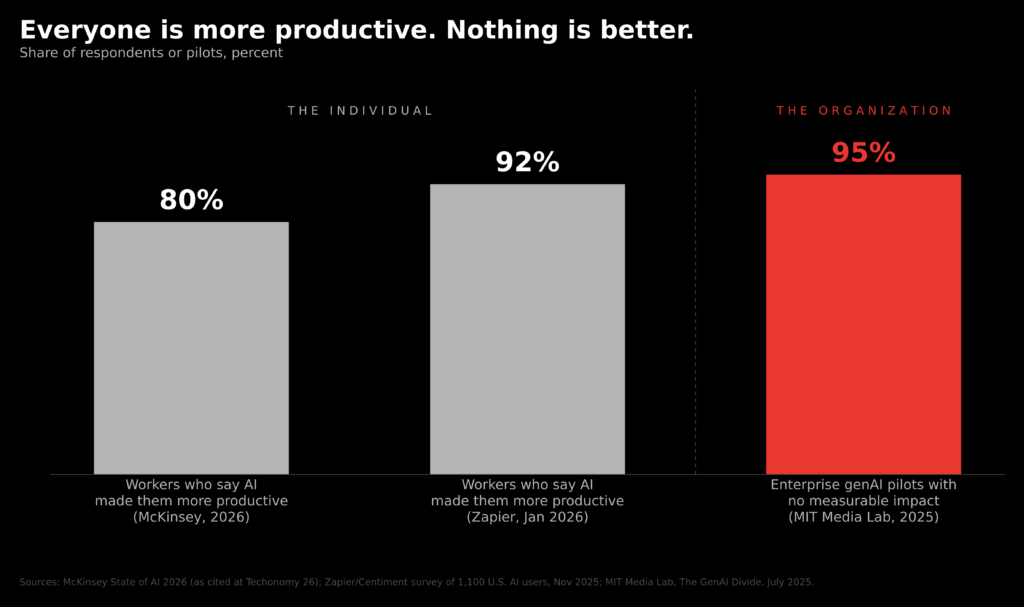
Individual employees see quick wins, but companies struggle to capture value. Teevan says this stems from a fundamental shift in what creating a document actually costs.
Historically, writing a thoughtful memo required effort—researching, drafting, refining. Readers recognized that effort as a proxy for rigorous thinking. “It used to be, if you sent me something that was beautifully written, I would know it had a lot of deep thought under it,” Teevan explained. “If you send me something that’s beautifully written right now, I don’t know.”
When clean copy and pretty formatting become effortless, that quality signal disappears. As Teevan put it: “When I use AI to write a paper about blah and share it with you, I’m essentially passing the hard work of judgment on to you.”
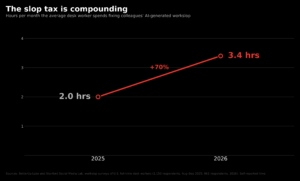
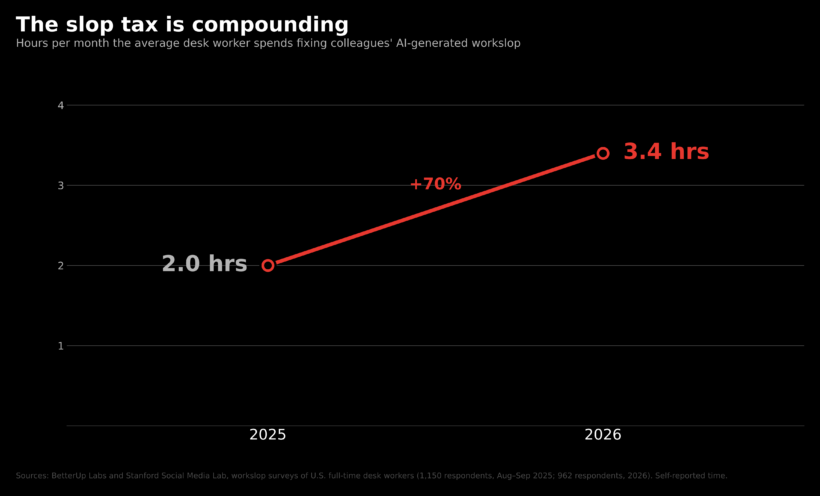
Researchers at BetterUp Labs and Stanford’s Social Media Lab dubbed this phenomenon “workslop.” Their survey of 1,150 workers showed that 40% dealt with AI-generated fluff in the past month, costing each recipient roughly two hours to sort through. They estimated this tax at $186 per employee monthly—nearly $9 million annually for a 10,000-person firm. A 2026 follow-up study found time spent cleaning up slop rose to 3.4 hours per month, with direct encouragement from management being the top driver of slop creation.
Consider Shopify CEO Tobi Lütke. In early 2025, he sent a widely shared internal memo establishing AI usage as a baseline requirement. Yet standardizing AI tools led to unexpected friction, which he later reflected on during an appearance on The Knowledge Project.

“We call those ‘slop grenades’ that people toss at each other,” Lütke noted, describing how unvetted AI text gets passed around to team members for review, slowing overall progress.
Other leaders are echoing those concerns. Synthesia cofounder Victor Riparbelli warned staff that uncritical AI generation causes net-negative productivity. Meanwhile, Zocdoc‘s internal guidelines explicitly instruct employees to refine AI output before sharing.
Michelle Volberg, CEO of recruiting firm Twill, put it plainly to her team: “Please stop talking to me like a robot.” Even tech-forward companies that mandated these tools are realizing that unrefined output creates more problems than it solves.
On surface-level metrics, these activities register as wins because documents are moving and emails are sent. But speeding up drafting at the cost of reviewer time creates a net loss that traditional dashboards miss.
That disconnect highlights a tracking flaw. Telemetry measures individual output, not organizational efficiency. “If my job is writing documents, I am a lot more productive,” Teevan said. “It is not the job of an organization to produce a lot of documents.” Standard surveys measure speed rather than quality, asking writers about their output while overlooking the reader’s experience.
Zapier’s findings capture this paradox: 92% of workers report feeling more productive using AI, yet 58% spend three or more hours weekly fixing AI-generated content. Individual speed increases, but collective maintenance eats away at those gains.

Teevan emphasizes that true documents represent accumulated knowledge and judgment. When text is generated automatically without deep thought, it lacks substance. Over time, unverified content fills company databases and pollutes future training models. As Oxford’s Matthias Holweg and Babson’s Tom Davenport noted in Harvard Business Review, this leads to “knowledge decay,” where organizational decision-making degrades alongside file quality.
Measuring activity is simple; measuring insight is harder. Teevan’s recommended approach is practical: use AI to help articulate your underlying reasoning and decision-making process, rather than relying on it to generate bulk content. The core value lies in the thought process itself.
Ultimately, organizations need to track actual decisions, not draft volume. Until metrics adjust, productivity reports will simply highlight how quickly companies can clutter their own workflows.