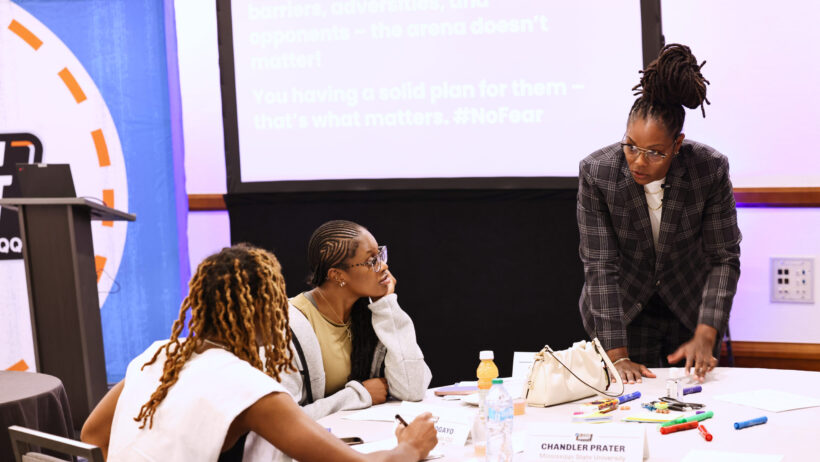
Like a lot of elite athletes, Lisa C. Willis has always kept a playbook in her back pocket. A self-proclaimed “high performing introvert,” the former WNBA star and UCLA Hall of Famer spent her career looking inwards—and has built her second act, off the court, teaching others to do the same.
She isn’t a therapist, and she’s careful to say so. Willis is a mental performance coach, working the stretch of road where success starts to feel less like a peak and more like a plateau. Her clients span an unusually wide range: young athletes learning emotional regulation, college players who freeze under pressure, and C-suite executives who have earned every bit of their success but still can’t quite believe they deserve it.

What ties them together, in her telling, isn’t talent. It’s the story they tell themselves. Across every age and arena, Willis keeps coming back to the same idea—that the discipline which makes a performer great can quietly become the thing that holds them back, and that being “enough” is a skill you practice, not a trophy you win.
Crouse: Who were you before the WNBA? How did you get into basketball?
Willis: I started playing at a very early age—about nine-years-old. My dad was a great basketball coach, my brother played, so I was always in the gym. Eventually, a crush I had on a fifth grader drew me to actually start playing. I didn’t get him, but it was exhilarating. As a kid, I just wanted to play basketball. All the parts were fun—practices were often more fun than games, because I could go two or three times a week but might only have one game. I loved that it’s a fast-paced game where you can be rewarded constantly—a good shot, a good pass, a good rebound, being in the right spot, communicating. That felt good to me.
People ask me about the sacrifices I had to make, and it sounds pompous to say I didn’t have to make any—but the reality is it didn’t feel like a sacrifice. Dances were sacrificed, hanging out with friends was sacrificed, but it was what I wanted to be doing, and nobody asked me to do it.

Q: What’s one thing you’ve had to unlearn—something that served you well while you were playing but had the capacity to hold you back once you stopped?
Rigidity. It was like the extreme version of discipline. I was very disciplined, but if I slipped up, I was beating myself up—nobody needed to do that for me. I just felt there was one right way to do everything. I realized around 2020 that it’s not that serious. That rigidity served me well when I was playing, but afterward I actually needed grace. As a basketball player, there was no space for emotion. If you did something good, run back down the court. Something bad, shake it off. Coach going hard on you—keep a straight face. There was no room for emotions.
Q: After retirement, when you were moving from rigidity to giving yourself more grace, how did you approach that transition?
It was actually a conversation with my sister. She gave me the language—”You’re too rigid, why are you so hard on yourself?” While I was writing my first book, she’d say, “You need to be kind to my little sister. You’re not going to keep being mean to my little sister.” She’d say it in the third person. After hearing it so many times, I finally thought—am I not being kind to myself? Why not? She’s a licensed clinical social worker, so I’d tell her, “You’re therapizing me”—but getting that outside perspective made me stop and think. And then I asked myself: what am I doing right now where, if I don’t make it happen, I feel like the world is over? And the answer was nothing. I always keep big goals, but nothing where my life would actually implode. That’s when I started giving myself more grace and flexibility.
Q: Is there a consistent theme in your message to the people you work with, or is it more personalized?
It’s all personalized, but there are themes—and that’s really how I developed the SPORT Method. The story people tell themselves seems to be the catalyst for so many challenges; that’s universal. And then worthiness—people struggle with self-forgiveness and grace because we’re really good at remembering the bad things and not the good. I call it building a résumé: all the hard things you’ve done and come out on top of. Beyond that, it becomes custom—I’m walking you through your very specific situation. But the common threads are: separating the data from the drama, forgiving yourself, and feeling worthy.

Q: Can you tell me about the type of work you do now and what it actually looks like—the different kinds of people you work with?
I work with kids, elite athletes, and executives—a very wide spectrum.
With kids, who are athletes, it’s about introducing concepts around mindset, resilience, grit, effort, and choice. A lot of younger kids right now struggle with emotional regulation—they crash out. I help them understand how to move forward and that they have more control over how they respond than they realize.
With elite athletes—I’m working with some college players right now—it runs case by case. It’s more the opposite of crashing out: a shutdown, where they can’t pull themselves out of a bad situation. I meet with clients for about an hour once a week. We talk about what they experienced the last seven days and whether they tried different methods—breathing techniques, daily journaling, visualization activities. My approach to visualization is a bit different than the typical “just picture the great thing happening.” If you only focus on the positive, you can actually lose trust in yourself. It’s about helping them understand what their body is doing and giving them tools.
With executives—these are all high performers—it’s a lot of self-doubt and negative self-talk. Not giving themselves enough credit for what they’ve done. Someone who was a chief of staff at an amazing company, still doubting themselves. With them, I’m never the subject matter expert—they tell me what’s going on, and I offer a different lens. Let’s think about it like this—and then let them see who they are when they do.

Q: How is talking to you different than talking to a licensed therapist?
I am not a therapist. There’s mental health and there’s mental performance. Mental health is more clinical—depression, anxiety, deeper emotional work. Mental performance is about giving you tools to keep going. If you have the tools to process information a certain way, hopefully you won’t need to see a mental health specialist. This can be the upstream work.
What makes me different is that I’m very relatable. I talk sports with everyone—I’ve worked with a priest, executives, actors—and I have a way of simplifying tough situations through sports that people understand universally. For whatever reason, people get sports, and it pulls them slightly outside their own situation so they can grasp a concept, then bring it back in. I’ll ask someone, “How are you going to get over the screen and roll?” And help them think critically about performing at a higher level.
Q: What’s one message you share with your clients that you’re still working on yourself?
That I’m enough. I tell people we come up with plays to handle self-doubt—a triple-threat move to quiet it—but it’s something you never fully get rid of. For me, the conversation around “enoughness” stems from being the baby of five and wanting attention. From being the youngest on teams, not always the coach’s favorite despite being a great performer. It comes from my dad—the goalpost always seemed to be moving. When you’re not getting the recognition, you don’t think “I’m not getting it”—you think “I didn’t do the thing well.” And that’s not the truth, but that’s how it gets internalized.
Basketball is a sport where you’re constantly rewarded and applauded. When you move away from that into life after sports, that feedback disappears—and you start to wonder, am I going the right way? I try to help my clients understand: it’s an uphill battle, but you’re enough to get it done. “Enough” doesn’t mean you’re perfect or have nothing to work on—it means you have what it takes to get where you need to go.
Q: Was there a particular moment when you felt the aha—this is what I’m going to do, I’m going to share this with people?
After I retired from the WNBA, I started a basketball training company called ‘Need a Jumper’. I was helping kids with their jump shots—that’s what people were paying me for. But parents started coming back and telling me: my kid’s jump shot looks amazing, and they’re a better player, but they’re also more confident, more respectful, getting better grades. After the fourth or fifth parent said something like that, I thought—okay, what am I actually doing here?
That made me examine my methods and what mattered to me. I’ve always wanted people to feel valued. My experience at UCLA on paper was phenomenal—I’m a Hall of Famer—but mentally and emotionally it was probably the most challenging time in my life. Being a star and still not feeling valued—I never want anyone to feel that way. Once I got that parent feedback, I realized it’s bigger than basketball. Anybody can teach skills. But I have a platform to help people with their motivation, their confidence, all of it.

Q: If the WNBA had a superlative for “most likely to become a motivational speaker,” do you think your teams would have voted for you?
No. None of the teams I played for would have voted for me. I was kind of a loner—I was in everybody’s clique, which really means you’re not in any clique. I think they were always trying to figure me out. They didn’t really know what drove me besides basketball. When I was with the Liberty, teammates would see me out somewhere and ask, “Willis, who are you here with?” I’d say, “Just me.” They’d go, “Why didn’t you tell us?!” I like to consider myself a highly skilled introvert—I know how to do it, but I enjoy the peace of being by myself. And I was really sarcastic back then, so no—that superlative was not coming my way.
Q: Is there a question nobody ever asks you that you’re dying to answer publicly?
The closest thing would be: what’s the hardest part about playing in the WNBA? People always ask about dreams coming true, the transition—but it was really hard in ways people don’t understand. By the time you get to the W, you’ve spent 12 years playing, and it’s always been about team, camaraderie, and relationships. Then you get there and it feels like a job. You’re fighting for healthcare and life insurance. It went from a sport where everyone loves the game—to these are my coworkers. No team dinners, no team building. You show up, do the work, go home. That was really hard for the little girl in me who just loved basketball and assumed everyone else felt the same way.
Q: Do you think performance would be higher if teams maintained more of that camaraderie?
Absolutely—the best teams have way better chemistry. The NBA is different because the lowest-paid player is still making life-changing money; even a single season is generational wealth. In the W, players are just now getting to what the NBA minimum was as a maximum. The financial experience is just very different. With NIL and the increased visibility of women’s sports, players can now get endorsements elsewhere—but this is all new. I’m hoping the culture I described becomes a thing of the past.
Q: Are you excited about the changes taking hold in the WNBA?
I love it. I just feel like I played 20 years too soon. I think they got it right—they haven’t arrived, but they’re doing great things. I believe it started with coaching changes. Players from my generation became head coaches, which allowed players to play more freely. And when you play freely, you can showcase what you can do. The WNBA is entertainment—you have to be entertaining. I hear people say these players are more skilled now, but it’s not that they’re more skilled—it’s that they’re finally able to show their skills. That opened the door for different players to emerge, new fan bases came in, and that brings money. But it started with new coaches.

Q: If you could ask Worth’s readership to do one thing differently after reading this profile, what would it be?
Create programs for WNBA players. It may sound unfamiliar, but I worked at Nike for five years through exactly that kind of program. Someone from their executive leadership watched a game and said, “These women are phenomenal—we need them in our company. We’ll teach them what they need to know, but what they already bring, we can use here.” I’d love to see more of that, because WNBA players are not one-and-done. We have full degrees. We go about things differently—partly because we have to. We’ve always had a Plan B and C in case it doesn’t work out, and that makes us exceptional leaders. Nike brought in over 60 WNBA players to their world headquarters over five years. It’s been done. Seek these women out—it can change your organization.