“I don’t believe he can live through the night,” the naturalist George Cherrie wrote in his diary in the spring of 1914, somewhere down an unmapped river in the Brazilian Amazon. He was writing about Theodore Roosevelt. The former president had gashed his leg in the rapids; the wound had gone septic, and malaria had pushed his fever to 105. He carried a vial with a lethal dose of morphine, and he meant to use it before he let his condition slow the other men. His son Kermit would not leave him. So Roosevelt, as he always did, pushed on.
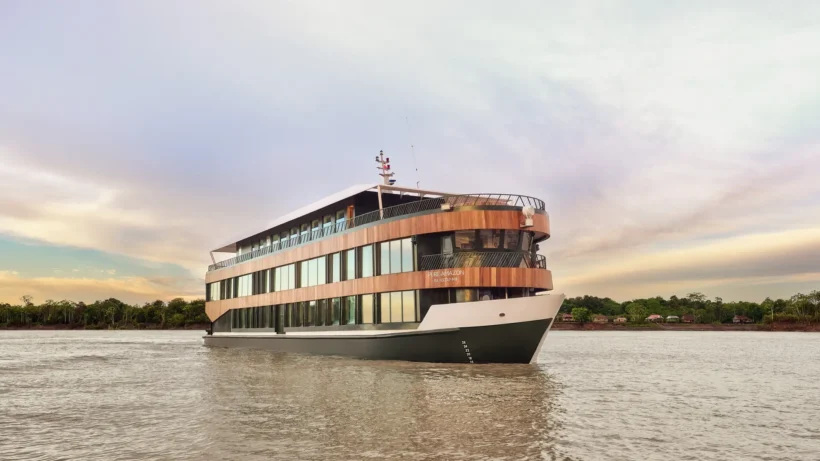
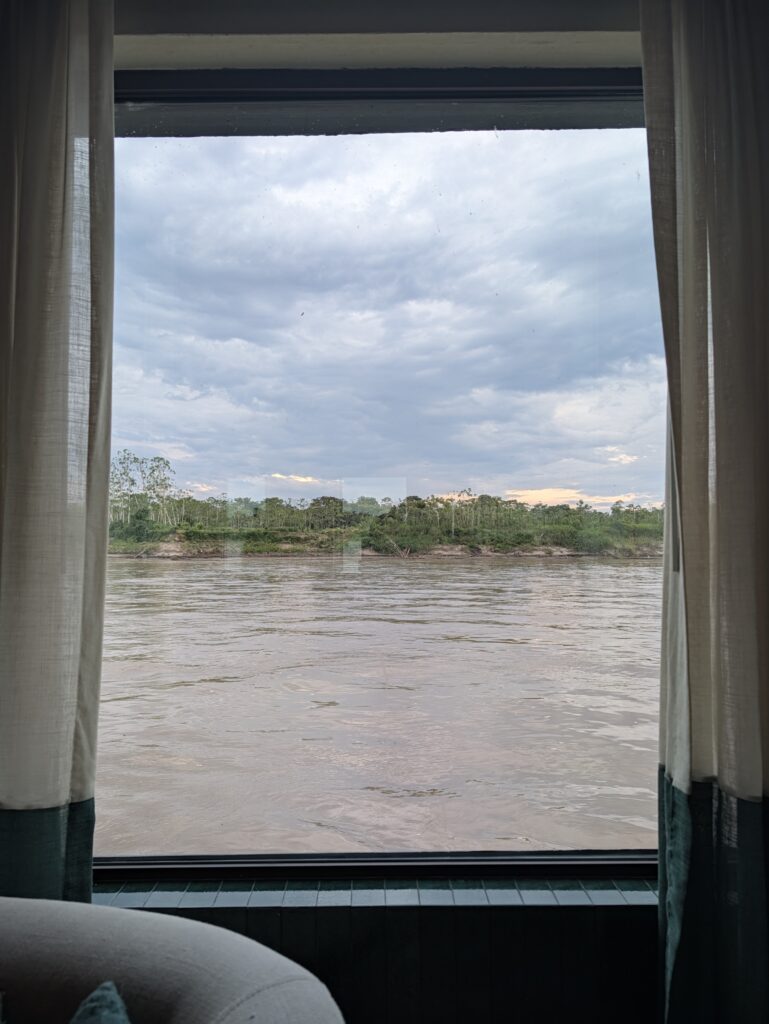
I thought about that vial from a king-size bed, sipping sparkling water as the shore scrolled by. My suite on Pure Amazon had floor-to-ceiling windows on the river, a private bath, and a mini bar. There were two other bars on board, a gym, and spa I never got to. Each night, they placed a gourmet Peruvian chocolate on a white saucer for me. So, as I always do, I pushed on.

Candice Millard tells Roosevelt’s story in The River of Doubt, which is not exactly the same river I was on, but they are certainly connected. His river is in western Brazil. I was on the Marañón and the Ucayali, in Peru’s Pacaya-Samiria National Reserve, about 900 miles to the northwest: same basin, opposite end.
What I took was the modern version of his trip. Roosevelt went south after losing the 1912 election and called the expedition his “last chance to be a boy.” He wanted a hard trip, and he certainly got it. Abercrombie & Kent’s three-night sailing starts at $5,475 a person. It is pretty much the opposite of hard. What the money buys is the Amazon with the doubt edited out.
The Journey
Roosevelt needed two months to reach his river. He went up by steamboat, then overland by mule train across the Brazilian highlands with his co-commander, Colonel Cândido Rondon, a Brazilian officer who had found the river’s headwaters five years earlier and named it the River of Doubt because nobody knew where it went. More than half the pack animals died of exhaustion on the way. The party did not reach the water until February 27, 1914.
I left Newark at 2:30 on a Monday afternoon and landed in Lima seven hours and 55 minutes later. (I had a middle seat, but used miles to move to a window seat.) A&K hosted me, which you should know before I describe the wine.
I spent most of the day in Lima eating. Urban Kitchen’s Chef Cesar walked us through a market, then took us to its teaching kitchen and taught us the two dishes Peru runs on: ceviche and lomo saltado. The ceviche lesson started at the fish stall with some unexpected tips: fresh fish has bright skin, eyes that nearly pop out of the head, flesh that pushes back when you press it – and it should barely smell at all.
Lomo Saltado is the other half of the country’s story: beef stir-fried with soy sauce, a dish that exists because Chinese laborers began arriving about 170 years ago and adapted their cooking to what Peru had. Cesar’s word for soy sauce was sillao, which came over from Cantonese. Evidently, the dish requires a fat-fueled plume of fire to season it properly. This, I can confirm.
Then I flew to Iquitos and rode about two hours south to Nauta, past tin-roofed shops and more mototaxis than cars. We stopped at a thatched roadside place where a calico cat worked the tables. A&K even packed us a lunch for the trip. At the Nauta waterfront, small boats crowded a brown river, and a skiff ran us out to the ship.
Pure Amazon launched in 2025. It carries 22 guests in 10 suites and two single cabins, with a crew member for every passenger. The Milan architect Adriana Granato did the interiors in Peruvian travertine and Amazonian hardwood. When Roosevelt’s party lost canoes in the rapids, the men stopped for days to hack new ones out of tree trunks.
The tour’s greatest asset is its guides. Helen Arévalo is a certified naturalist from Iquitos who was raised in a small Amazonian community, worked at ecolodges and a research reserve, and is now one of Pure Amazon’s head guides, in a trade still run mostly by men. Robinson Rodriguez Novoa has been at it for more than three decades. He helped found the Birdwatchers Club of Loreto and a group that records the medicinal plant knowledge of the Kukama Kukamiria, and he once lectured at Dartmouth on Amazonian ecotourism and traditional medicine. Roosevelt had Rondon, who knew the country but not where the river went, I had Robinson and Helen.
The Menu
The Roosevelt expedition’s quartermaster, Anthony Fiala, was a veteran of a failed Arctic expedition, and he had provisioned for the gentler cruise Roosevelt first planned. Much of it never reached the river. On March 15, Kermit’s canoe went over a waterfall. A paddler named Simplício drowned, and 10 days of rations went down with the boat. The men lived on hearts of palm and whatever fish they could catch. The party marched all day, even as they neared starvation.
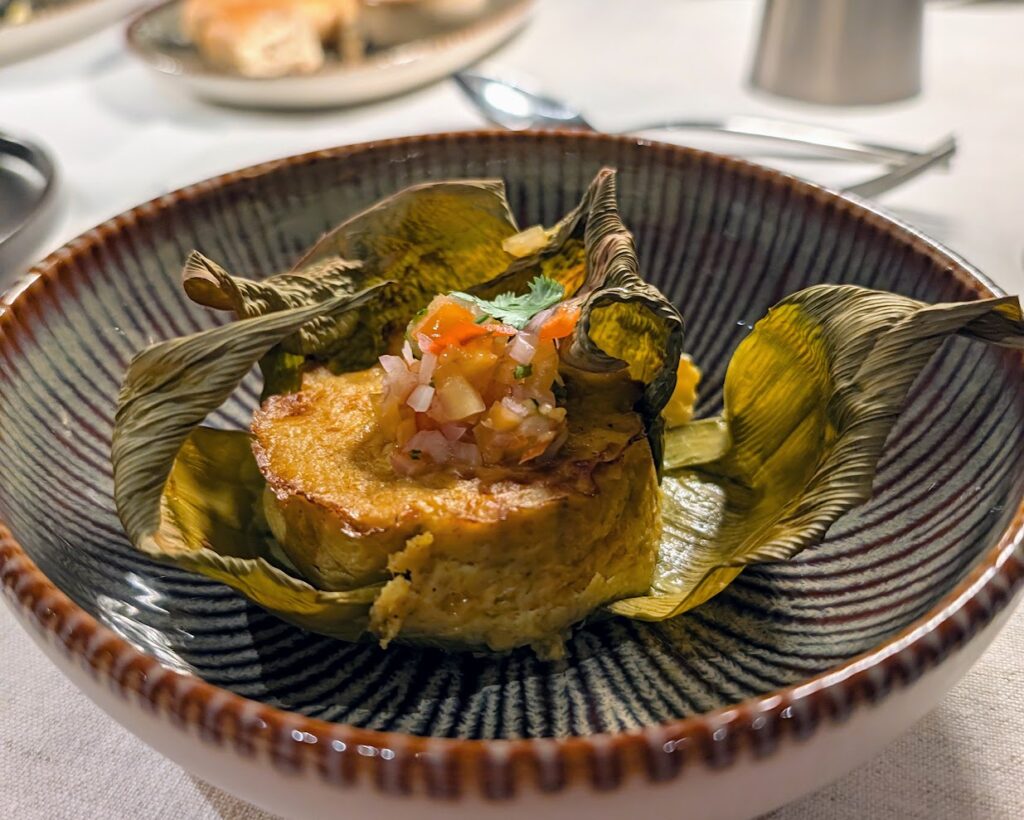
My first dinner aboard was a Wednesday. It opened with a cassava croquette filled with smoked pork, with a cocona-cilantro emulsion. Then roasted squash soup, poured at the table. It was followed by a tartare of paiche, the Amazon’s giant fish, in a Nikkei-style citrus marinade, topped with a piece of its own crisped skin. The main dish was doncella, a river catfish, marinated in Amazonian spices and steamed in a bijao leaf, with yucca sautéed in butter. A Chilean Chardonnay came with the soup, an Argentine Torrontés with the tartare, a Peruvian Torontel with the fish. Dessert was a citrus cream with camu camu.
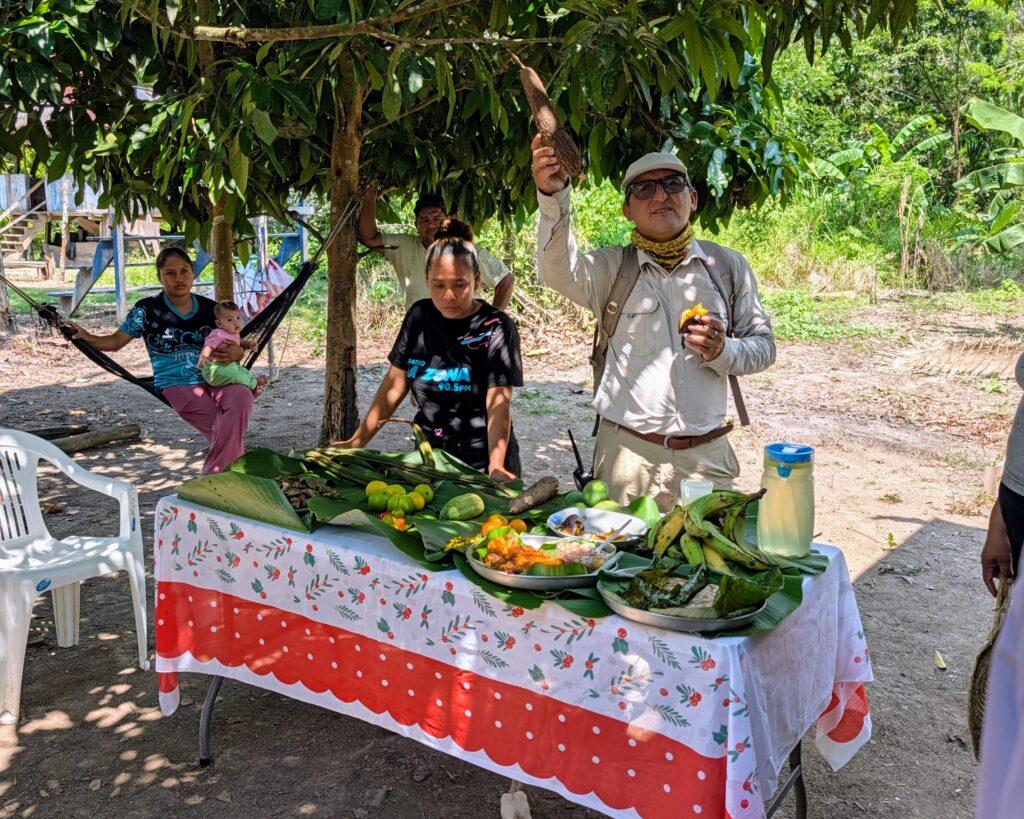
The river people solved the food problem long ago. In a village on the Ucayali, our guide Robinson explained how families soak and toast poisonous yuca into fariña, a meal that keeps through the flood season. Fish is 90% of the diet, he said. Chickens are for something else. “It’s like a bank.” You sell one when somebody needs to get to a hospital.
Roosevelt’s men were starving in a place where people had been eating well for a few thousand years.
The Wildlife
A few days into the descent, a coral snake struck at Roosevelt’s leg and got a mouthful of boot. He called the insects a “torment and menace.” And his account of the piranha did more than any other to make the fish a man-eater in the American imagination. This turns out, like so many fish stories, to be less than true.
My wildlife interactions were on a schedule. The skiffs left the ship at 6 a.m. to catch the birds and other wildlife at sunrise. They were powerful metal boats that could carry you upriver at great speed. By 6:19 a.m. a ringed kingfisher, blue-gray with a rust-colored belly, launched from a bleached branch against the mud bank. A quarter hour later another sat on a log with a fish in its bill. Four tiny bats hung in a row on the underside of a leaning trunk, so close in color to the wood that they read as part of the tree. A pale-headed raptor stood on a dead stalk and watched us pass. Just before seven, a man paddled by in a long wooden canoe loaded with cargo—the same technology that failed Roosevelt in the rapids, and still the local standard.
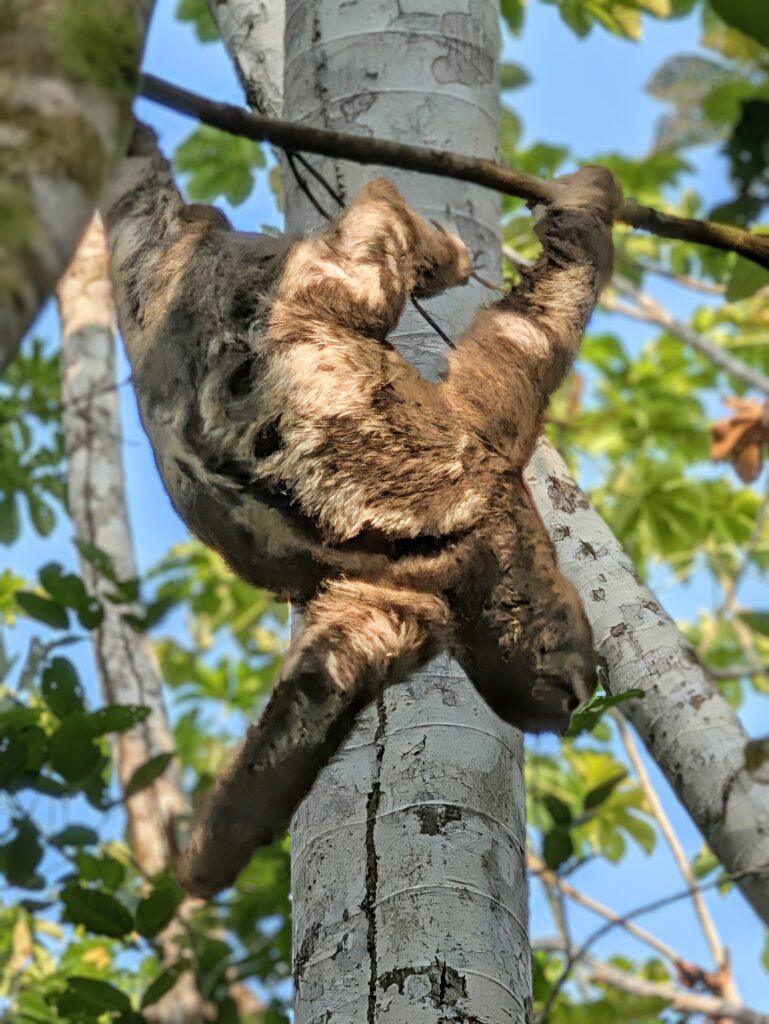
Later that morning, our guide found a sloth in the crook of a bare tree.
The best thing I saw was something Robinson says he’s seen only twice in his 30 years working the river. A pink river dolphin gave birth near our skiff. The mother dragged the calf up into the air and kept dragging it around the surface until it learned how to breathe. It looked dead, but it was only having a rough start. You know they are OK, he said, when they stay underwater and swim away.
The rest was managed in advance. Before the jungle walk, we were told to go “very well covered.” Rubber boots were waiting in our lockers. For piranha fishing, we wore closed shoes, in case a fish came into the boat with its teeth working. I asked about jaguars. Helen answered with a question: “Remember, who is the biggest predator on Earth?” Yeah, it is us.
A&K’s philanthropy supports a village called Nueva Arica, and our itinerary included a visit. The water was too low to get there. A company can engineer nearly everything about this trip, down to the footwear, but the water level is still the river’s business.
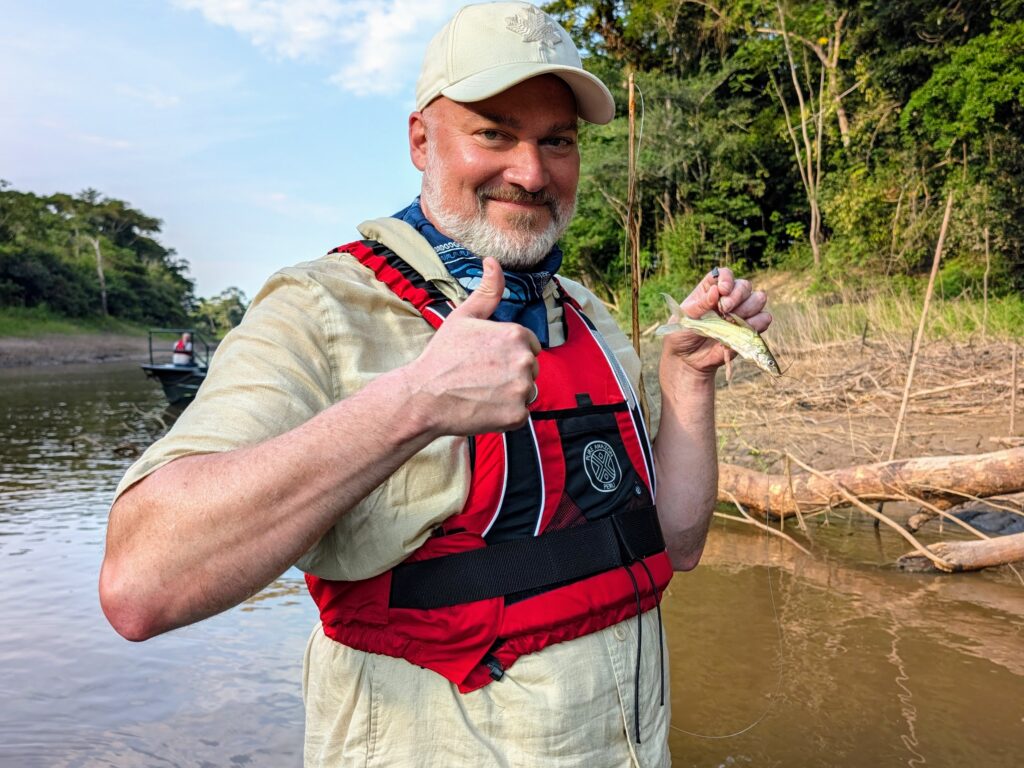
Then we went fishing for Roosevelt’s monster. Nobody caught one. I caught a small catfish. I should have been tipped off when we passed kids splashing, waving, and swimming in the very river we were about to fish. “Not everyone can catch a fish,” Robinson said.
The Neighbors
On March 21, 1914, Rondon heard what he took for a spider monkey and followed the sound with his dog, Lobo, running ahead. The call was an imitation. Lobo died with arrows in him. For the rest of the trip, the Cinta Larga shadowed the expedition from the trees, never seen, and according to the tribe’s own later account, they argued over whether to kill every man in the party. Rondon’s standing order to his soldiers was already famous in Brazil: “Die if necessary, but never kill.” Nobody fired. The canoes went on.
We went to San José de Paranapura instead of Nueva Arica. Every building there stands 15 feet off the ground. In the rainy season, six months of the year, the river climbs as much as 30 feet up its banks, and about 85% of Pacaya-Samiria goes underwater. Keep in mind, the river is half a mile across here; the volume of water is otherworldly.
Across the Amazon lowlands, roughly a sixth of the land floods this way. The whole village becomes a river, and pink dolphins can swim right up to the front door. Women sold handicrafts in the shade under the houses. I bought some woven napkin holders, though one man demonstrated a blowgun that seemed both too cool to be true and unlikely to make it through airport security.
Robinson remembered a different reception. “Many years ago,” he said, “people just ran away when they saw us.” Outsiders had once come to enslave people, and the memory lasted. “But now, these people, they wait for us.”
In my history books, Peruvian culture began with the Incas. Turns out they were just the last empire standing when the Spanish arrived, so they got the last word on everyone who came before them.
Robinson spent an afternoon lecturing on the people that version leaves out. The Amazon, he said, was never an empty wilderness. Some scientists believe more than three million people once lived off these floodplains.
For most of the twentieth century, the prevailing view among archaeologists ran the other way: the rainforest was too poor to support an advanced civilization. Then, in the 1980s, an archaeologist named Anna Curtenius Roosevelt excavated the earthen mounds of Marajó Island, at the mouth of the river, and concluded that the society that built them had grown up right there. One settlement held about 10,000 people. And yes, she is Theodore’s great-granddaughter, reaching the Amazon seven decades after he did.
She has said his expeditions had nothing to do with where she chose to dig, and that following an ancestor around would be narcissistic. (And to be fair, Teddy did get around.) Even so, the family still came to the Amazon twice. The first Roosevelt came to put an unknown river on the map. The second found evidence of the people who had been living on the big one all along, and their successors were up on those stilt houses, making change for tourists.
Roosevelt said the Brazilian wilderness stole ten years of his life. He was dead within five. It took five nights of mine and sent me home with a thousand photographs, a set of napkin holders, and one small catfish to show for an afternoon spent hunting a man-eating piranha. Robinson said it right. Not everyone can catch a fish.