The Milken Institute Global Conference convened in Beverly Hills with the Strait of Hormuz still closed, Brent crude trading above $100 a barrel, and the U.S.-Iran conflict in its third month of unresolved hostilities. By the time the conference ended on May 6, the S&P 500 had closed at a record. Three trading days later, it printed another one. The Nasdaq did the same.
During my interviews in Beverly Hills, the prevailing tone was confidence—measured and qualified, but strong—highlighting the market’s resilience amid geopolitical tensions.
Andrea Guerzoni, EY’s global vice chair for strategy and transactions, has been to six of these conferences. He framed the moment plainly. “It’s quite stunning, the dichotomy between the uncertainty that the geopolitical situation is causing and the level of confidence that investors, corporates in particular, are showing.”

His firm just released the latest EY-Parthenon CEO Outlook Survey, a quarterly poll of 1,200 CEOs across 21 countries. The headline finding: 62% of U.S. CEOs plan to actively pursue M&A in the next twelve months, up from 35% in September 2025. That’s a 27-point swing in the wrong half of a brutal year.

The numbers behind the mood are strong. S&P Global Market Intelligence reported that global M&A volume hit $861 billion in Q1 2026, the strongest start since 2021, reflecting proactive resilience and optimism.
Meanwhile, the underlying world has not improved. Iranian forces declared the Strait of Hormuz closed on March 4, disrupting roughly 20% of global oil supply. The Dallas Fed projected the closure would shave 2.9 percentage points off annualized global GDP growth in Q2. Brent crude peaked at $114.44 a barrel on May 4. A fragile ceasefire is in place, but maritime traffic remains a fraction of pre-conflict levels.
Sen. Bill Hagerty, the Tennessee Republican and former private-equity executive, has attended six Milkens, mostly from the buy side. He noticed the same pattern Guerzoni did. “A lot of optimism is coming through, particularly with those who are in the capital allocation industry,” he told me. “Folks in finance are seeing massive commitments of capital coming into America right now.”
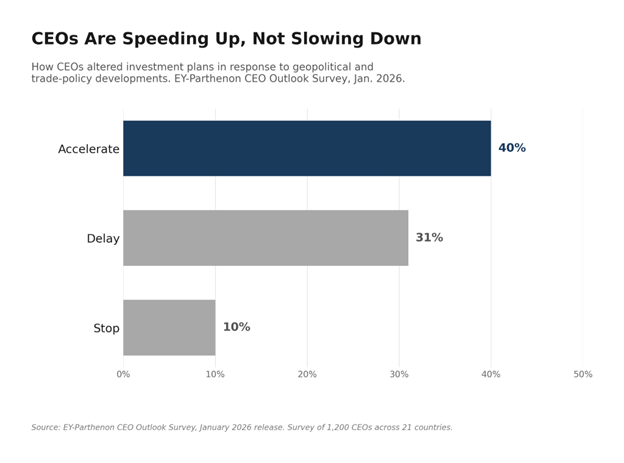
That’s not a coincidence. The EY survey found that 40% of CEOs are accelerating investments in response to geopolitical and trade-policy developments. Thirty-one percent are delaying. Only 10% are stopping. Among U.S. CEOs, 85% said they have altered strategic investment plans over the past year, and 46% of those did so by speeding up rather than slowing down.

This is what changed. Through the volatility cycle of 2024 and 2025, the operating principle was deferral: wait for clarity on tariffs, wait for clarity on rates, wait for the Fed. By 2026, deferral had become the more expensive option. Guerzoni’s read: M&A is now “a tool to get more resilience in this environment.” When the executive class can no longer plan around stability, it starts buying its way toward flexibility.
The earnings floor
John Koudounis, the CEO of Calamos Investments and a 20-year Milken veteran, anchored his view in the underlying corporate numbers. “If you look at earnings, they’re still very, very strong. There’s a reason why we’re hitting all-time highs on the S&P and the Nasdaq. It’s because the earnings are strong.” His read on the Iran conflict was characteristically blunt. “This is a shock to the system. There’s never been a shock this bad in so many years. But it’s going to help that we’re producing a lot more oil. It’s going to help that we’re friendly with Venezuela.” When Treasury Secretary Scott Bessent extended swap lines to the UAE, Koudounis noted, the Emirates announced two days later that they were leaving OPEC. “It’s not a coincidence, I don’t think.”
The bet is that the geopolitical event is bound—costly in the medium term, but manageable—and that the U.S. economy has the energy and earnings to absorb it, fostering confidence in resilience.
That bet may be wrong. The Dallas Fed model suggests that if the disruption persists for three quarters, global GDP could lose 1.3 percentage points. The market is not currently pricing that scenario. It is pricing the shorter version.
Resilience, not efficiency
The most useful reframe in three days of interviews came from Guerzoni, who said something that should land harder in C-suite planning than it currently does. “Resilience is probably a more important attribute than pure efficiency.”
That’s a real shift. For most of the post-2008 cycle, the operating mandate was efficiency: leaner supply chains, lower inventory, narrower margins held in place by globalized just-in-time logistics. Tariff whiplash and a sustained conflict in the Middle East have made every one of those margins more expensive. The CEOs Guerzoni surveyed are no longer optimizing for the lowest-cost run state. They are paying for the ability to operate through disruption. M&A is the instrument.
That is what the bull case at Milken 2026 actually is. It is not a bet that the world has gotten safer. It is a bet that the executive class has finally learned how to operate when it isn’t.
The room could still be wrong. Earnings beat rates are a lagging indicator. The S&P at 22 times forward earnings is well above its 10-year average. If the ceasefire breaks, the soft-landing thesis breaks with it. But the gap between the headlines and the spreadsheets is real, and it is not closing. Milken 2026 was where the optimists made their case in public.
What they are buying is not the absence of risk. It is the ability to keep buying.