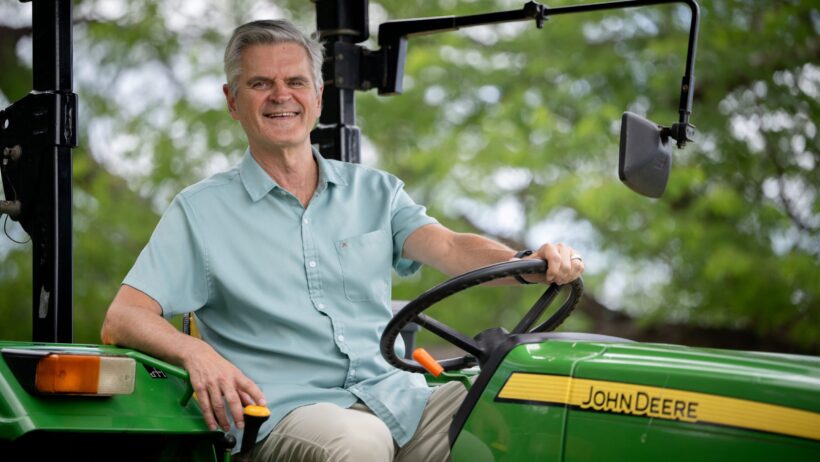
For many, Steve Case’s name is synonymous with the early internet era. As the co-founder of AOL, Case helped bring the online world to the masses, creating one of the first large-scale digital communities. In the 1990s, AOL wasn’t just an internet service—it was a portal into a new kind of connection, where people could meet, communicate, and collaborate in entirely new ways.
Today, Case is still in the community-building business, but with a different kind of infrastructure. “Maybe I’m good at only one thing.” he joked, when I sat down with him in his offices in Washington, D.C. Instead of dial-up modems and chat rooms, he’s now using investment capital, land development, and philanthropy to create real-world impact in overlooked places—from revitalizing startup ecosystems in the American heartland to developing sustainable resorts and residential communities in Costa Rica and Hawaii.

Whether through the Rise of the Rest fund, which backs entrepreneurs outside traditional tech hubs, his real estate ventures under Revolution Places, or the philanthropic work of the Case Foundation, Steve Case’s mission is clear: use capital as a lever to spread opportunity and rebuild belief in the American Dream.
Case reflected on what the American Dream means to him today. “It’s really the idea that you have a shot at building a better life—for you, for your family, for your community,” he said. “But it is harder for people to build companies and create jobs in many parts of the country. The American Dream is not as bright in some parts of the country as it is on the coasts.”

That disparity is what prompted him to launch Rise of the Rest—a nationwide effort to invest in entrepreneurs in cities like Pittsburgh, Des Moines, and Chattanooga, far from the capital-saturated corners of Silicon Valley, New York, and Boston. “We’ve made over 200 investments in 100 cities across 38 states,” Case said. “Some of those companies have gone on to build multi-billion dollar businesses, proving that great ideas can come from anywhere.”
But Case’s belief in the power of place extends beyond startups. Long before real estate became trendy in the tech world, Case had quietly begun investing in land with personal significance. One of his first major post-AOL investments was a 40,000-acre parcel on Kauai in Hawaii—land where his father was raised and his grandfather worked on a sugar plantation. That initial move into land ownership laid the foundation for Revolution Places, the hospitality and real estate arm of his investment firm.
Just as AOL created an online community where people could connect across digital borders, Case is now focused on creating physical communities that foster a sense of belonging, sustainability, and shared purpose. Through projects like Exclusive Resorts—a private club offering its 4,500+ Member families access to a $1 billion portfolio of more than 400 luxury homes and rare, curated experiences—Case continues to shape not just how people travel, but how they live. Since 2002, the Club has quietly evolved into a tightly knit community of global achievers: Fortune 500 executives, founders, Michelin-starred chefs, renowned artists, and elite athletes. For these families, membership represents more than access to extraordinary destinations—it’s an investment in a life well-lived.
Exclusive Resorts took a strategic leap forward earlier this year with the launch of a branded residential vertical, developed in response to increasing demand for ownership and extended-stay opportunities in destinations where the Club already thrives. With more than 60% of Members owning second homes, the initiative is designed to deepen engagement and provide continuity for families seeking long-term alignment with the Exclusive Resorts ethos. The inaugural development will break ground at Punta Cacique, Case’s master-planned coastal enclave on Costa Rica’s Cacique Peninsula.
“In Costa Rica, when I first went there 25 years ago, the area was mostly farmland,” he said. “Now it’s a booming tourism economy with high-end hotels, an upgraded airport, and a surge in job creation. We’re trying to contribute to that in a responsible way—by creating opportunities for both visitors and the local community.”
The community-oriented philosophy that powered AOL is clearly visible in these offline ventures. At Punta Cacique, the Costa Rican development he’s now actively building, the focus isn’t just on luxury real estate—it’s about creating an integrated, authentic experience. “We want people who stay there to venture out, to engage with the local culture, to contribute to the region’s growth—not just consume it,” he said.
In Hawaii, Case is applying the same ethos. On Maui, where he’s the majority shareholder in Maui Land & Pineapple Company, he was deeply troubled by the demise of the local pineapple industry. “There were 10,000 acres growing weeds and over a thousand lost jobs,” he said. “That bothered me.”
Case is now leading an effort to plant agave and build a new agave spirits business, one that could eventually scale to thousands of acres and generate a significant number of farming and tourism jobs. “Agave is water-efficient, looks beautiful, and it could become a real economic driver,” he said. “We’re trying to do something sustainable and regenerative—not just economically, but ecologically and socially as well.”
That combination of investment strategy and civic responsibility extends to his philanthropic efforts with the Case Foundation, which he leads with his wife, Jean. “We wanted to use all the tools in the toolbox,” he explained. “Sometimes that’s a grant. Sometimes it’s a policy push. Sometimes it’s an investment in a startup or a community. The goal is always the same: how do we have the most meaningful impact?”
The foundation has supported everything from early-stage entrepreneurs to civic engagement and policy reform. “We helped launch the Startup America Partnership at the White House with President Obama,” he said. “We also advocated for the JOBS Act and Opportunity Zone legislation—policies that made it easier for companies in underserved areas to raise capital and grow.”
That blend of entrepreneurship, public policy, and place-based investment is what defines Steve Case’s current chapter. Through Revolution—a venture firm headquartered not in Silicon Valley, but in Washington, D.C.—he’s backing companies that combine breakthrough innovation with an understanding of the regulatory and societal landscape.
“We wanted to invest in big industries that hadn’t yet been reimagined by technology—like health care, transportation, and financial services,” Case said. “And we wanted to do it from a place where we could influence policy. Being based in D.C. gave us a home-court advantage.”
Companies like Tempus, which uses AI to provide precision cancer diagnoses, or Clear, the biometric ID company used in airports and stadiums, embody this approach. “The core technology is important,” he said, “but the real value is created through partnerships and policy alignment.”
This mindset also influences his view of emerging technologies like artificial intelligence. Case sees parallels to the early internet boom—but he’s cautious. “AI will destroy some jobs and create others we can’t yet imagine,” he said. “We need a responsible transition—open source models, smart regulation, and investments in people.”
That belief in balanced progress—technology with empathy, capitalism with conscience—drives his approach to business. It also puts him squarely in the camp of stakeholder capitalism, the idea that companies should create value not just for shareholders, but for employees, customers, and communities.
“If you figure out the right integrated model, you can have great returns while also having a great positive impact,” he said. “They don’t have to be in conflict.”
Looking back, it’s clear that Steve Case’s journey—from pioneering digital connectivity with AOL to cultivating inclusive economies through Rise of the Rest, to building physical communities in Hawaii and Costa Rica—is less of a pivot than a progression. He’s still building platforms. Still connecting people. Still believing in the power of shared experience to shape a better future.
“When we started AOL, we were based in Northern Virginia, not Silicon Valley,” he said. “It took a while for us to be taken seriously. But eventually, people stopped caring where we were—they cared about what we built.”
That same ethos now drives him to invest in Kansas City instead of San Francisco, to plant agave in Maui instead of another server farm in the Bay Area, to build real-world communities where people can thrive.
“I still believe in the aspiration of the American Dream,” Case told me. “And we all need to do what we can to make it as easy as possible for as many people as possible to believe in it, too.”
Discover what it means to be an Exclusive Resorts member.
This article was originally published in September of 2025.