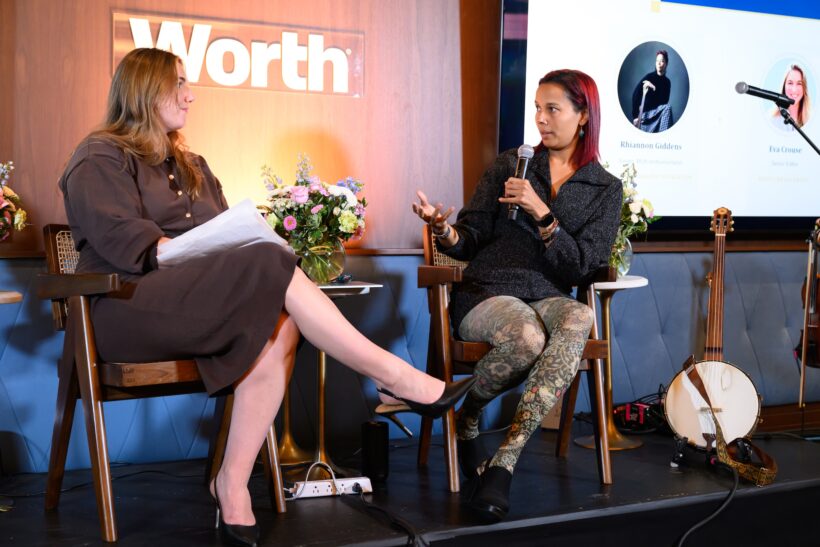
Rhiannon Giddens closed Worth’s Groundbreaking Women 2026 summit the way she does most things. She brought a buried history back into the open and then turned it into a party.
The Grammy winner, MacArthur Fellow, and Pulitzer Prize–winning composer sat down with Worth Senior Editor Eva Crouse to talk about her new album, Hope Is the Thing With Feathers. The title track came to her almost whole. She came across the Emily Dickinson poem on her computer in a hotel room, and a melody “downloaded into [her] head.” She sang it a cappella into her phone. Later, she sang it for Niwel Tsumbu, a guitarist from the Democratic Republic of Congo, and he started playing along. Thinking of his home country changed what the song meant to her. “We who are privileged have to carry hope for the folks who don’t have the ability to have hope because they’re too busy trying to survive,” she said. “Who am I not to hope?”
She recorded most of the album live at Dirk Powell’s studio, a converted house on a Louisiana bayou. Giddens calls herself “a communal maker.” Her method is to build a space where musicians feel safe, record it well, and let the group do the rest. She wants listeners to hear where a record was made and who made it, which she thinks the industry is losing.

That same instinct drives her decades of work on the banjo. She has spent her career correcting its image as an Appalachian “hillbilly” instrument. “Without the transatlantic slave trade, there is no banjo,” she said. The instrument was born of the African diaspora in the Caribbean, and for a couple hundred years, it was known as a Black instrument. From there, it spread through working-class communities that had always lived close together. She argued that commerce is what split the music apart. In the 1920s, record companies needed records to sell. They divided Southern music into Black records and hillbilly records, and music that had been regional became racial.
Her opera Omar, written with composer Michael Abels, won the 2023 Pulitzer Prize for Music. It tells the story of Omar ibn Said, a Senegalese Islamic scholar who was enslaved in the Carolinas and wrote his autobiography in Arabic. Giddens agreed to the commission right away, then “went home and freaked out.” She solved it the way she usually does, by bringing in someone who could do what she couldn’t. She cold-emailed Abels after hearing his Swahili chorus in Get Out.
Her newest project, the Biscuits & Banjos Foundation, grew out of a festival in Durham. It supports what she calls “cultural excavation” through concerts, community square and line dances, and sets of eight banjos for groups in Fort Worth, Oakland, Maryland, and beyond. Her request to the audience was simple: give if you can, but show up. “Don’t buy my record. Go to your community event,” she said. Then she added, “Actually, do both.”
She ended with her biscuit recipe, laid out with a composer’s precision: White Lily flour, frozen Kerrygold butter grated on a box grater, a wet dough, and a 475-degree oven. And don’t twist the cutter.