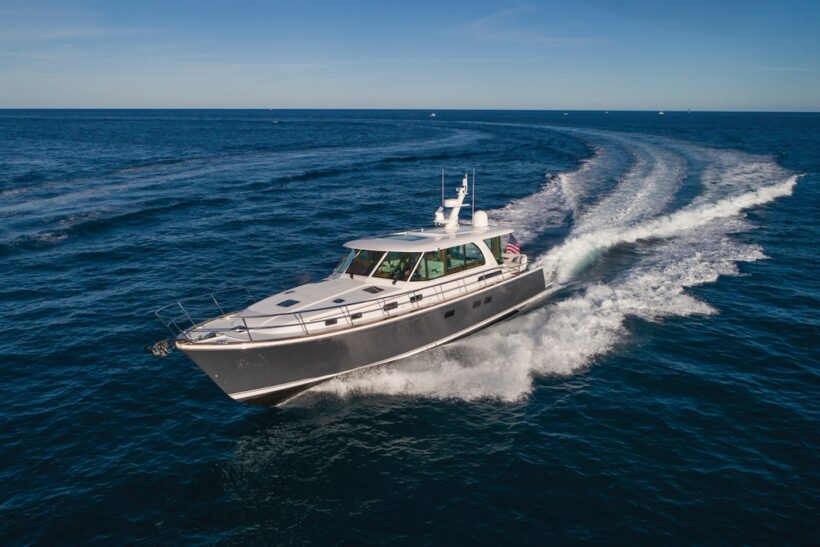
It’s hard to imagine the ubiquity of shipbuilding that took place in Maine starting in the early 17th century. Hundreds of shipyards employed tens of thousands of craftspeople engaged in scores of trades along “Down East’s” 3,000-mile coast. From sea captains and navigators to riggers, loggers, sawmill operators, plank steamers, carpenters, metal fabricators, sailmakers, and painters, the sights and sounds of marine construction rang out loud and clear for hundreds of years. For a while, they were nearly silenced by Post WWII market forces. Now, they’re heard again and Sabre Yachts is leading the way.
In 1608, the first ocean-going ship, built by the English in America, was from Maine. The Virginia made two trans-Atlantic crossings, which was a bold move at the time.
Abundant hardwood from northern forests, many in Maine, allowed the colonists to start an industry that would make America the preeminent maritime power in both commerce and war.
Before the American Revolution, several Maine shipyards were turning out large vessels used for coastal trade. Later, these same yards built the fledgling fleets that became the U.S. Navy. The Maritime War of 1812 saw legendary ships like the USS Enterprise defeat British warships off the southern coast of Maine.


Maine shipbuilding authority Nathan Lipfert, in his encyclopedic book Two Centuries of Maine Shipbuilding, sums it up. “Maine’s dominance in the shipbuilding industry came about for three reasons: in the beginning, the presence of large forests of shipbuilding timber; Maine’s 3,000 miles of tidal coastline, much of which is suitable for building vessels and launching them into deep water; and a large workforce (built up over the years) of people highly skilled in all the trades needed to construct some of the largest wooden vessels ever built.”
With peace came the formation of the Hodgdon yard in East Boothbay in 1816. That yard, the oldest continuously operating shipyard in America, is still thriving and is currently working with Maserati to co-producea series of the sexiest electric yacht tenders imaginable.
In the 1850s, when the world relied on maritime trade, the largest, fastest clipper ship the world had ever seen, the legendary Red Jacket, was built in Rockland, Maine. Hundreds of others followed, and the state continued to lead the nation in this luxury craft.
Thousands of smaller boats also came out of these yards—fishing smacks, lobster boats, and small coastal schooners. Heavy duty “stone sloops” brought Maine granite to be used as the foundations of buildings across America’s burgeoning cities.
The late 19th and early 20th centuries saw the continuance of commercial and military shipbuilding. In 1890, the first steel vessel was built in Bath, Maine, a place called “the city of ships.” WWII saw the Bath yard (and others) lend a hand to the war effort by converting to building destroyers, supply ships, and submarines. Over a thousand were launched. Today, Bath remains an important yard for the U.S. Navy and receives significant defense budget appropriations.
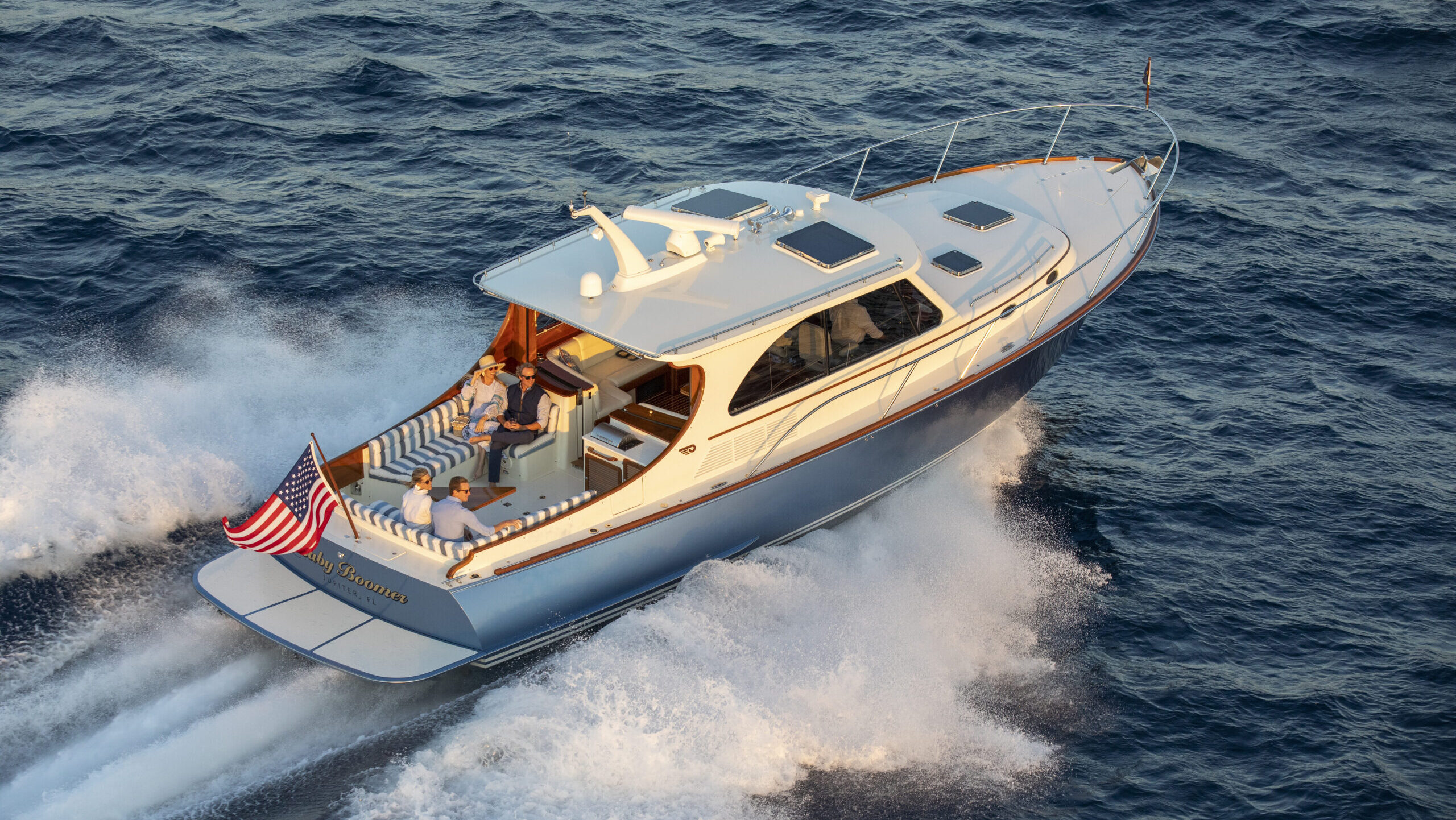
Post WWII, everything in Maine, including farming and manufacturing, experienced a dramatically steep decline because affluent America tooled up for mass production of everything, including recreational boats. Some of the largest shipyards went to the Midwest and south in search of bigger facilities and cheaper labor. Factory-produced yacht builders like Chris-Craft were the antithesis of the custom-built quality yards that were the hallmark of Maine.
For decades, boat manufacturers producing commercial fishing, recreational, and pleasure boats have relied on the Carolinas and Florida as ideal hubs for mass production. Plus, the lucrative American market was targeted by overseas boatbuilders, specifically Taiwan, which brought scores of models to our shores, both power and sail. Today, China and Malaysia are the bases of several luxury brands, like HH Catamarans, Palm Beach Yachts, and Grand Banks.
These changes left Maine yards in a depressed state. Hundreds closed their doors, and the remaining ones cut back, trying to survive on commercial craft for the local fishing and ferry industries.
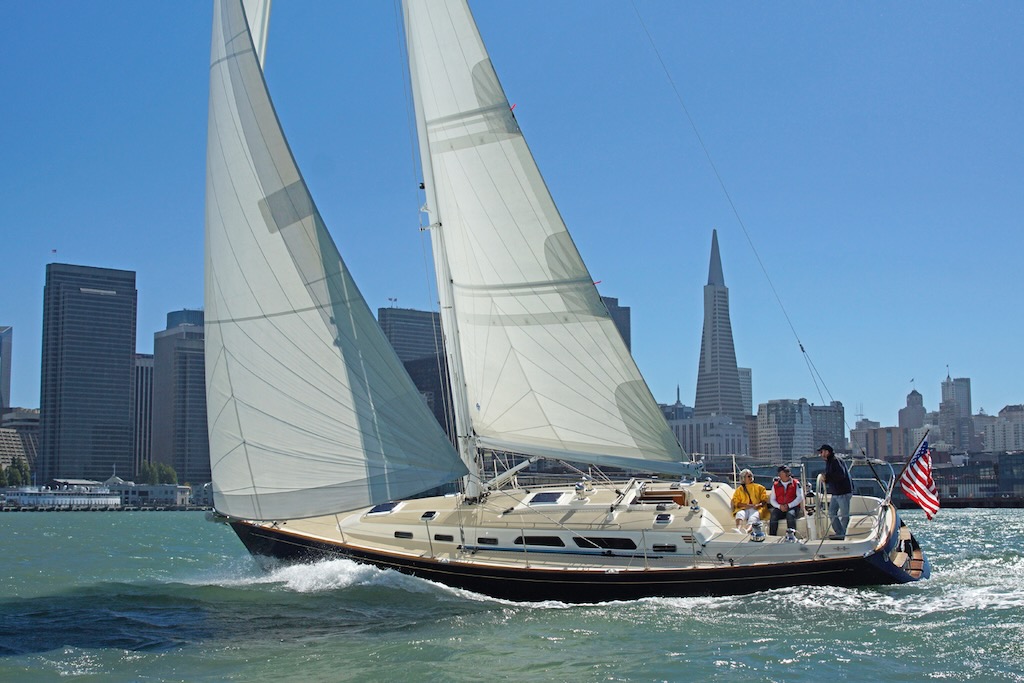
Seeds of renewal started in the late 1960s when Maine experimented with fiberglass and aluminum. Innovative builders, like Hinckley, switched from wooden to fiberglass hulls for their iconic Bill Tripp-designed Bermuda 40 sailboats.
Others followed. Sabre, founded by the energetic and innovative Roger Hewson in 1970, had the seemingly disparate goals of producing a fiberglass sailboat that was “crafted in the Maine tradition.” They succeeded…thousands were built, from 28 – 45ft. The enterprise finally stopped in 2011 when it became unprofitable.
Fortunately, however, Saberline 36, their first powerboat—a fast trawler—debuted in 1989. She quickly became the foundation of the company’s survival.
Today, with business-oriented professional managers and engineers (chairman Daniel Zilkha has both an engineering degree from Princeton and an MBA from Harvard), Sabre is thriving.
Long gone are the days when boat design was done by rule of thumb lofting (a technique made outdated by technology). In the face of relentless cost advantages from places with cheaper everything (labor, energy, overhead), intelligent production is what makes Sabre’s yachts competitive.
As respected yacht broker, Chris Fairfax of Wellington Yacht Sales told Worth at the Newport Boat Show, “I think they do an amazing job giving people what they are looking for. Sabre offers tremendous value. Their warranty work is second to none, and their dealerships are top-line. They are always one step ahead of the competition.”
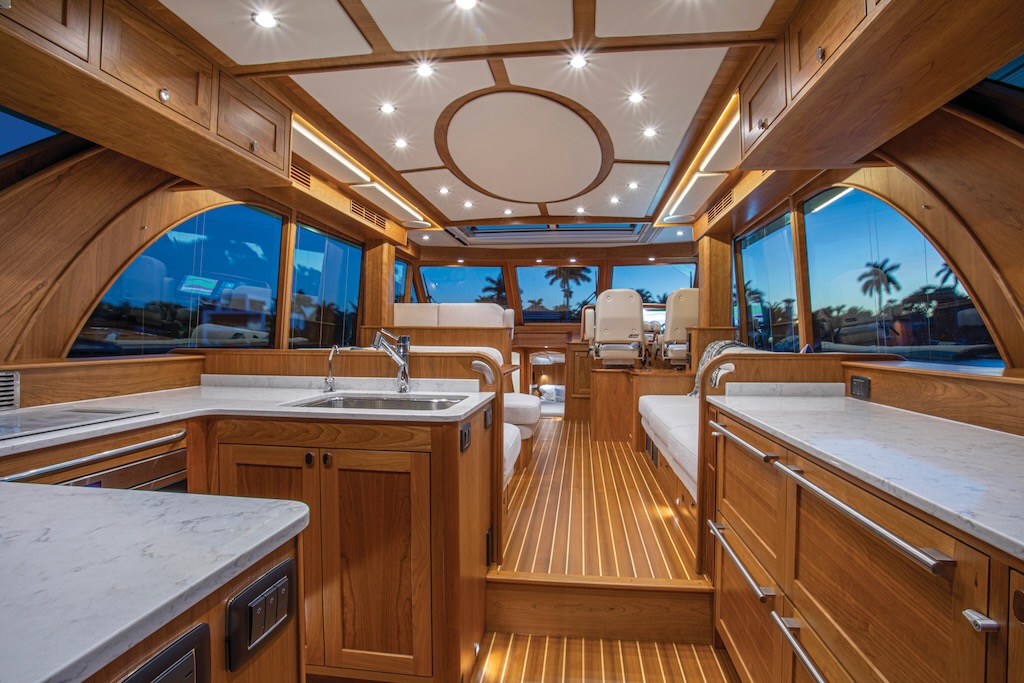
Since price is often an issue and Sabre experienced the loss of market share to less expensive, offshore-built boats, in 2003, they launched the Back Cove line. At a lower price point, they have simpler engine systems and a less fussy interior. Back Cove was an immediate success and, as a stand-alone, would be a major yacht brand. Sharing some of the same management and design teams amortizes overhead.
With over 350 Sabre/Back Cove employees, all sharing the Made-in-Maine ethos, they are the largest yacht builder in the state.
Kevin Burns, the VP of design and product development for Sabre and Back Cove, explained to Worth, “Downeast style for us is an evolutionary approach to design that was born from the proportions and sensibilities of Maine’s working lobster boats. Form and function are completely intertwined. The low profiles, flared bows, and thoughtfully curved sheer lines all serve very practical functions but are also beautiful. New technologies ensure they meet the ‘nautical sensibility’ benchmarks Sabre has developed over many decades.”
Currently, Sabre offers seven models ranging from 38 – 58ft. Most are the Express version, i.e., without a topside navigation station. The entry price for a Back Cove is around $800,000, while the largest Sabre is around $3,500,000.
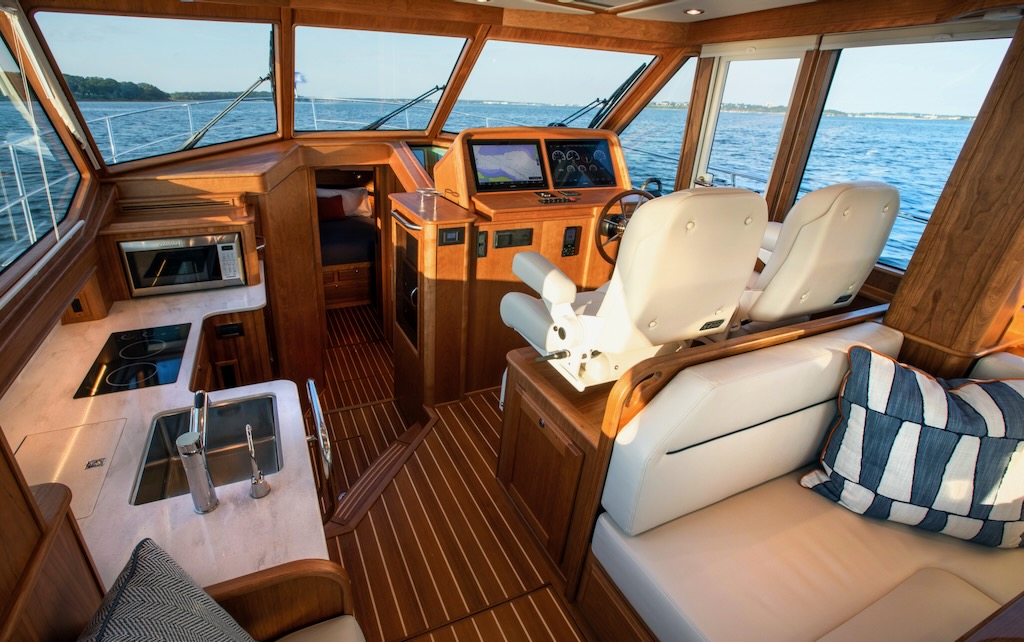
Boat size can be deceptive—longer vessels have exponentially more volume. Unlike a stretch limo, a 58-foot yacht is far more complex to operate than a 38-foot one, with additional systems and challenges. Many yachts at this size require a captain or professional crew to manage them.
The competition mimicked the Downeast style, and, to the casual observer, it would be hard to tell a boat made in Malaysia from one made in Maine. However, according to Ken, “What they don’t have is Maine’s centuries-old boat building culture with their dyed-in-the-wool familiarity with (and passion for) boats. It bleeds into every hull built in our state.”
Sabre has no plans to expand beyond Maine. As Aaron Crawford, Sabre’s President and CEO put it, “We have a culture of building boats. For 55 years, Sabre has continued to refine those traditions including attention to detail and nautical sensibility. Starting with the iconic Sabre 28 sailboat and continuing to our modern range of luxury motor yachts, we remain committed to our legacy of innovation and timeless craftsmanship in Maine.”
There are other successful yacht builders in Maine today. The state continually forges ahead in innovation, like 3D boat printing, and cutting-edge composite use. Yards like Hinckley have an enthusiastic following and reputation for luxury with classic design. Lyman Morse continually turns out state-of-the-art power and sailboats for the custom and semi-custom market. They are also out front in electric boat development. Southport Boats makes a range of fishing and day boats well known for quality. Then there are the truly bespoke yards like John Williams, Front Street, Wilber, Ellis, SW Boatworks, and others. Maine yacht designers, including Stephens Waring and Chuck Paine, have well-deserved stellar reputations.
So, what’s old is new again. Maine is leading the nation in the construction of world-class boats.
Sabre is a big part of the story.