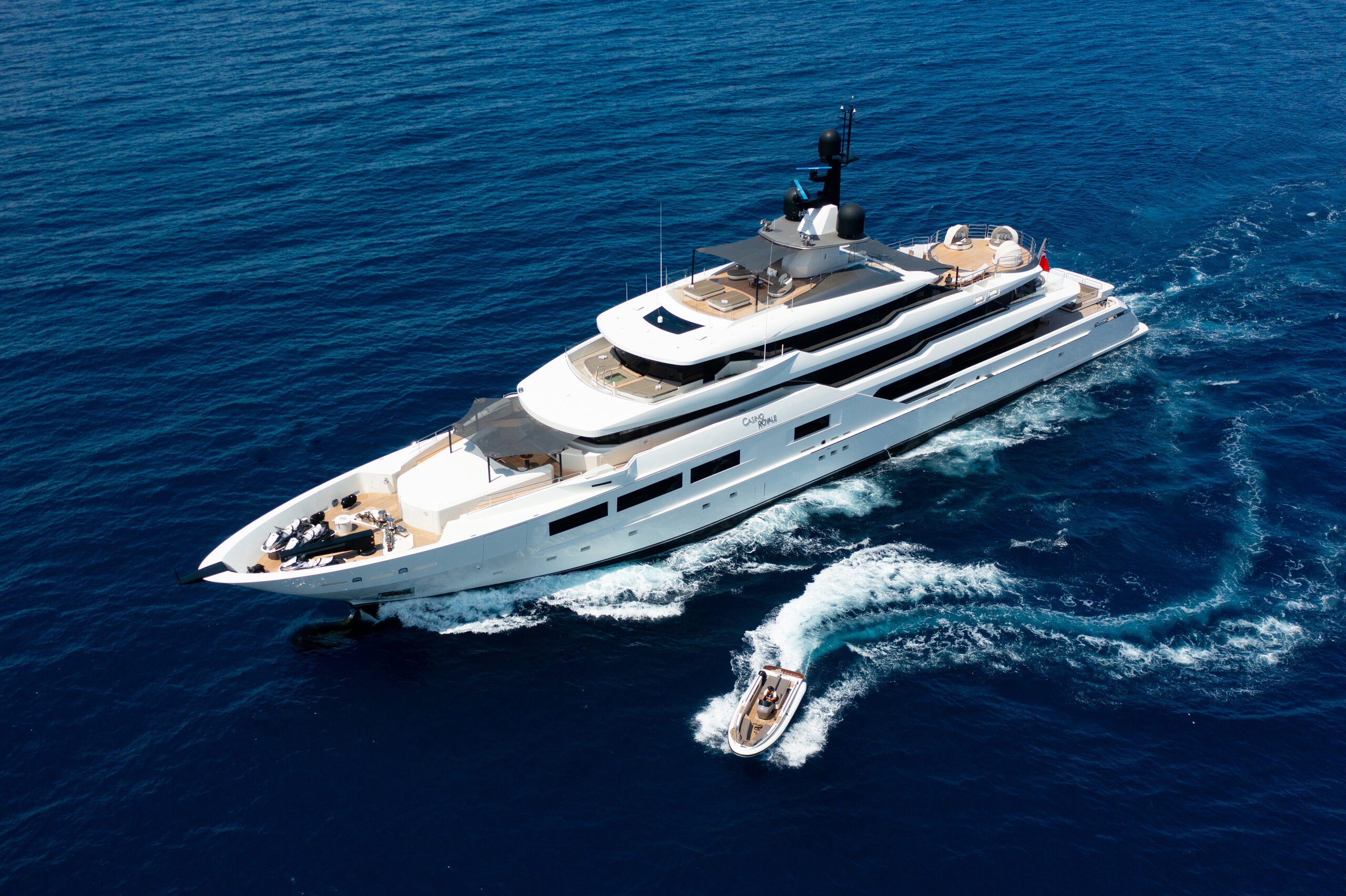
The 154-foot sailing yacht Andromeda La Dea has had an eventful existence. Tom Perkins, cofounder of Silicon Valley’s powerhouse VC firm Kleiner Perkins and a sailing aficionado, commissioned Italian shipyard Perini Navi to build it in 1990 with the latest technology available, including a then-newly developed computerized system to furl and unfurl its sails, reducing the size of necessary crew. It featured four deluxe staterooms, state-of-the-art communications systems and, with a range of 4,000 nautical miles at a maximum speed of 13 knots, the vessel could explore any ocean in the world. “This yacht was a marvel, and she sailed over 200,000 miles under my ownership in a 10-year span,” wrote the late Perkins in his 2008 biography Valley Boy. The ship withstood circumnavigating the globe, voyages to the Arctic and Antarctica, and even the fierce 1991 nor’easter that inspired the George Clooney film The Perfect Storm. “In many ways this boat was the perfect yacht—fast, beautiful and practical.”

Still, Perkins sold Andromeda La Dea in 2001 to build an even larger and more innovative ship, the 289-foot Maltese Falcon. Andromeda has had serveral owners since then, including former New York Daily News honcho Fred Drasner, who also sailed around the world on it for three years, and Charleston, S.C.–based real estate developer Charles “Buddy” Darby III.

“She wasn’t a classic sailboat, but when the sails are furled up and she’s at dock, she basically has the room of a motor yacht,” says Darby, who purchased the boat in 2007. As a lifelong sailing enthusiast and developer of the luxury yacht marina Christophe Harbour in St. Kitts, Darby wanted a ship that combined traditional ketch features with the convenience and entertaining space of a modern superyacht. “For my needs, I got a sailboat that today would be considered a modern classic.”
For yachtsmen like Perkins and Darby, who both owned smaller vessels before supersizing, having a boat like Andromeda La Dea fulfilled a passion. And as the global yachting market grows—market research firm Global Industry Analysts projects it to reach $74.7 billion by 2022—more people are entering the superyacht game. Yacht sales have held steady throughout the last decade according to the latest Superyacht Times industry report, and charters, a lower-cost access to boating and usually the first step toward ownership, have grown as the wealthy clientele has skewed younger. Even traditional hoteliers have jumped into the market: the Ritz-Carlton Yacht Collection is debuting in 2020 with three custom-built ships to provide intimate cruising experiences; in the Maldives, Four Seasons offers the liveaboard Four Seasons Explorer for guests who want to island-hop; and even the 21-room boutique hotel Atzaró in Ibiza has launched an 180-foot-long Indonesia-based superyacht, Prana by Atzaró.
But at a certain point, enthusiasts with the means will prefer to own a boat rather than be at the mercy of booking agents and space availability. So what does it actually mean to buy a yacht? Here’s what you should know.
VALUE THE EXPERIENCE, NOT THE ASSET
While passions sometimes make great investments, this is almost never the case with yachts. Unlike an art collection or prized wines, a yacht seldom increases in value. “The average owner would want to buy a boat that works for them, but it’s not about making money,” says Jonathan Beckett, CEO of London-based Burgess Yachts, one of world’s leading superyacht brokerages that handles everything from sales and charters to management and insurance. While he admits some of his clients do make money buying and selling yachts, “they tend to be very savvy—they look for unique opportunities in the marketplace” that allow them to buy particularly low and significantly improve the asset.

“It’s like flipping a house,” says Kathy Lefakinis, president of Valef Yachts, a Greek superyacht charter management company that started out in 1969 by acquiring vessels. “If you get a boat at a good deal and invest a little more into it, you can make a lot of money,” she says. But those opportunities are hard to come by—and they might be here today and gone tomorrow. That type of buyer typically has a preexisting close relationship with a brokerage or a shipyard.
Buddy Darby puts it more bluntly: “Boats are horrible investments.” For all its storied heritage, pristine maintenance, and major upgrades and refits, Andromeda La Dea has only decreased in value. Tom Perkins reportedly built it for $15 million; it was subsequently sold for well under $12 million, and Darby, who has tried to sell it for a number of years, has it listed for just over $8 million. Perkins’ other technological marvel, the Maltese Falcon, cost upwards of $150 million, but Burgess Yachts sold it in 2009 for $100 million. “A few people I know make money on boats,” Darby says, “but very few.”
USE IT OR LOSE IT
First and foremost in buying a yacht is understanding what its purpose will be. “You either buy the boat for personal recreation, or you buy it for the charter business,” says Lefakinis, whose company manages all aspects of chartering for ships such as the legendary Christina O. Most owners fall into the first category, but that doesn’t mean they won’t deal with charters. Because a yacht’s running costs can be so high, the majority of owners operate them like a vacation property. “Many people take their boat for X amount of time for themselves and offset the cost of maintenance by putting it on the charter market,” she says. Jonathan Beckett estimates that charter operation might offset as much 60 percent of running costs. So before you even buy, have a clear idea of what you want out of your yacht.
The average first-time buyer owns a yacht for three years, according to UK–based Towergate Insurance, before trading up or getting out altogether. “First-time buyers often feel they are going to use the yacht more than they really do,” says Beckett. “The first and second year is when people use it most. After the second year, the usage drops off a bit.” That’s one of the reasons Darby has listed Andromeda La Dea. “I want to take a pause since I’m not using it as much, and see where I want to go from here,” he says.
BUYING COULD TAKE LONGER THAN YOU THINK
The process of buying a yacht is similar to that of a home. Normally you go to a broker, who can show you what’s available, talk through your preferences and budget, schedule viewings and even take you to an event like the Monaco Yacht Show to see many ships at once. This process could take months and a great deal of back-and-forth as a broker guides you to your desired yacht. But some companies, such as Miami–based YachtLife, are trying to streamline this by giving potential buyers immediate access to available choices through a mobile app. “We eliminate a lot of that process that is done with phone calls and emails going back and forth with a broker guessing what you’re going to like,” says CEO Patrick Curley, who launched the company in 2015. “This puts the control in the hands of the customer.”
Once you’ve zeroed in on a boat and a seller accepts your offer, you make a 10 percent cash deposit. Then the due diligence begins. “Buyers should work with an independent marine surveyor who is accredited and who can provide a report on a yacht’s condition, seaworthiness, the condition of its machinery, its parts and its systems,” recommends Jeremy Backman, VP of recreational marine at insurance giant Chubb. “An underwriter would evaluate that survey in their understanding of whether they want to insure the asset. But it also provides the client with clarity on what they are purchasing.” A sea trial and other inspections are also recommended, as well as a good maritime lawyer who can help you navigate the appropriate flagging and registration of the ship, which can vary according to usage and location.
THINK BEYOND THE STICKER PRICE
The larger a boat is, the more it costs to maintain it. According to Beckett, yachts are typically considered to be any luxury seacraft over 50 feet in length, which sell in the $4 million to $12 million range. Superyachts are over 120 feet in length and sell for $30 to $80 million. And megayachts upwards of 250 feet in length cost hundreds of millions.
But the carrying costs of a yacht are arguably more important than what you need to fork over up-front. “First-time buyers can underestimate the running costs,” Beckett says. These include dockage, crew salaries, insurance, fuel and maintenance. “It is the single largest personal asset that a client will own.”
Any yacht requires a captain to lead the operation, assuming you’re not a licensed captain yourself. According to a 2017 poll by the industry publication Dockwalk, the average monthly salary for a yacht captain was $6,900; for a superyacht like Andromeda La Dea, a captain could earn upwards of $18,000 a month. Owners may also need additional crew such as first mates, deckhands, stewards, engineers and chefs—with bigger crews depending on the size of the ship. In the context of a sailboat like Andromeda La Dea, which has nine crew when fully operational, this could be as much as $60,000 a month. Though Darby does not reveal his ship’s carrying costs, he concedes that it is a complex and costly operation. “You get a superyacht, you get super complicated.”
After crew salaries, maintenance and repairs are the next largest expenses for yacht owners. For the larger yachts, this could be more than $1 million a year, with fuel, insurance and dockage each costing between $300,000 and $450,000 a year. “The rule of thumb for estimating carrying costs per year is 10 percent of the original purchase price,” says YachtLife’s Patrick Curley. “You’ve got to understand what you’re walking into. When you start getting into superyachts and megayachts, it’s like owning a new company.”
MAYBE YOU SHOULDN’T OWN ONE
During the pre-purchase process, some potential buyers are hit with the realization that they are not cut out for yacht ownership. And that’s not a bad thing, says Beckett, who is giving a speech at this year’s Monaco Yacht Show about the subject. “We have lots of clients who are very happy charterers. They didn’t want the aggravation or hassle of yacht ownership. They are permanent charterers and you are never going to convert them into yacht ownership.”
For Curley, whose company brokers yacht charters throughout the U.S. and Caribbean, the Mediterranean and even Dubai, it all boils down to practicality. “If someone lives in Manhattan but uses that asset only three to four months out of the year, and you are still paying the full carrying costs, does that make sense?” he asks. “That’s why chartering is such a huge industry. And if something happens during a charter, it’s not your problem.”

Not that chartering a yacht is inexpensive. While smaller yachts can go for $21,000 per week, according to Valef Yachts’ Kathy Lefakinis, a superyacht charter could be well over $300,000 a week. “It’s not a cheap way to travel,” she admits, “but chartering becomes addictive. Our repeat clientele is huge.”
And yet the question of what makes sense can flip the other way. “There are a lot people who will charter, but once or twice a year, not regularly,” says Buddy Darby, who chartered some larger boats before purchasing Andromeda La Dea. “When you get up to that level, that market will say, ‘I’ll just buy it.’”
Getting Started
Interested in owning a yacht? These six resources will help you learn more.
Burgess Yachts, a full-service yacht brokerage, Jonathan Beckett, CEO, 377.97.97.81, burgessyachts.com
Christophe Harbour, a yacht marina in St. Kitts offering freehold berth ownership, marina@christopheharbour.com, 869.465.9755, christopheharbour.com
Chubb Personal Risk Services, a subsidiary of insurance giant Chubb that offers recreational watercraft policies, 877.513.2338, chubb.com
U.S. Superyacht Association, a trade association, info@ussuperyacht.com, 800.208.5801, ussuperyacht.com
Valef Yachts, a Greece-based charter management company, Kathy Lefakinis, president, 267.404.2415, valefyachts.com
YachtLife, an online yacht charter and sales platform, 786.574.6762, yachtlife.com