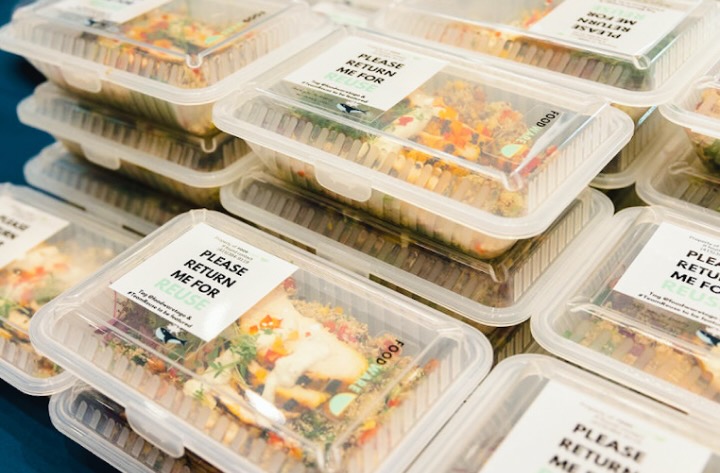
How does a childhood in post-independence Lithuania inspire a bold vision for tackling the global waste crisis? For Ignas Bolsakovas, founder of FoodWare, the answer lies in early lessons from a culture that valued reuse and resourcefulness. After acquiring his smart thermostat company, Homely Energy, Bolsakovas focused on single-use packaging, combining his entrepreneurial spirit with innovative technology to create a scalable solution for reducing waste. Drawing on his passion for sustainability and a belief in the power of the circular economy, he’s tackling one of the food service industry’s biggest challenges: making reusable packaging as seamless and efficient as the disposable systems it seeks to replace. From smart labels to closed-loop systems, Bolsakovas’ work demonstrates how innovative thinking can turn small shifts in behavior into significant environmental impact.
What inspired you to transition from developing smart thermostats at Homely Energy to tackling single-use packaging waste with FoodWare?
Realizing my purpose of solving climate change led me to start another climate company, this time in the circular economy space. After acquiring Homely, I sought new opportunities since I knew I could create so much more impact as an entrepreneur rather than an employee. I’ve been passionate about resource conservation since a young age, and linear supply chains and single-use packaging never made sense. I grew up in Lithuania, which had recently regained its independence. That’s where I saw the old reuse systems in place and being very effective. At the time, there weren’t many large retailers, and there was a significant material scarcity, which led to most materials being used as long as possible, including food packaging. There was never a thought about throwing things away that have some value or could be put to use again. I would see my grandmother exchange egg cartons or milk jars at a local market; “bulk aisle” and fresh farm-to-home delivery in reusable packaging was the norm. In the early 2000s, there was a shift, and big retail chains started developing and moving in. This brought more convenience, which is familiar to the Western world, and, together with it, single-use packaging.

Can you elaborate on how FoodWare’s technology enables a seamless collect-and-return system for reusable packaging?
We have developed an innovative smart label technology that allows reusables to be tracked across their use cycles throughout their lifetime. These labels integrate seamlessly with our mobile and web applications, creating a user-friendly collect-and-return process. By leveraging technology, we can ensure high return rates (in most cases over 99%), enabling significant savings and operational efficiency. For end-users, the experience is designed to be enjoyable and hassle-free, encouraging participation and supporting a sustainable lifestyle. The process is streamlined for operators, making sustainability metrics tracking simple and eliminating common pain points. Our commitment to continuous innovation ensures the system remains convenient and effective for everyone involved, fostering a robust and scalable reuse model.
What challenges have you encountered in encouraging consumers and businesses to adopt reusables, and how have you addressed them?
Encouraging people to adopt reusables is not an easy feat. We had to go through many hoops, challenges, and quite a few pivots. Some small, some fairly significant. In the beginning, we started working with restaurants and cafes, and that’s when we first launched our mobile app. We tried multiple program variations, including several improvements to the mobile app. The key was to ensure that we provide an inviting experience and that it is accessible to everyone—encouraging consumers instead of penalizing them. To tackle this, we made several iterations of our deposit system. We first started with a deposit that would be returned to the customer only if they returned the container, similar to how recycling deposit schemes work in Europe. Based on our feedback, it was later scrapped in favor of a non-return fee, similar to a library model. This way, it provides easier access and encourages people to return, increasing customer satisfaction and return rates. Along the way, we learned that our system has to have the least barriers possible and be as close to the current convenience model. We took these learnings when we started working with colleges and large corporations.
One of the biggest challenges in our space is that for larger-scale reuse ecosystems to work in an open loop setting, i.e., with restaurants and cafes, we require a significant policy change as well as extended producer responsibility (EPR) laws put in place. This led us to focus more on higher education and corporate campus clients. So-called closed-loop systems with large on-site dining operations can implement quick changes and have significant environmental goals.
We also needed to address the challenges that operators face. Sanitization, logistics, and operational aspects must be considered when working with these businesses. How do we make sure to support them each step of the way? Most importantly, we learned that our solution has to be at the same price point or cheaper than the current alternative, which led us to create new business models and pricing strategies to make it possible.

How does FoodWare’s model contribute to reducing carbon emissions and waste in the food service industry?
Each time a product is reused, you’re saving 100% of all the resources required to create it, including resource extraction, processing, manufacturing, shipping to the final destination, all the in-between logistics, and managing the product’s end-of-life. This results in many carbon emissions required to create something that is only used for a few minutes, if not less. This also includes energy and water usage that could be put to better use elsewhere. The same applies to waste—most recyclable and compostable materials don’t end up being recycled or composted due to limitations and the inherent complexity of the industry. Microplastics from single-use packaging surround us each day—through water and soil—and end up being in our food and water taps, further polluting our environment and our bodies.
Could you share any measurable environmental impacts or success stories from FoodWare’s implementation?
We have already avoided tens of thousands of single-use items working alongside our partners and customers, such as UC Berkeley Fortune 500 companies, and expanding to locations in the U.S., such as New Hampshire and Hawaii. One of our first customers, Haas School of Business at UC Berkeley, has been a partner since 2022. Because of the visionary leadership of their Director of Sustainability, Danner Doud-Martin, we were able to move fast and achieve a significant impact very quickly. Since then, we have expanded across different programs and settings at Haas and reached over 5,000 students. Haas also uses our environmental data for their TRUE zero waste certification each year and has achieved Platinum level year after year. Such leadership and understanding the complexity of sustainability issues, as well as the variety of solutions you can implement at your organization, drive the change and are key to winning the battle against climate change.
We’re proud of a recent prestigious award that one of our customers received by participating in the reuse program. Maria, the owner of The Rising Loafer in the Bay Area, CA, was nominated earlier this year as an “Activist of the Year” by an internationally recognized organization focusing on reuse, Upstream, for her work in sustainability and participation in our program. It’s the success stories from our customers and communities that we serve that give us the fuel and motivation to keep innovating.
What strategies does FoodWare employ to ensure the scalability and sustainability of its reusable container system across diverse markets?
A combination of innovative technology, operational excellence, and targeted go-to-market strategy drives our system’s scalability and sustainability. By striving to build solid and scalable technology that enables high return rates, we can ensure reliability and significantly reduce waste and expenses. To further support our customers, we provide comprehensive education and guidance, empowering them to implement and maximize the reuse system’s benefits successfully. By promoting high-quality, durable materials, we can ensure the longevity of products, enhancing both scalability and environmental impact. Additionally, our strategic focus is on markets where we can drive the most meaningful change, enabling targeted growth and maximizing overall impact. Most importantly, our strategy is not only external—we make sure our internal operations and activities are as sustainable as possible—we live and breathe sustainability. Having a solid foundation and values is key to building a sustainable business.
How does FoodWare integrate data analytics to enhance user experience and operational efficiency?
At the core, FoodWare is a data company. Our track and trace technology allows for deeper visibility and transparency of the key part of the food service supply chain, which gives added value to the customer and provides key insights into their operations and how well the program is doing. This ensures the reusables program’s success and simplifies inventory management, saving time and money by eliminating the need for manual tracking. We were also the first in our industry to introduce a life cycle assessment based on environmental impact data translated to avoiding single-use materials. This idea came to us from my experience building IoT and data companies. By quantifying the impact of every single piece of packaging, we can easily show what our customers are saving environmentally and what they need to do to achieve their sustainability goals. Additionally, for students and employees, seeing their environmental impact creates a more enjoyable experience, fostering a sense of purpose and contribution.
In what ways does FoodWare collaborate with other organizations or initiatives to promote a circular economy?
Given our backgrounds and experience, we’ve partnered with multiple community organizations, nonprofits, cities, and counties. Our scope of partnerships ranges from local community organizations to more prominent national and international NGOs, such as Surfrider, Plastic Free Future, and Upstream. This range is also reflected in the projects we have worked on with our partners—from helping strengthen their education and grassroots engagement efforts to implementing reuse pilots in the communities. We worked on developing, strengthening, and implementing reuse policies with cities, counties, and coalitions. And in general, many resources and knowledge is sharing with all different partner organizations based on our experience building reuse systems.
It is essential to understand that circularity is a community effort that affects everyone in the supply chain. Often, waste treatment, recycling, and composting facilities are built outside of the cities in disadvantaged communities, affecting their lives daily and building on social inequality. That’s how reuse and circularity have a much broader impact than just a single piece of packaging.
What future developments or innovations can we anticipate from FoodWare in sustainable food packaging?
Several things on our roadmap are keeping us busy. We continue innovating to make an even more seamless experience by improving existing tools and introducing new ones. We plan to expand to the rest of the U.S. and abroad in the next few years. We are also adding more AI-powered capabilities to our existing tools to get smarter and bring even more value to our customers, who rely on our data precision and accuracy daily. But I’m most excited about how we can take the technology we built beyond food packaging and bring it to other industries!
What does ‘Worth beyond Wealth’ mean to you, and how does this philosophy influence your approach to entrepreneurship and environmental stewardship?
“Worth beyond Wealth” embodies the idea that value lies in the positive impact we create rather than just financial gain. It means using my skills, resources, and opportunities to make a meaningful difference in the world, contributing to a future that benefits not just specific individuals but the planet as a whole. A philosophy that drives my every decision with a sense
of greater purpose. We all have a choice in how we shape the world, and I believe the best way to envision the future is to build it. Through my work, I focus on creating solutions that have a significant impact, aligning personal and professional goals with the urgent need for climate action. By prioritizing the effect, the resulting “wealth” is not just financial but emphasizes a healthier planet for future generations. This vision, or rather, way of life, fuels my commitment to making entrepreneurship a force for environmental and social transformation.