Electric vehicles (EVs). Conjure up one of the earliest examples in your mind, and you’re probably picturing little hatchbacks that look more like golf carts than anything else. But you can happily forget about them now. EVs have evolved. They went mainstream a few years ago, so makers like Audi, Mercedes, and Tesla, among others, turned those golf carts into cars you will want to drive.

But this year, and especially over the next few years, if you’re looking for the latest in EV innovation, you’ll investigate the luxury and supercar market. This is where EV engineering is blossoming from something you’ll settle for in the name of sustainability and green energy to something you’ve just got to have right now! These cars are amazing, and we’ve compiled a list of our 10 favorites.

2024 Cadillac Celestiq

Say the name Cadillac, and many of us picture massive black SUVs with a Chevy Yukon-style footprint, just sporting a Cadillac logo on the grill. If that’s in your head, blink it away because it is not the Celestiq. Cadillac isn’t going after Chevy’s high-end customers with this car, it’s going after Bentley’s, and it’s doing a damn fine job.
What’s great about the Celestiq is that even though most of its marketing is around its “ultra-luxury” features, it has excellent EV specs, too. Cadillac is building the Celestiq around its Ultium EV platform. This two-motor design is like the Audi e-tron, but with a beefier battery pack at a claimed 111-kWh compared to the Audi’s 93kWh.
That culminates in an all-wheel drivetrain combining 600 horsepower with an also-estimated 300-mile range. But the Audi will still edge it on torque, as Cadillac estimates it’ll do the 0-60 thing in 3.8 seconds, compared to the e-tron GT’s 2.9. However, you won’t see a Celestiq until next year, so if you’re looking for tested, non-estimated numbers, you’ll need to wait until after New Year’s.
Now, to all that ultra-luxury goodness. First, you probably won’t see any of it in the flesh unless you buy one. That’s because every Celestiq is “bespoke,” to use Cadillac’s word. Every car will be custom-built to that individual customer’s specifications. And not by some faceless factory bot, either, but by hand. Yeah, this isn’t your grandpa’s Cadillac.
But while its bespoke-ness certainly makes it exclusive, it’ll also make the Celestiq a rare sight on your local highway, since production will be minimal. It also means the price is currently vague. Cadillac confirms that it’ll be well over $300,000, but that’s all the details you’ll get now. Given that this was referenced as a starting point, I’d expect that an actual price, once you get all the bespoke out of your system, will be considerably higher.
Still, if you manage to land one, you’ll enjoy it. This will be a singularly smooth ride based on what Cadillac is showing on its virtual tours of the Celestiq. The cockpit is a sea of electronics. Where most luxury cars these days have central infotainment displays between 10 and 12 inches, the Celestiq’s entire cockpit is one large display that’s almost 60 inches long. And that’s just for the driver and passenger, who both have their set of controls on this screen. If you’re in the back, you’ll still have access, just via a more normal-sized 12.3-inch screen that’ll let the kids surf the interwebs or tick off the driver by messing with the 38-speaker stereo (yeah, you read that right: 38-speaker, 3D surround sound).
There are too many luxury features for us even to begin listing here. From an intelligent glass roof with adjustable opacity to various 3D-printed components to the car saying ‘hi’ with a customized light show every time your key fob gets in range, it’s about customizable ultra-luxury.
2024 Lotus Evija

My name is Evija. Lotus Evija. British EV engineering at its most bleeding edge. Lotus doesn’t bill the Evija as an EV supercar but an EV hypercar. Who knows what that means outside of a marketing meeting. But on the road, it means 0-60 in under three seconds and a top end of 218mph, which should get you wherever you’re going in plenty of time, though probably with an unwanted police escort.
On the EV specs front, the Evija flirts with the truly ragged edge. That starts with the battery, which is a 2,000 kW behemoth that Louts built in partnership with Williams Advanced Engineering. That battery delivers a target of 375 kW to four independent motors, one for each wheel. That’s what gives the Evija all that power.

But it’s also got some radical charging characteristics. Lotus claims it has the world’s fastest charging battery, which can handle an 800kW charge. That can get you to a complete set of battery bars in nine minutes flat. But even using a more standard, circa 350 kW public station, you’ll get the car to 80% in 12 minutes and 100% in just 18. On the range side, the Evija isn’t quite as ragged edge, promising only an average-sounding 250 miles, but at 218mph, who cares?
The rest of the car is just like Mr. Bond. Ultra cool and brimming with gadgetry. A couple of dihedral doors give you the maximum space to get in and out of the vehicle. Everything you need to know is on a single digital display behind the wheel, like your current battery charge, your remaining range, and how close to the speed of sound you’re currently getting. There’s what Lotus describes as a “ski-slope style” central console that features all the buttons you need to control the rest of the car’s functions. These provide haptic feedback and are recessed into the console with its own lighting.
Those are just a few sample features, though. There’s a very long list of other options, but you can see that up close when you set yours up, which you’ll have to do, because just like the Cadillac Celestiq, every Evija will be made-to-order for a particular customer. And get yours quick, because they’re only making 130 of these things, and they started back in 2020.

Sure, the Evija targets extraordinary track times more than the smooth-as-a-cloud driving experiences some of our other luxury EVs are touting. But if you’re looking for EV performance that’ll truly set your hair on fire, I’d strongly recommend giving one of these a try.
2024 Tesla Model S Plaid

The Model S represents the current top of Tesla’s EV line, and the S Plaid version stands out among the Ses because it’s fast. Very fast, at least for what’s still a mainstream production car. However, if you’re thinking of competitors, think more of Porsche than Audi or Mercedes.
The S Plaid’s performance is powered by a 100-kWh capacity battery that provides an impressive 405-mile range, according to Tesla. How quickly you can charge your S Plaid depends on whether you’re using Tesla’s Supercharge platform. If you’re charging via AC, then you’ll get about 17 kW worth of power, which means you’ll be at 100 percent in just over 7 hours. If you’re charging at a max 250 kW DC fast charger, you can get from 10 percent to 80 percent in about 30 minutes.

Now for the good stuff. All that electric juice gives the Plaid upwards of 670 horsepower, with a top speed of just over 200mph and a zero-to-sixty time of 2.1 seconds. That’s squarely in supercar territory but with a starting price of around $111,000. That’s a very nice compromise if you don’t have a spare two million smackers to drop on a car.
You might be slightly disappointed with the Tesla S’ plushness. Yes, it’s still classed as a luxury EV, but you’ll find more luxury in the Mercedes EQS. You won’t find all the customizable environmental controls that you would in the Mercedes, and the Tesla’s ride is said to be more in line with high performance than the Merc’s emphasis on quiet and smoothness. The Model S yoke steering is famous or infamous, depending on whether you like that method. It’s not my cup of tea, but some people love it.
But you’ll still be happy with the cabin if you’re a technofreak. Mainly because it’s all built around a honking 17-inch digital console that controls everything, including all infotainment and climate controls. Those controls include all the temperature and air basics, adjustable per seat, and ventilated seats. You can connect your phone via Bluetooth and hear your conversations on the car’s 22-speaker audio system.

More advanced technology features are all about Tesla’s self-driving beta technology. Quick summary: It’s still there, they’re still working on it, and all the bugs still haven’t been worked out. But updates are coming at a fairly regular rate, and the car accepts them over the air, so as long as Tesla’s CEO doesn’t implode, who knows?
Lucid Air Sapphire

So far, we’ve seen EVs focus heavily on luxury or emphasize performance. But what if you could have both? That’s what Lucid wants to deliver with its Air Sapphire. The company bills it as a “luxury super sports-sedan,” which sounds like snake oil until you dig into its specs.
Its EV chops are a cut above much of the current crop. The Air Sapphire is built using a custom 900V+ electrical architecture that supports charging via AC levels 1, 2, and the most powerful 3. That lets the Air Sapphire add 20 miles to its range every minute, if you’re charging via its peak rate of just over 300kW. The onboard 19.2kW AC charger can hook up to any public charging station and deliver up to 80 miles of range per hour of juicing.
Those electrical chops translate into some surprisingly muscled performance claims. Lucid says the Air Sapphire has upwards of 425 miles of range on a single charge, the longest of any car we’ve seen. It is built around a three-motor drivetrain, which is all custom-made and pumps out over 1,230 horses, which can push the Air Sapphire from 0 to 60mph is an eye-opening 1.89 seconds and achieve a top end of 205 mph.
But that’s all performance. Looking at the Air Sapphire luxury specs makes you want it even more. Ultra-plush heated and adjustable seats will also massage the kinks out of your neck. And then there’s Lucid’s DreamDrive Pro driver assistance features, which include LIDAR. If you’re looking for the best cross-over between hair-blazing speed and an interior that’ll feel like a comfy cocoon, the Air Sapphire should be on your list.
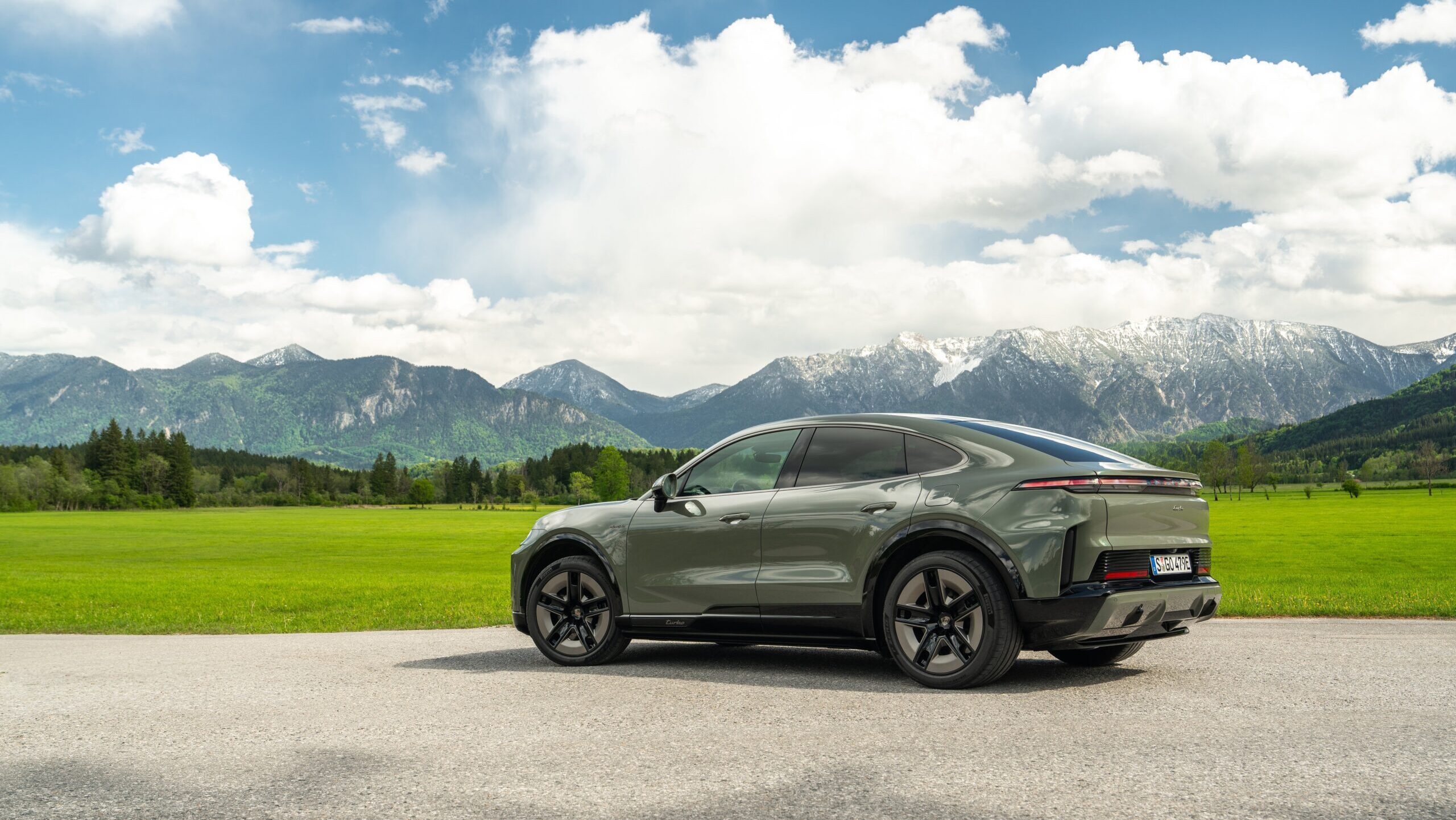
2024 Porsche Taycan
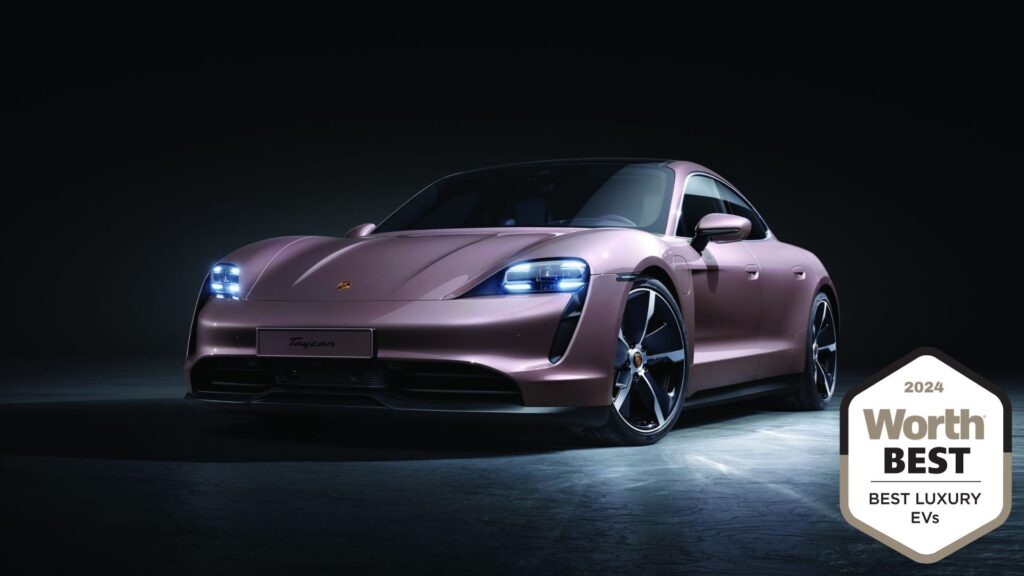
Picture the 4-door Porsche Panamera and then stick an electric motor in it. That’s essentially a Porche Taycan, though you can also get sibling vehicles as a station wagon-y-slash-SUV-type chassis, called the Cross or Sport Turismo.
The Taycan’s EV system uses a two-motor design—one for the front and another for the rear wheels—a design platform it shares with the Audi e-tron GT. That’s based on a 93.4 kWh capacity battery that can push over 500 horses if you’re driving the Taycan S, but that can jump up to 670 and even 750 if you’re driving the Turbo or Turbo S, respectively. Those higher-end Taycans will also get you to the 60 mph mark in around 2.4 seconds, with an expected top end of 155 mph, depending on the exact model. The Taycan Turbo GT, however, outstrips both the Turbo and the Turbo S. Coming in at 1019 horsepower and accelerating to 60 mph 2.1 seconds, it is fastest Taycan model to date.
EV range is a little disappointing, coming in at only 246 miles. However, charging times were pretty good. The onboard 9.6 kW AC charger will get you to full bars in 9.5 hours, while optimal 270 kW public charging stations should get you to 80% in around 22 minutes.
Step back from the powertrain, and the Taycan is all you’d expect from a Porsche. The interior is plush and has all the technology features you want, and then some. The virtual cockpit behind the steering while is about 16 inches wide, bolstered by two center console screens.

The top screen measures 10.9 inches and handles all your driving and telemetry functions. The one below is smaller at 8.3 inches and handles mainly climate and infotainment features, based on the Android Auto operating system, with Apple CarPlay built on top. Those entertainment and climate features are mirrored in yet another display dedicated to the front passenger and two more optional 5.9-inch screens in your headrests, so the folks in the back don’t feel left out.
You’ll find the usual driver assist features, like lane and braking assist, on the safety front. But you’ll also get some standouts, like night vision and remote-control parking.
Bottom line: not to trivialize it, but this is a Porsche. Which is great. Everything you want in one, including the performance, just with a humming EV motor, not the usual petrol-fueled roar.
Maserati GT Folgore
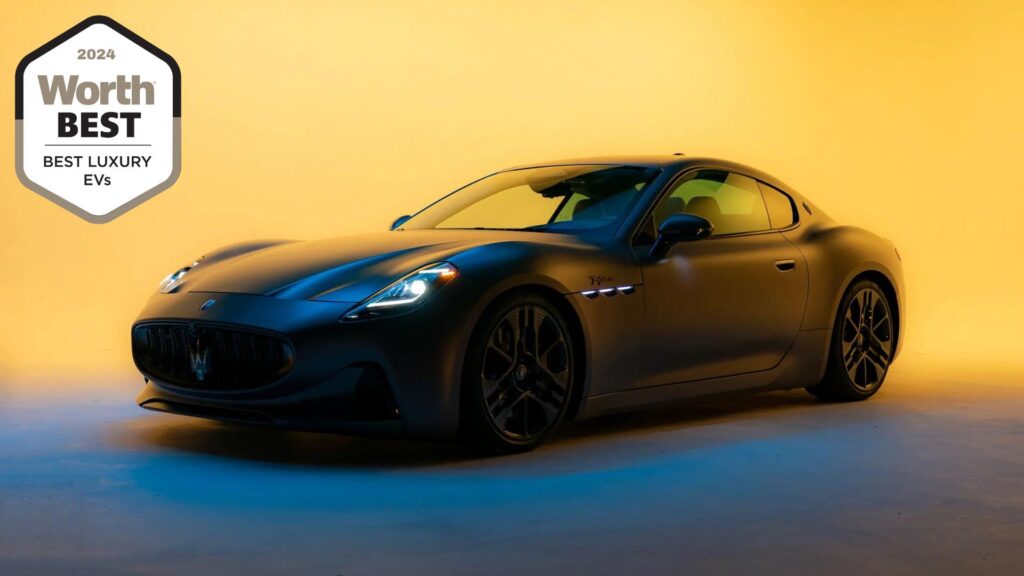
We recently spoke with Maserati’s U.S. CEO, Bill Peffer, who made several significant promises regarding Maserati’s GT product line and the company’s vision around all-electric vehicles. We’re happy that the GranTurismo Folgore is making good on those claims.
Even though Peffer downplayed how important EV specs might be to the average Maserati customer, the company has nevertheless put quite a bit of engineering emphasis into that aspect of the car. The Folgore EV powertrain is designed around a custom 800-volt platform that drives three e-motors, one in front and two in the back. The battery is produced in conjunction with Mirafiori and has a capacity of 92.5 kWh. That adds up to 818 horsepower, a 279-mile range (450 km), and a top speed of 201 mph.

Once you start running out of juice, Folgore’s charging stats will look pretty good, though not quite the best we saw on this list. At its optimal 270 kW rate, the car will add 62 miles of range (100km) every five minutes. You’ll get an 80% recharge at public charging stations in 18 minutes.
On the luxury side, peek your head in the cabin, and you’ll find it’s just as slick as the gorgeous exterior. All the expected climate, seat, and entertainment controls are there, and even better for the sustainability-conscious, it uses materials that Maserati says are taken from recycled fishing nets.
Maserati has dropped in Amazon’s Alexa digital assistant, as well as primary telemetry data you can see through a mobile app and a custom location feature in case the car gets stolen.
Mercedes-Maybach EQS SUV

The Mercedes-Maybach EQS SUV represents a significant step forward in electric luxury vehicles, blending advanced technology with the brand’s signature focus on comfort and refinement. Its exterior, highlighted by the iconic Maybach grille and subtle chrome accents, conveys understated elegance.
Inside, the EQS SUV offers a serene and meticulously crafted cabin. High-quality materials like Nappa leather and customizable ambient lighting enhance the experience. Rear passengers, particularly those opting for the Executive Rear Seat Package Plus, enjoy a level of comfort rivaling executive jets. Twin rear seats feature massaging calf rests, folding tables, and cupholders that warm and cool. For an added touch of luxury, a champagne chiller is included, complete with bespoke silver flutes.
The MBUX Hyperscreen, a large digital interface that spans the dashboard, provides intuitive access to controls and information, complementing the minimalist design. On the road, the fully electric EQS SUV delivers a smooth, quiet ride with a commendable range, prioritizing efficiency and a relaxed driving experience over high-speed performance.
The Mercedes-Maybach EQS SUV is less about making a grand statement and more about delivering a well-rounded, luxurious driving experience, perfectly aligned with the expectations of modern, discerning clientele.
Mercedes-AMG EQS

The 2024 Mercedes-AMG EQS Sedan redefines luxury EV performance with its bold combination of cutting-edge technology, remarkable speed, and quintessential Mercedes refinement. Unlike the traditional sedans of yesteryear, the AMG EQS offers a zero-emission ride that doesn’t compromise on power or comfort.
At the heart of the EQS is a potent electric drivetrain that produces an astonishing 751 horsepower and 752 lb-ft of torque, allowing it to sprint from 0 to 60 mph in just 3.4 seconds. The all-wheel-drive system ensures that all this power is delivered smoothly and efficiently, regardless of road conditions. With a range of up to 350 miles on a single charge, you’ll be able to travel long distances without frequent stops, and its 200 kW DC fast-charging capability means you can recharge quickly when you need to.
Inside, the AMG EQS is a sanctuary of luxury. The cabin is dominated by the massive 56-inch Hyperscreen, which stretches across the entire dashboard, providing a seamless interface for all your driving and infotainment needs. High-quality materials and meticulous craftsmanship make every journey an experience in comfort and elegance. Whether you’re cruising through the city or taking a long road trip, the AMG EQS promises a ride that is as exhilarating as it is serene.
Rolls Royce Spectre

I was looking for one word to describe the Rolls Royce Spectre, but all I could say was, “oooh.” Nothing impresses more than a Rolls, and the Spectre is no exception to that rule.
On the EV side, the Spectre is powered by a 102 kWh battery with a good, Rolls-tested range of 329 miles. Its charging capacity is limited to 195 kW for DC fast charging. That will get you from 10% to 80% in around 34 minutes. The Spectre’s 22kW AC charger will get you to a full charge in a surprisingly quick 5 hours and 30 minutes, at least according to Rolls Royce.
What that EV data translates to when it comes to performance is 584 horsepower, a 0-60 time of 4.4 seconds, and a top speed of 155 mph.

What does that cradle look like? Let’s just take the doors as an example. Rolls Royce says these doors are laser-welded onto the car and describes them as pillarless coach doors. They have power assist to help you open them and a door brake to help you close them again. They even have sensors, so they open the same regardless of whether you’re parked flat or on a hill. That’s just the doors.
It’s difficult to fit the rest into a space this small. I mean, these guys spent over 830 hours designing the hood ornament! Your interior light isn’t a bulb; it’s 4,796 soft LEDs that Rolls calls “stars.” Your frame is based on a proprietary design Rolls calls the Architecture of Luxury. While that sounds a little much, it’s pretty innovative, being constructed entirely out of aluminum, with flexible structure points that Rolls Royce can adjust as needed.
2024 Rimac Nevera

We’re back in supercar territory with this one—oops, I mean hypercar. We’re also pretty far across the pond, as this puppy comes from Zagreb, Croatia, not that it has any impact on oomph. Floor the pedal on this one, and you will go hyper, since it’s pushing just over 1,900 horses on its all-electric drivetrain.
That drivetrain is based on a liquid-cooled 120 kWh battery that powers four motors, one at each wheel. That gives a decent 340-mile range, and as long as your charging station supports 500 kW, you’ll get to 80% capacity in around 19 minutes.
But those are the EV nerd numbers. The hair-raising performance numbers include 1,914 horsepower, a top end of 258 miles per hour, and a zero-to-sixty warp speed of 1.85 seconds.
But those performance numbers don’t tell the whole story, not by a long shot, as the car is designed from the ground up to milk every possible drop of performance value. For example, the whole body is adjustable. The front hood, the rear wing, and even the undercarriage can all move independently in response to changing driving conditions. A sophisticated algorithm will do that automatically, or you can add your own two cents by messing with advanced settings, like adjustable downforce or different drag coefficients.
Even better, you can have the Nevera nag you, too. Yup, this car includes an AI Driver Coach. By leveraging 12 ultrasonic sensors, 13 cameras, six radars, and the Nvidia Pegasus operating system, Nevera’s driving coach will analyze your performance and give you pointers. You can overlay the driving coach over specific racing tracks, and it’ll give you audio and visual cues on the right lines to take through corners as well as your optimal acceleration and braking points.
Rimac also stresses the Nevera’s creature comforts, though it prefaces this by saying the car will easily accommodate two riders in full racing gear. But, while it’s probably not as comfy as a Mercedes EQS, it’s still highly customizable. Three digital screens let you set up the Nevera’s controls whenever you need them.
At an estimated starting price of $2.2 million, this isn’t a daily driver. But if you’re looking for the bleeding edge of EV super—er, hypercars, then this is your baby. But you better grab it soon because, just like the other super/hypercars here, it’s a limited production run, with the Nevera’s ending at just 150 units.