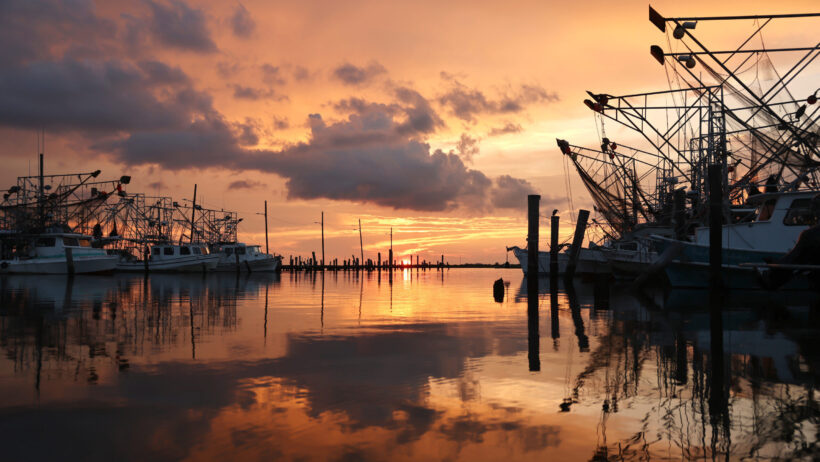
“I’ve never seen it this bad.” Eddie LeJuine has been fishing and shrimping along the southwestern coast of Louisiana for about four decades. The garrulous 62-year-old can talk for hours about the best fishing spots and the quiet moments at dusk when the ospreys glide through the marshes. He’s raised a family in Cameron Parish, the heel of the boot, as the state is known, with five kids and 10 grandchildren, one of whom just joined the local sheriff’s office.
But his life and livelihood have been upended in recent years by the proliferation of liquefied natural gas (LNG) terminals in the region—once the largest producer of seafood in the entire country. The LNG activity has devastated the environment and polluted the water, leading to significant declines in catches for fishermen.

“They’ve ruined so much of our fishing grounds,” LeJuine told Capital & Main, noting that a dredging accident in early August by a gas company preparing for the new CP2 LNG facility buried crab traps and oyster beds. He’s seen his income from fishing and shrimping plummet to a quarter of what he was earning in 2019—from $175,000 before expenses down to about $40,000 before expenses.
LeJuine has also been hit by skyrocketing property insurance rates due to the increasing severity of climate change-related disasters like hurricanes and coastal flooding. Louisiana is one of the most expensive states for property insurance, with many insurers withdrawing from the market due to massive losses. LeJuine said his homeowners insurance premium more than tripled in just three years, from $5,800 in 2021 to $19,000 in 2024.

“I can’t afford it. This past year was the first year that I didn’t have insurance, and I’ve lived here since 1985,” he said. The only thing keeping him and his wife from moving back to her home state of Virginia is the desire to stay close to their grandkids, LeJuine added.
The perfect storm of climate change, expanding oil and gas production, and costly homeowners insurance is devastating residents of coastal Louisiana, as well as many other states from Florida and North Carolina to California and Arizona. They’re inextricably linked, creating a vicious cycle—the insurance industry invests heavily in the fossil fuel industry, which contributes significantly to climate change, causing a spike in insurance rates for residents living in the many risk-prone regions of the country.
The insurance company that LeJuine says hiked his rates, Louisiana Farm Bureau Insurance, is an affiliate of the Louisiana Farm Bureau Federation, which is a member of the American Farm Bureau Federation. Some affiliates of the American Farm Bureau invested more than $800 million in the oil and gas industry through 2024, according to a database compiled by Urgewald, a German environmental and human rights nonprofit. The American Farm Bureau has long questioned the science of climate change and actively opposed climate action, such as federal regulation of greenhouse gases and international agreements like the Kyoto Protocol, an international agreement that commits countries to reduce greenhouse gases.
“For decades, the Farm Bureau has derailed climate action, deploying its political apparatus and 6 million members in a forceful alliance with conservative groups and the fossil fuel industry,” noted Inside Climate News in 2018.

A spokesperson for the American Farm Bureau Federation did not comment on its position on climate change, but emphasized that the federation “is independent and legally separate from the insurance company with separate governing boards and staff. We are a nonprofit, grassroots membership organization. Our members are the 50 state Farm Bureaus plus Puerto Rico Farm Bureau.”
A spokesperson for the Louisiana Farm Bureau did not return a request for comment.
Investing in the Cause of the Problem
Though many property and casualty insurers have reduced their investments in oil, gas and coal over the last decade, insurance giants remain among the largest financiers of fossil fuels. U.S. insurers held $536 billion in fossil fuel-related assets in 2019, according to a report by sustainability consulting firm ERM and advocacy group Ceres.
The trend has only accelerated. In 2023, fossil fuel companies made up 4.4% of the investment portfolio of the insurance industry—an increase from 3.8% nine years earlier, per the Wall Street Journal. Major insurers are still investing heavily in fossil fuel companies—in 2024, Berkshire Hathaway had almost $96 billion in fossil fuel investments, State Farm had more than $20 billion, Allianz had more than $26 billion and Chubb had nearly $900 million, according to the Investing in Climate Chaos database maintained by German nonprofit Urgewald.
It’s deeply frustrating to residents who’ve been impacted and wish the insurance industry took steps to stop this vicious cycle.
“They’re investing in the cause of the problem,” said one of LeJuine’s neighbors, James Hiatt, a former oil industry worker and the founder of nonprofit For a Better Bayou. He said that his homeowners insurance has jumped 50%-60% in the last few years.
He’s hardly alone. Home insurance rates have spiked more than 40% across the U.S. in the last six years, according to a LendingTree analysis. And a majority of Americans are connecting the financial squeeze caused by soaring premiums to extreme climate disasters, according to the “Climate Change in the American Mind” survey by Yale’s School of the Environment in May 2025. About half of those surveyed think global warming contributes to increasing homeowners insurance costs.
Hiatt noted that major insurers also underwrite the liquefied natural gas projects in the region, which require coverage for a vast array of potential problems, from environmental pollution to equipment failure. At least 35 insurance companies—such as American International Group, AXA, Allianz, Chubb, Liberty Mutual, Lloyd’s of London, SCOR and Sompo—are among the insurers of the LNG terminals, according to a report by Public Citizen, Insure Our Future and the Rainforest Action Network. In the face of pressure from activists, some insurers have sought to shield their names from public disclosure, but the nonprofits filed more than 50 Freedom of Information Act requests to obtain the certificates of insurance for projects that are filed with local authorities.

“Insurance companies are supposed to protect us from catastrophic risks,” the report’s authors wrote. “Yet when it comes to climate change, insurers perpetuate climate chaos and dependence on fossil fuels by insuring new coal, oil, and gas projects while raising premiums and abandoning communities that are hit by worsening and repeat climate disasters.”
In the face of international pressure, Chubb stopped providing property insurance this spring for the Calcasieu Pass project owned by LNG company Venture Global in LeJuine’s home of Cameron Parish. But it continues to provide coverage to the industry—its ACE subsidiary provides a liability insurance policy to the nearby Lake Charles LNG, owned by Energy Transfer, reports Inside Climate News.
The insurance industry is well aware of the climate crisis—its use of climate scenario analysis increased 28% in 2023, with 148 insurance groups incorporating the model, which helps financial institutions understand and prepare for the possible risks of climate change. Last year, 27 weather disasters caused $182.7 billion in damage in the U.S. And that has contributed to a growing affordability crisis: An estimated 7.4% of homeowners now go without insurance, putting $1.6 trillion in assets at risk.
Insurers have touted their sustainability practices and their adoption of green policies, pledging to reduce or eliminate their exposure to coal and other fossil fuel projects as part of their net-zero commitments. But many continue to underwrite liquefied natural gas projects in the Gulf of Mexico, as well as pipelines in Africa and drilling in the Arctic.

Overall, Chubb earned an estimated $750 million in fossil fuel premiums through underwriting oil and gas projects, per a new report by global nonprofit Insure Our Future. “Despite recognising that fossil fuels are driving climate risks to new extremes, the industry’s ongoing underwriting of LNG expansion continues to pose long-term risks to profitability across other lines of business and exacerbates correlated systemic climate risk for reinsurers,” noted the authors of the report.
Spokespersons for Chubb, State Farm, the American Farm Bureau and Berkshire Hathaway did not respond to several requests for comment.
A representative for Allianz sent a summary of its policies and a statement to Capital & Main:
“They consider a wide range of sustainability factors as part of their investment and risk management processes, including but not limited to climate change, biodiversity, human rights. Risks arising from an untenable situation can occur in the short, medium, or long term, therefore sustainability factors are part of a robust investment process. Furthermore, Allianz Global Investors has exclusion policies on coal, and exercises voting rights to influence companies to adapt their business models and make the transition to a low-carbon energy supply.”
‘They Hit the Ground Running’
Cameron Parish sits squarely in the midst of the nation’s liquefied natural gas buildout, which is largely on the Gulf Coast. Last year, the Biden administration paused approvals for new liquefied natural gas export terminals, but one of President Donald Trump’s first actions upon taking office in January was an order to restart those reviews.

Nine months into his second term, Trump is pushing ahead on at least six projects that had been awaiting crucial federal approvals. Along the Gulf Coast in Texas and Louisiana, six terminals are operating, six are under construction and another six are proposed, reports The Guardian. In total, the amount of liquefied natural gas exported—last year it was 11.9 billion cubic feet per day—is expected to double by 2028.
“As soon as they got the green light, they hit the ground running, and it’s been quick and dirty,” said Alyssa Portaro, an environmentalist whose nonprofit group Habitat Recovery Project is active in Cameron Parish. “The impact on the environment has been devastating.”
She said that a proposed 42-inch-thick pipeline feeding natural gas to the export terminals on the coast would run through her farm in Vinton, just north of Cameron Parish, and “dramatically decrease my home value” and raise her insurance premiums.
Venture Global’s LNG plant Calcasieu Pass, on the waterway of the same name, sits directly across from Commonwealth LNG. Another energy company, Cameron LNG, operates just north of Venture Global, and two other projects, Woodside’s Louisiana LNG and Energy Transfer’s Lake Charles LNG, are planned at the northern ends of the waterway.

Though liquefied natural gas has largely replaced coal as an energy source, its greenhouse gas footprint is 33% worse when processing and shipping are taken into account, according to a study by Cornell University researchers. Liquefied natural gas is primarily made up of methane, which is 80 times more potent than carbon dioxide over the first 20 years and 30 times worse over the span of a century when it comes to trapping heat, significantly contributing to global warming.
The insurance industry says its investments in the fossil fuel industry are key to overall financial stability and to help finance the energy transition. They also highlight their push to make homes more resilient to climate change, promoting risk mitigation and preventative efforts by homeowners.
“There has been a tremendous focus paid, probably more than in any other industry, to climate change and to the effects of climate change,” said Matthew Gabin, general counsel at NormanMax Insurance Solutions.
Critics say that insurers are focused on the profits they make from their investments in the fossil fuel industry, more so than on managing and reducing climate risk.
“The higher the premiums go due to climate risks, the more they have available to invest and the higher their investment profits,” said Carly Fabian, policy advocate for Public Citizen’s Climate Program. “And their investment profits far outweigh what they’re earning from collecting premiums and paying claims. So over time, there’s a perverse incentive—to actually let premiums go up, collect more, invest more, profit more.”