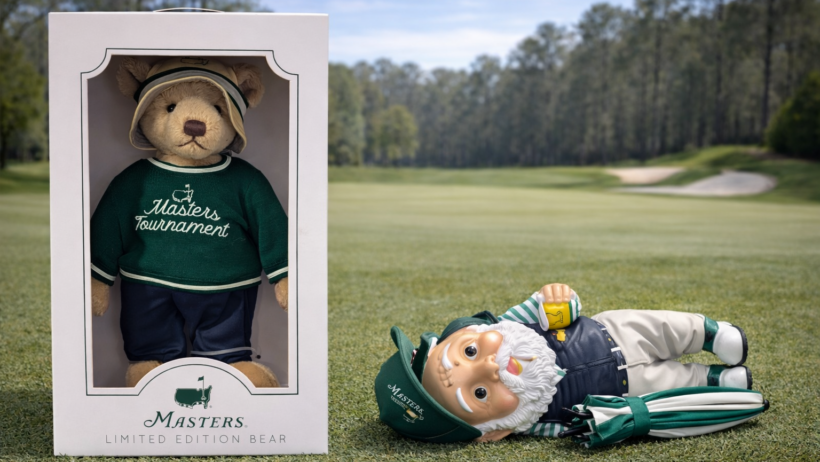
The Masters Gnome might be famous, but the Masters Teddy Bear is legendary.
The Gnome has become part of the Masters ritual where fans know to line up before dawn and sprint to the merchandise shop when the gates open. They know the ceramic figure that retails for $60 can quickly command many times that on the secondary market. It is embedded in the annual culture of Augusta.
The Teddy Bear operates differently. It is not stacked in plain sight, it does not greet patrons from a display table, and there are no obvious towers of boxes. In many cases, there is not even confirmation it exists, you have to find the right associate and hope they have the right information.

At an event built on prestige, exclusivity, and carefully controlled access, the Masters Teddy Bear may be the purest expression of all three.
While thousands of Gnomes are produced, only 500 Teddy Bears are made. The numbers alone reshape the hierarchy. The Gnome may get the headlines, but the bear is the insider’s prize. The thing people miss because they do not know it is there until it is not.
Our group had arrived with a mission centered on the Gnome. The Teddy Bear had only entered the conversation the day before, mentioned in the tone reserved for secret menu items or rare bottles hidden behind a restaurant bar.
After a 4:30 a.m. wake-up call and a strategic arrival at the South Gate, we were inside shortly after the 7:00 a.m. opening. By 7:05 a.m., we had secured our Gnome.
But in the Masters merchandise economy, success is temporary. The next chase began immediately, we started asking about the Teddy Bear.

One associate directed us elsewhere, another seemed unsure, a third sent us deeper into the store. Eventually, we were pointed toward the back, where the conversation shifted from retail transaction to treasure hunt.
There, an associate delivered the kind of answer that usually ends the story. “We haven’t gotten any” he said “I’m not sure when and if we will.”
For most shoppers, that would have been enough. But scarcity changes behavior, it creates patience where there normally would be none. It encourages irrational optimism and makes adults stand around the back of a store waiting for a stuffed animal with the focus of traders watching a market open.
Ten minutes later, the same associate looked up and subtly motioned us back to the counter, then came the reveal. From behind the counter, he pulled out a boxed Masters Teddy Bear. Displayed proudly on the back of the box is its Certificate of Authenticity with its individual production number.

The retail price was $250, significantly above the $60 Gnome. Yet price becomes relative when supply is nearly nonexistent. By the time many patrons learn the bear exists, resale listings are already pushing $1,000 or more.
That premium says as much about human psychology as it does about collectibles.
The Teddy Bear is not simply expensive because it is plush or packaged. It is valuable because it is hidden, finite, and difficult to obtain. It rewards information, timing, and persistence. In modern markets, whether for watches, sneakers, sports cards, or rare wine, those are the same ingredients that drive demand.
The Masters just happens to apply them to merchandise with uncommon precision.
Unlike most major sporting events, Augusta National does not flood e-commerce channels and it does not make every product endlessly available online. Merchandise remains tied to presence, you must enter the grounds, you must navigate the process, and even then, there are no promises.

That limitation transforms ordinary items into artifacts of experience. A hat is not just a hat if it came from your first Masters. And a Teddy Bear is not just a Teddy Bear if it requires pre-dawn planning, gate strategy, store intelligence, multiple inquiries, and a discreet handoff from behind the counter.
That may be why Masters merchandise resonates beyond traditional collectors. It appeals not only to golf fans, but to anyone who understands the emotional value of earned access. The Teddy Bear and the Gnome, captures that dynamic.
The Gnome is now famous enough that almost everyone knows the playbook; Show up early enough and you’re likely to get one.
The Teddy Bear still lives in a more interesting space. It remains partially hidden, knowledge is fragmented, availability is uncertain, and acquisition feels personal, almost conspiratorial.

In an era when nearly anything can be purchased instantly online, that kind of friction is rare. And rarity, when paired with desire, becomes powerful. There is also something wonderfully funny about the whole enterprise.
The Masters is a cathedral of golf with its green jackets, ceremonial tradition, and some of the most iconic moments in sports. Yet every April, serious adults with jobs, responsibilities, and functioning judgment systems become laser-focused on locating a numbered teddy bear before breakfast.
Beneath the prestige and polish, the Masters still understands that anticipation, the hunt, and the stories matter.
But the real value will be remembering what it took to get it. The early alarm, the fast walk through the gates, the dead-end answers, the decision to wait, the subtle wave back to the counter, and the moment a hidden box appeared from behind the curtain.
The Gnome may be the current celebrity, but I think the Teddy Bear is the crown jewel.