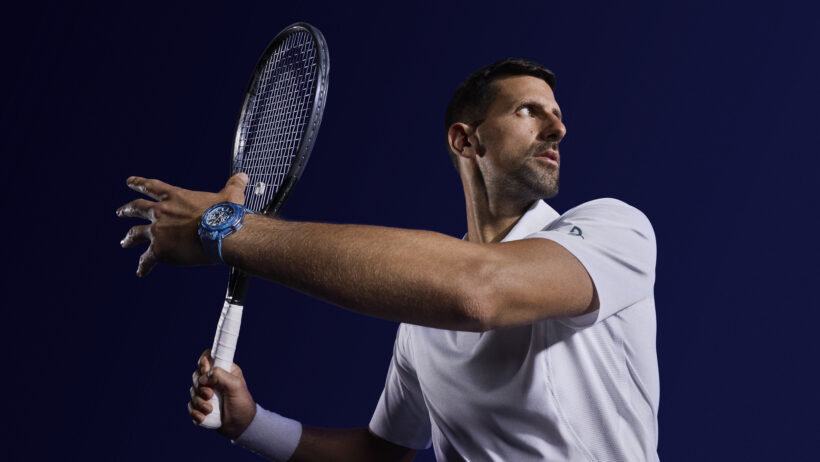
The term GOAT (greatest of all time) is thrown around a lot these days, but when it comes to Novak Djokovic and the world of tennis, the sentiment reigns true. He holds the men’s all-time record of 24 Grand Slam singles titles, the most major final appearances in tennis history at 38, and a record 428 weeks as the world number one tennis player. He has also ended the year as world number one a record eight times. Outside the regular season tournaments, he’s even notched a gold medal at the 2024 Paris Olympics and a bronze medal at the 2008 Beijing Olympics. No one else comes close.
We know that precise and accurate timekeeping is an important part of any sport, including tennis. Rolex started out as the official timekeeper at Wimbledon in 1978 and since 2019 has served as the official timekeeper of all four Grand Slam tournaments. Omega has an even longer-standing history with the Olympic Games, working as the official timekeeper since 1932. The shot clock and the measure of changeovers and set breaks are one thing, but actually wearing a watch on the court is an entirely different ballgame (pun intended). Both modes of timekeeping are equally complex and impressive in their own right. For instance, shot clocks have evolved from simple manual stopwatches to intricate systems tied to electric line calling and acoustic sensors. Similarly, wristwatches have transcended from a basic accessory, complimenting the ever-fashionable tennis uniform, to a tool optimized to withstand the shocks and G-forces during play. This was the impetus for Djokovic to join Hublot as a brand ambassador in 2021.


Brand sponsorship is a big part of the tennis ecosystem, and this extends down to the players—the racquets, bags, clothes, shoes, and accessories from visors to jewelry all present an opportunity to take center stage on the court. Personal style is a core part of the sport, whether it’s centralized around ritual, superstition, and good luck or simply self-expression and shared ethos. Djokovic has always had a unique and distinct sense of style, opting for apparel from Lacoste, footwear from Asics, and gear from Head. His watch brand of choice is equally interesting. Hublot is not your typical luxury watchmaker. It doesn’t fit the standard tennis aesthetic. It’s sporty, sure, but certainly not preppy, buttoned up, or timeless. Hublot has been a disruptor in the industry since its founding in the 1980s, being one of the first brands to use rubber for the strap paired with a precious metal case in gold—a combination that’s set the tone for luxury sport watches today. Material innovation has remained at the core of Hublot’s designs ever since, spanning into work with other mediums like ceramic, carbon fiber, and titanium as well as its own proprietary materials like Magic Gold.
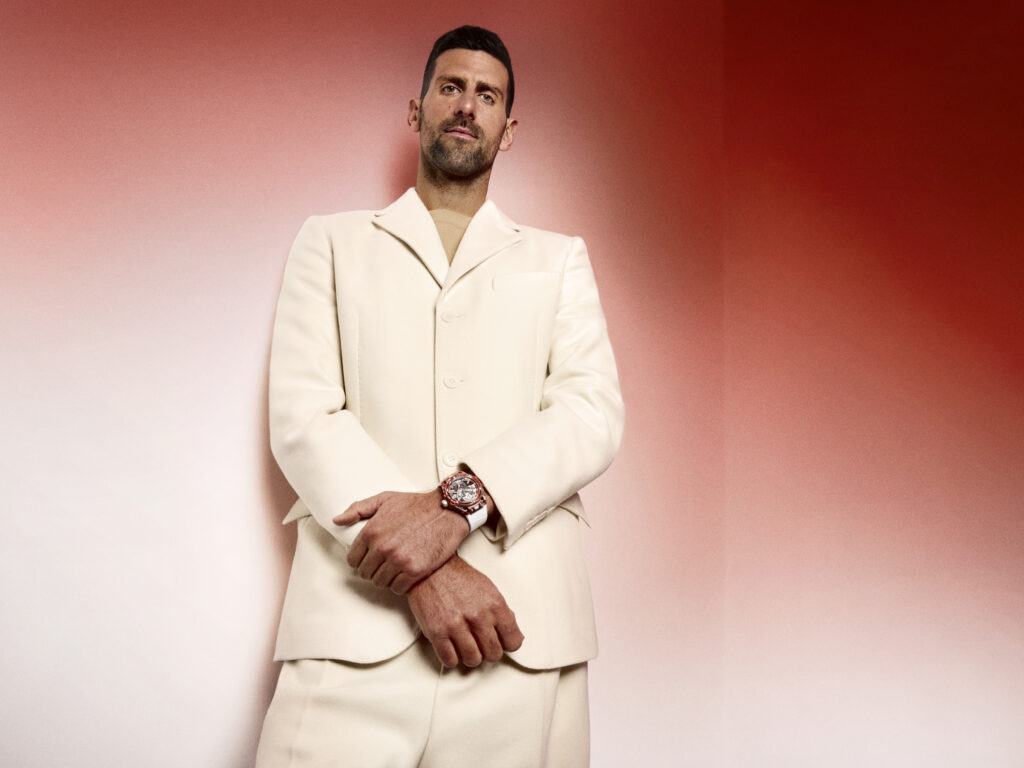
The synergy between Djokovic and Hublot extended beyond personal style and brand alignment—it came from a mutual passion for precision, pushing boundaries, and challenging what is possible. “When we started talking about creating a watch together, we agreed it would not simply be a luxury piece. This would be a watch that could survive the intensity of the court,” shares Djokovic. “When you are playing, you don’t want to think about the equipment. You want it to become part of you. That is how I saw the watch I wanted to create—one that feels less like a traditional timepiece and more like an extension of your body.” It takes time to bring a watch to life, particularly when very specific technical and aesthetic parameters are involved. The pair’s first co-created design was three years in the making. “I think what I respected most was the patience in developing these timepieces,” Djokovic emphasizes. “In tennis, you are always looking for very small improvements. Sometimes it is one millimeter on the racquet, a small change in your technique, your movement, your recovery. You can spend a lot of time working on something that nobody watching from the outside will even notice. I saw something very similar with the watchmakers at Hublot,” confirms Djokovic. “They are working on these incredibly small details, and they must be right. There is no shortcut.”
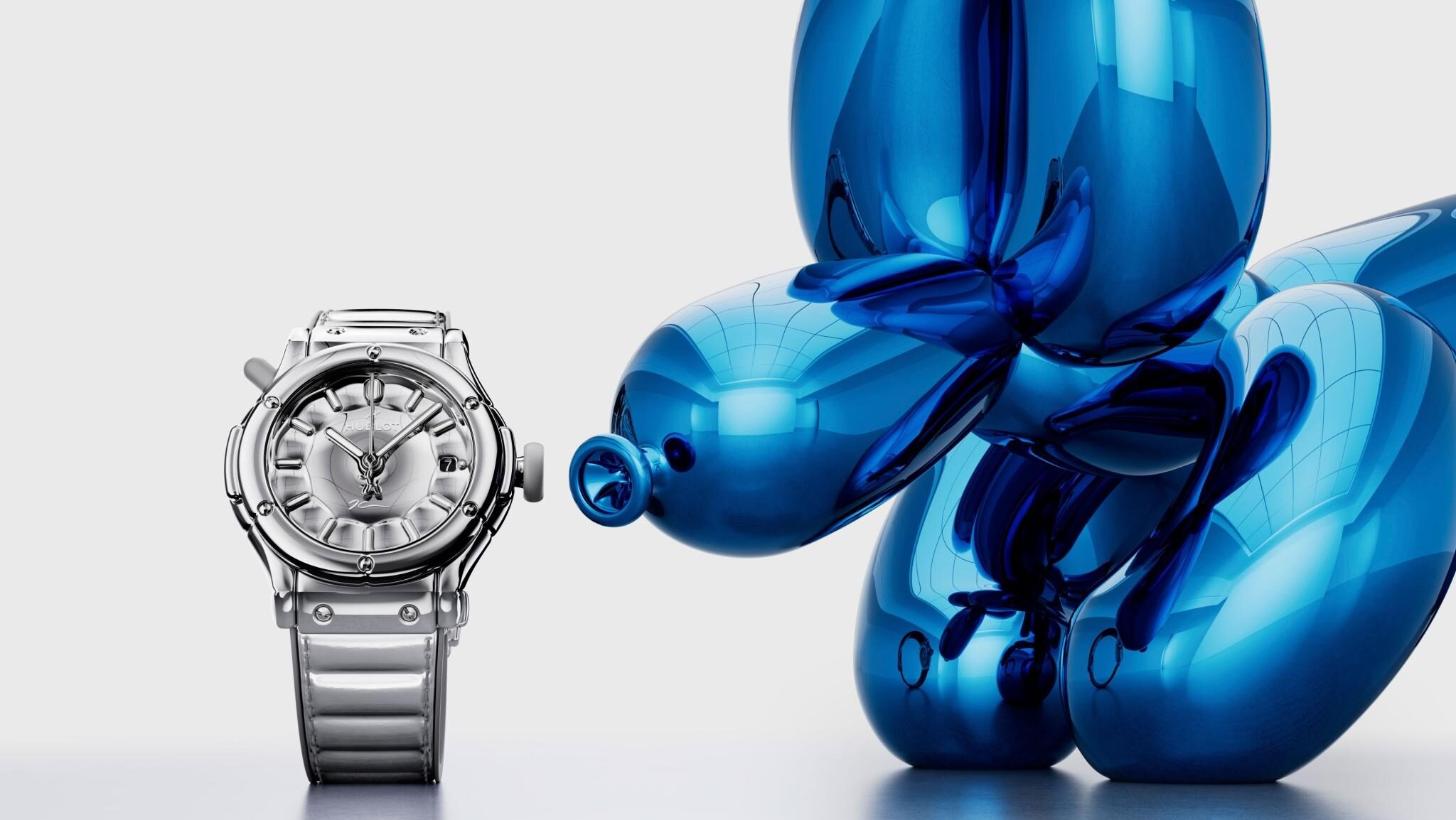
The result of this hard work was the brand’s first collaboration, the Big Bang Unico Novak Djokovic. The model combines Hublot’s expertise in material science with actual materials from Djokovic’s racquets and apparel. “For the first collaboration, the idea of using my racquets and polo shirts was so special to me,” Djokovic confesses. “These are things that were part of my journey, part of the matches and the tournaments, so giving them another life inside the watch makes it much more meaningful.” To achieve the design, Hublot started with 25 Head racquets as well as 17 dark blue and 15 light blue Lacoste polos used by Djokovic during his 2023 season, the year in which the world witnessed the player make history and break records with 24 Grand Slam singles titles. These recycled racquets and shirts were fused with the composite that makes up the case and bezel of the watch, which is made of Epoxy resin reinforced with quartz powder and glass veil. The resulting material is speckled with fragments of light and dark blue textiles and black carbon. “When you see the blue color, the pattern, and the texture, it’s not just a design,” clarifies Djokovic. “There are pieces of my equipment from that period of my career inside the watch. I find that very cool because you can make a beautiful watch, but when there is a story behind the material, it becomes something different.”
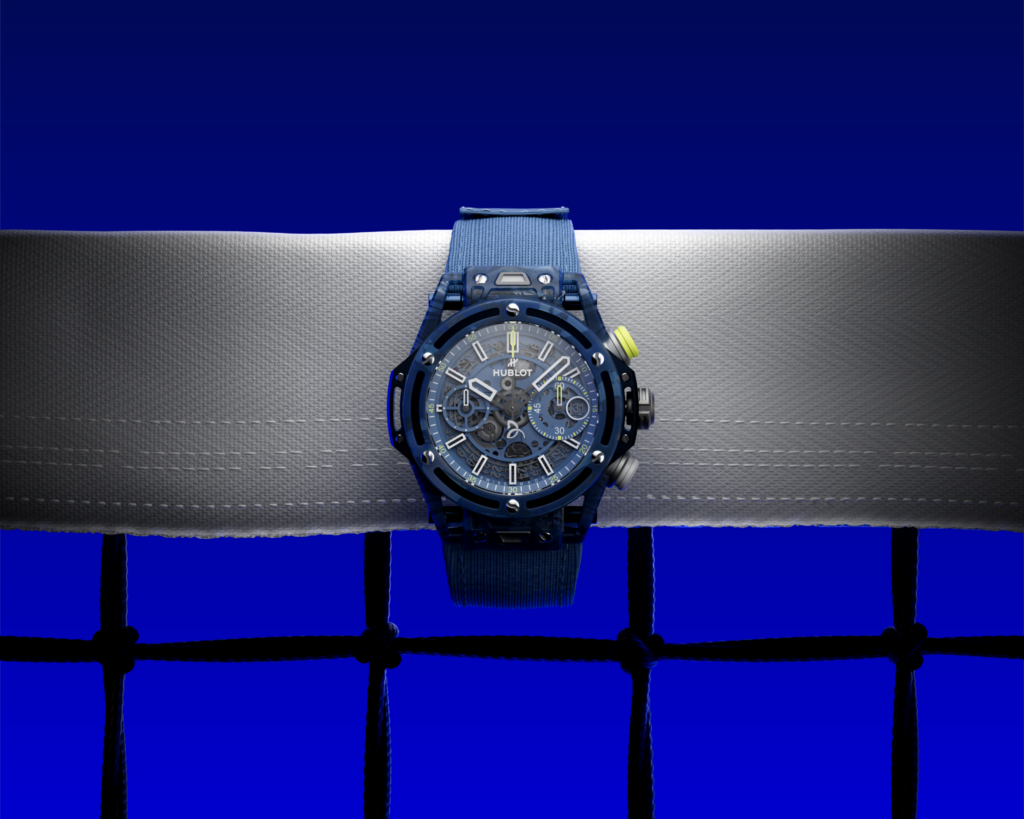
The Big Bang Unico Novak Djokovic is not just visually interesting—it’s performance-driven. “Tennis is very demanding physically, especially on the wrist,” emphasizes Djokovic. “There is a lot of movement, acceleration, and impact. To create a mechanical chronograph that is so light and can still handle that environment is not easy.” To ensure a feather-light feeling on the wrist, Hublot had to find ways to reduce the weight of the watch. Instead of using traditional sapphire crystal, the brand chose a tempered Gorilla glass, a material used in high-end electronics and two times lighter than sapphire. In addition, the standard Unico movement in brass had to be reinvented to reduce weight. Here, Hublot chose aluminum and anodized it in light blue and grey to
echo the color scheme of the case. In doing so, Hublot’s engineers were able to reduce the weight of the movement by 27%, shedding almost a third of its weight. Aluminum has also been used for some case components, such as side pieces, the sub-bezel, bezel lugs, pushers, crown, and caseback. Finally, the model offers four strap styles: a “Lacoste” tennis wristband that attaches to the watch head with the one click system, a light blue Velcro strap with a polished blue aluminum sports buckle, a white rubber strap with a titanium deployant buckle, and a blue elastic strap—this combination weighs a total of 49.5 grams, even lighter than a tennis ball.

This year, the duo followed up by unveiling their second collaboration. “With the Big Bang Tourbillon Novak Djokovic GOAT edition, we wanted to take the story further,” explains Djokovic. “We created three versions inspired by the three different tennis surfaces—blue for hard court, orange for clay and green for grass—and the number of watches reflects my victories on each surface. There are 72 for hard court, 21 for clay, and eight for grass.” Here, many of the same qualities from the first edition carry over, including the case construction made with the proprietary composite made from Lacoste polos and Head tennis racquets. For this series, 12 blue polos, four in orange, and two in green were needed to achieve the required volume of material and colors, as well as 12 racquets. Alongside this is the case’s middle section, which is formed from another advanced material called Titaplast, the world’s strongest polymer. It has high-performance mechanical properties that are similar to titanium, can be machined to very fine tolerances, delivers an exceptional strength-to-weight ratio, and has a soft matte finish. It can also be colored using an anodization process to perfectly match the hues needed to echo the court surfaces.
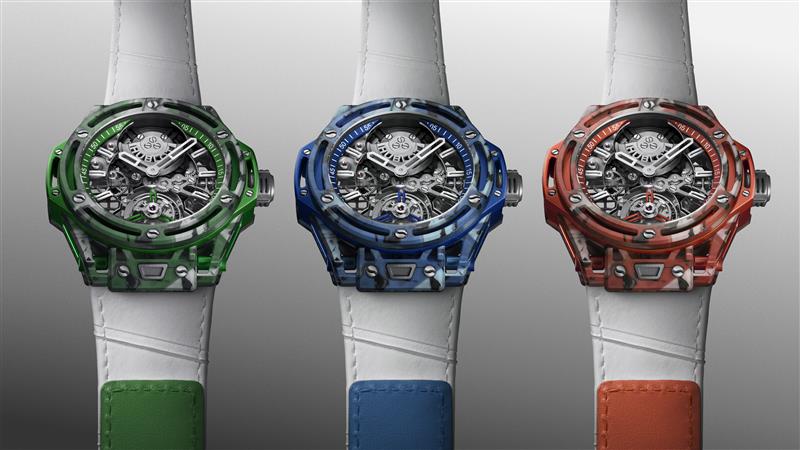
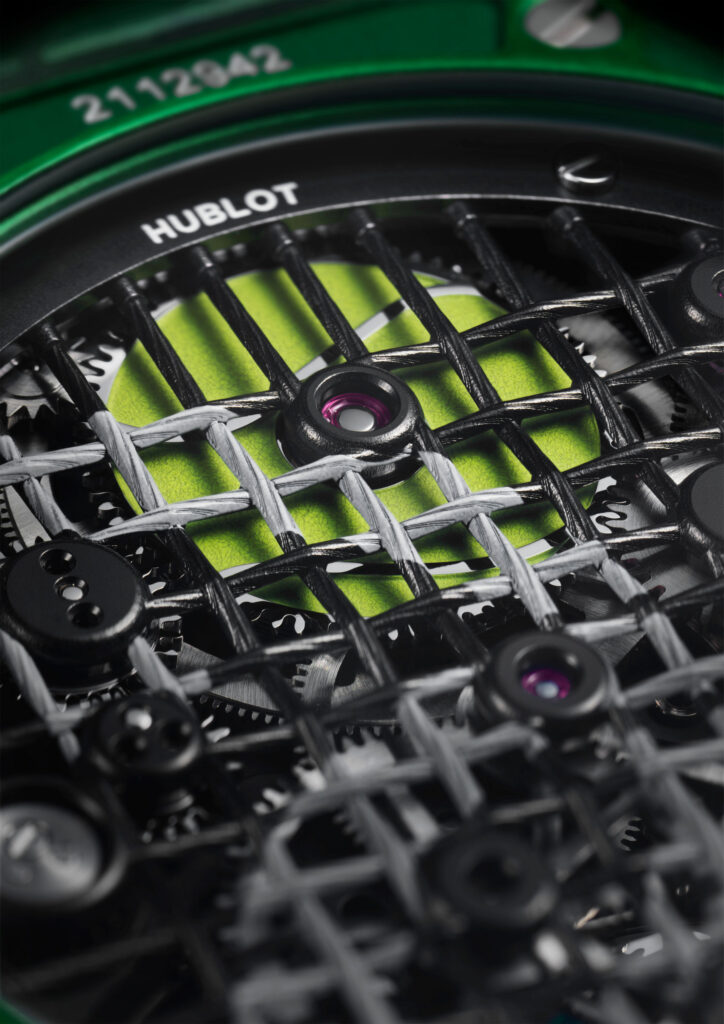
Once again, the innovations extend from the external to the internal. In place of a traditional, solid mainplate to hold the movement components in place, Hublot’s engineers conceived an eye-catching three-dimensional lattice that takes the shape of tennis racquet strings. Each “string” is just 0.55mm thick and appears to be secured into the mainplate edge by attachment points that echo those found around the inner rim of a tennis racquet. While it may appear the mainplate is a series of individually twisted and woven strings held in place by those attachment points, it is in fact a single piece, cleverly machined in a high-tech laser-engraving process. Once it’s laser-engraved, the mainplate is then finished with a black PVD coating with a thickness of just a few microns, before Novak’s famous swooping personal “ND1” logo is printed over it in contrasting white. Together, every element of the model has been designed to
withstand the forces a watch experiences when worn during play, all while weighing only 56 grams.
“As an athlete, you think a lot about how to extend your career and how to stay at a high level for as long as possible. There is a connection there for me,” describes Djokovic. “Whether it is a watchmaker working on a movement or an athlete working on a backhand, the difference is often in the details that nobody else sees. And maybe that is what I appreciate most about this collaboration. It reminds me that mastery doesn’t really have an end-point.”