AI video has reached the point where the demos no longer matter. What matters now is economics.
At Techonomy 2025, I moderated two conversations that arrived at the same conclusion from different directions. One focused on synthetic talent and AI-driven media production. The other examined how enterprises are using AI not to replace workers, but to make sense of overwhelming volumes of information—especially video. Together, they revealed something more consequential than better visuals or faster edits: AI is collapsing production costs, accelerating workflows, and forcing a rethink of who does what in media and creative work.
When the Cost of Video Approaches Zero
Josh Taylor, co-founder and chief production officer of Inception Point AI, came to AI through filmmaking. That matters. Filmmakers understand where the time and money actually go—not into the final shot, but into iteration, revisions, and scale.
Taylor described Inception Point’s growing roster of AI-generated personalities—more than 165 today, with plans to exceed 1,000. “They’re characters, yes,” I said during the session, “but they’re not people.” Taylor agreed. Instead, he explained the work required to make them legible to audiences.

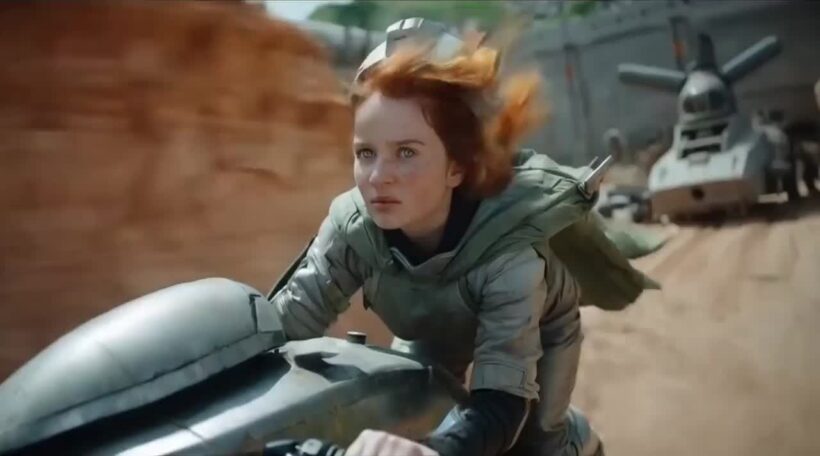
“We build character bibles,” he said. “Back stories, flaws, struggles they’ve had.” The team even laughs about the hardships they invent for these characters, because, as Taylor put it, “it does make it much more relatable.” Want to know what it looks like? Check out Clare Delish, she is smart, cute, and entirely AI.
That relatability isn’t artistic indulgence—it’s a distribution strategy. “It costs us less than a buck to make one of these,” Taylor said. “If 20 people listen to it, we’re all right.”
That single sentence explains why AI video matters economically. When marginal production costs approach zero, the logic of media flips. Content no longer needs mass appeal to be viable. It needs fit the target audience–even if it is just a handful of people
This is already visible in corporate financials. Klarna told Reuters that generative AI helped cut its marketing costs by $10 million annually, and that 37% of its Q1 2024 sales and marketing savings were directly attributable to AI, while slashing image production timelines from six weeks to seven days.
Mondelez has gone further. The Oreo maker told Reuters it expects generative AI tools to reduce content production costs by 30% to 50%, explicitly targeting creative and advertising workflows.
AI Video Is Not a Tool. It’s a Stack.
If cost reduction were simply about a single breakthrough model, the story would be easier. But as Jonathan Yunger, CEO of Arcana, explained during the “AI as an Information Ally” panel, professional media doesn’t work that way. “You need to be working in a multi-model thing,” Yunger said. “Runway is good for one thing, Sora is good for another, VO is good for another.”
Yunger was clear about where AI helps—and where it doesn’t. “We’re about artist-driven AI, not AI-driven art,” he said. “If you have a crappy script, it’s just going to be crap.”
That distinction is echoed in the data. The OECD defines “exposure” to generative AI as jobs where 20% or more of tasks could be done at least 50% faster using these tools—and estimates that roughly one-quarter of workers across OECD countries already fall into that category.
That’s how the stack works in practice. Script drafting, previsualization, rough cuts, captioning, localization, archive search—each task gets faster. Together, they move budgets. Phil Petitpont, CEO and co-founder of Moments Lab, focuses on the least glamorous—and most expensive—part of video production: finding footage. “Seventy percent of the time,” he said, “is just to find the three seconds you need.”
Moments Lab uses AI to search massive video libraries and surface relevant clips in minutes. Petitpont described generating a rough cut in under three minutes by turning a journalist’s brief into an agent-driven search across millions of hours of video. That’s not about replacing editors, according to Pettipont, it’s about eliminating wasted labor. (And anyone who has slogged through a video library looking for clips will probably agree.)
This is where AI does its quietest, most consequential work: it removes friction from workflows that were never meant to scale.
Productivity Gains, Labor Churn
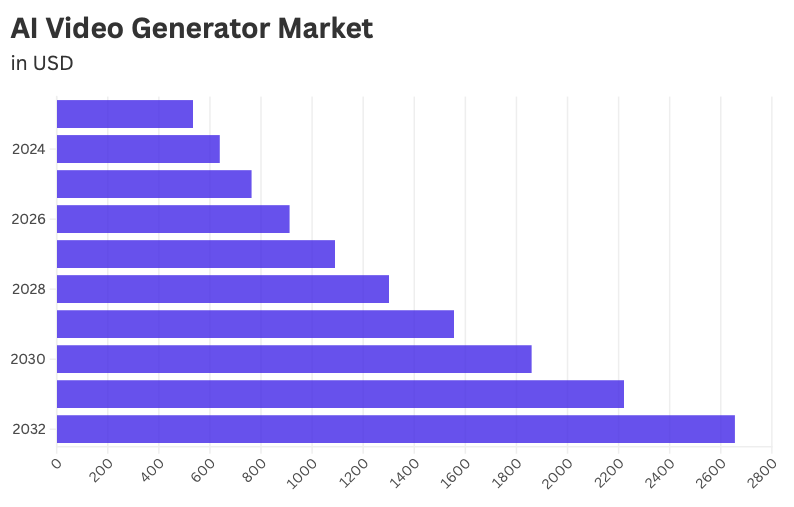
(Fortune Business Insight)
When productivity rises sharply, workforce pressure follows. Not always immediately. Not always cleanly. But inevitably. There seems to be some agreement forming on this.
- McKinsey estimates that generative AI could increase productivity in marketing functions by 5% to 15% of total marketing spend, a category that includes video production, editing, and distribution.
- At the macro level, the IMF estimates that AI will affect about 40% of jobs globally, with advanced economies facing the greatest exposure.
- The World Economic Forum puts sharper numbers on the churn. Its Future of Jobs Report 2025 projects 92 million jobs displaced and 170 million new roles created by 2030—a net gain, but one that requires massive reskilling and role transition
- Goldman Sachs frames the exposure even more starkly, estimating that generative AI could affect the equivalent of 300 million full-time jobs worldwide through task-level automation
In media and creative work, this doesn’t look like a sudden wave of layoffs. It looks like smaller teams doing more. Fewer junior roles dedicated to logging footage or resizing assets. Higher expectations for those who remain.
The human advantage is accountability, not creativity
Across both Techonomy conversations, one theme kept resurfacing: AI systems don’t own outcomes.Not yet anyway.
Taylor was explicit about the limits of synthetic talent. “We want them to be helpers, partners, allies,” he said. “Not in a creepy way.” Transparency matters, especially as regulation catches up. New York recently passed a law requiring advertisers to disclose when AI-generated avatars are used in ads—an early signal that the era of frictionless deployment is ending
AI can generate motion, surface clips, and suggest edits. It cannot decide what a brand should stand behind—or what risk it’s willing to take.
That’s the real story behind the rise of AI video. It isn’t about machines replacing people. It’s about machines reordering the economics of creative work—stripping cost and time out of the system, and forcing organizations to confront which human decisions actually matter.
The future of media production won’t belong to the flashiest model. It will belong to the teams that understand how to build a stack, keep humans in the loop (somehow?), and rides the AI wave without defaulting to AI slop.
Watch the full video here.