 Medical professionals are increasingly embracing mobile apps. They enable patients to track and share their metrics with doctors, and let caregivers monitor treatments and guide patients following surgery or other procedures. Now an app released earlier this year targets the core function of doctors—helping them diagnose and treat diseases.
Doctors have long relied on a host of reference tools—including the weighty Physician’s Desk Reference (PDR), medical journals, and input from colleagues—to help them diagnose and treat patients. And in the Internet age, a range of websites and apps offer what the medical profession calls clinical decision support.
But Andrew Brandeis, a licensed naturopathic doctor working at Care Practice, a small private clinic in San Francisco, concluded that even these new tools weren’t enough. He discovered the information he was getting from his personal mentors in the medical profession often conflicted with what he could access in clinical references on the Web and in books.
“My mentors were making choices based on experience, using treatments that always worked for them,” he says. “But the tools available in reference sources, including Epocrates, a medical app offering drug and disease information, weren’t always keeping up. Many were out of date. These tools don’t change very often, which means their information could be years behind current research. Or it could be information many doctors don’t agree with.”
How could a doctor bridge the gap? Brandeis’ first attempt to address the issue was to create a Dropbox account which over time brought together about 50 physicians who shared ideas about treatments.
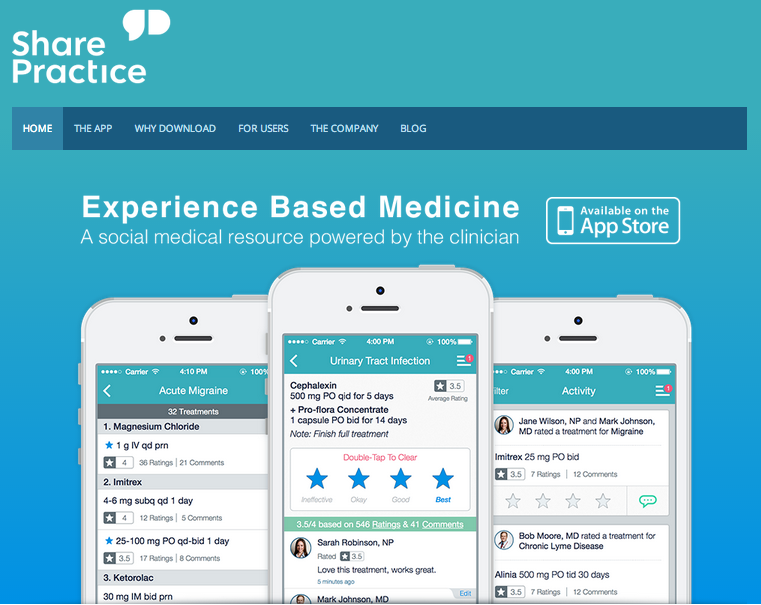
The approach was unwieldy. “What we needed was a Yelp for medicine, easy to use but up-to-date,” says Brandeis. “One that would let doctors rank treatments and comment on them, but which also would allow them to add non-traditional treatments that might not involve drugs. These could be shared with the community, which could give feedback.”
Brandeis and Benoit Carrier—a system administrator, application developer, and project manager in the medical informatics industry—launched SharePractice, a collaborative medicine mobile app for practicing healthcare professionals across a range of disciplines. The app gives them the ability to search thousands of illnesses to find preferred treatments based on the experience of others in the field. For now the mobile smartphone app is free, but Brandeis thinks he can develop it into a business.
SharePractice essentially creates a feedback loop allowing doctors to share content with each other. Unlike apps like Epocrates and UpToDate, which offer clinical data but aren’t social, or HealthTap and doximity, which are social but have no clinically relevant data, SharePractice offers both. “It’s a point-of-care clinical reference with information about 20,000 drugs and 10,000 supplements,” says Brandeis. “Doctors curate the content, putting forth their best ideas.”
It’s become a reliable source of information for treating acute illnesses now that doctors with specialized niches are sharing their techniques and protocols. Brandeis believes acute illnesses too often proceed to chronic and terminal phases because of inadequate or inexact treatment.
SharePractice also allows for open discussion of uncommon treatments—such as using the antioxidant glutathione for Parkinson’s disease patients—and off-label uses for drugs, creating case studies that might spur the FDA to launch studies for the new uses of drugs already on the market.
“It’s all about trust, and evidence-based medicine,” says Brandeis. “This isn’t always available in journal articles, trial outcomes, and drug company studies, which often have certain biases, though many doctors rely on them.”
SharePractice layers experience-based data on top of all that. “Experienced practitioners are essentially downloading their brains via the app, and younger ones benefit. Doctors who are retired after decades of experience, with a vast amount of knowledge, now have a channel to share it,” says Brandeis.
The site has drawn users from around the globe, but it’s primarily focused on the U.S., where it’s easier to verify medical solutions. And because the app isn’t consumer-facing Brandeis doesn’t have to worry about regulators. It is essentially a social site for doctors, who use it voluntarily. If SharePractice continues to catch on in the medical profession, reference books like that gigantic PDR may just gather dust on the shelf.
To read about how entrepreneurs, companies, and organizations across Southeast Asia are developing web and mobile applications to speed improvements to healthcare delivery in that region, click here.
Health + Science
This Social Medicine App Helps Doctors Find Cures Together
Medical professionals are increasingly embracing mobile apps. They enable patients to track and share their metrics with doctors, and let caregivers monitor treatments and guide patients following surgery or other procedures. Now an app released earlier this year targets the core function of doctors—helping them diagnose and treat diseases.