With the holiday season behind us, you might be among the many Americans looking at their checking and credit card statements wondering just where their money went in December, or possibly even all of 2013. If so, 2014 may be when new apps help you get control of your finances.
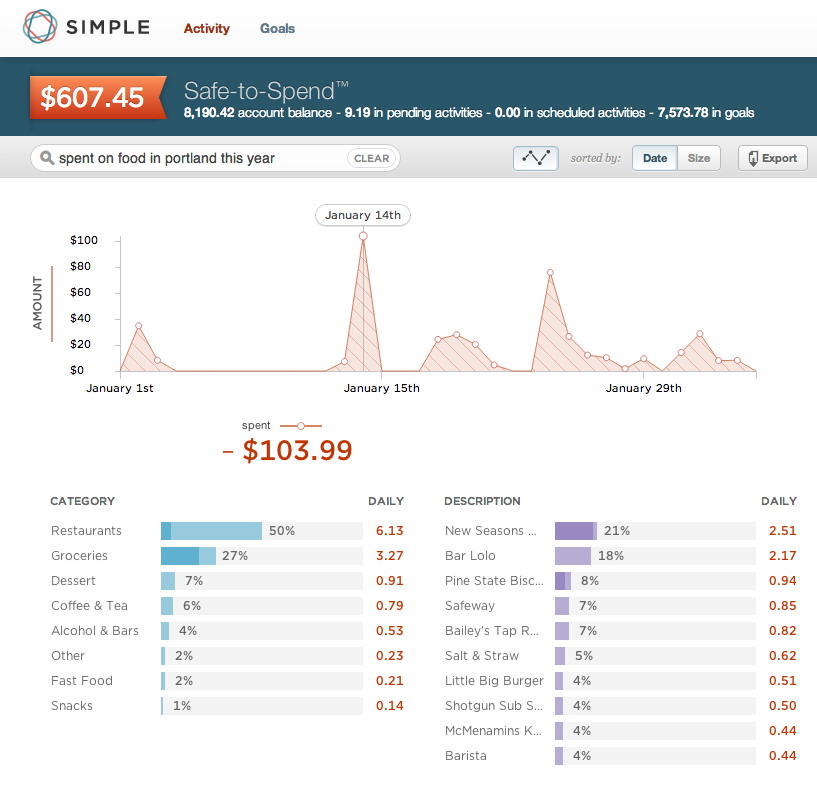
Several simple new tools leverage social media and mobile technologies to help manage your money and spending. Moven, Simple, and GoBank give users who have FDIC-insured, bank-backed debit cards links to mobile apps that provide services including expense categorization and spending alerts, as well as tools for budgeting, saving, and transfering money. The fees for all this are minimal.
These tools aim to help you go beyond knowing your current balance, so you can answer the question “How much can I spend now?”
A recent poll from the National Foundation for Credit Counseling reveals the need for these services: 80 percent of respondents indicated their worst decisions were related to financial planning—ahead of health, marriage, and work issues. Three out of five Americans don’t do any financial planning at all, and more than one-fifth don’t track their expenses each month, according to NFCC data.
A recent “Chart of the Week” from American Century Investments paints a similar picture: American financial services companies devoted to credit cards, checking and savings accounts, car loans, mortgages, and home equity products dedicate only 4 percent of their more than $17 billion marketing budget to consumer education. American Century’s position: Consumers face significant challenges to managing their finances. Education is imperative.
Moven is among several new companies seeking to address this problem. The New York-based startup helps users track spending on dining out, transportation, groceries, and other categories. It offers a free MasterCard debit card with access to more than 40,000 free ATMs nationwide and the ability to pay friends using mobile, e-mail, and even Facebook. Users can also transfer money between any of their bank accounts with a single click, and use the Moven card or their smartphone’s mobile wallet tool to pay for items. Moven generates revenue by taking a piece of the merchant fee when customers use its tools to make purchases.
Moven President Alex Sion suggests banks have long had an adversarial relationship with their customers. “Most retail banking has been driven by what we think are punitive economics,” he says. “When customers are in the least advantageous position to become financially well is when firms end up making the most money.” In other words, banks thrive on overdraft, late payment, and ATM fees—all painful experiences for customers.
Several things make it difficult for banks to better serve retail customers, says Sion. They are burdened with “the physicality of it all,” namely store branches, paper checks, a host of credit card offerings, and the huge regulatory and compliance apparatus in which they must function.
Moven hopes to shake up the paradigm by leveraging two of today’s dominant technologies, mobile and social, to change its value proposition for customers. The goal is to change behavior.
Sion wants his customers to reference their phones as much as possible in the process of paying for something. The phone alerts users instantly when something has been paid for, and updates the user’s financial situation. Because the Moven card can be linked to a range of accounts, it can track activity on other bank cards. Some customers have even been informed first by the Moven app on their smartphone when their credit card has been lost.
Big banks would be hard-pressed to offer such a service, even if they wanted to. “When it comes to Moven, Simple, GoBank, those types of companies, the main difference is that everything revolves around mobile,” says David Albertazzi, a senior analyst at the Aite Group, a financial services research and advisory firm. “They focus on personal financial management solutions, which for the big banks would be an afterthought. The newcomers’ ability to blend different account types—pre-paid, debit, credit—makes for a fluid experience for the user, since it’s easy to move money among all those accounts. It’s pretty rare among the large banks to see that kind of blending.”
Furthermore, says Albertazzi, big banks’ businesses have been built around a host of separate channels: mobile, online, branches, and ATMs. Creating an “omni-channel” experience for users is difficult because each of these areas may have its own legacy computer and back-office systems. Making them work in new ways is difficult, especially as such moves would create new regulatory and compliance challenges.
Moven doesn’t have to deal with this kind of legacy infrastructure; in fact, it has very little infrastructure at all, with no branches or ATMs to run. Nor does it require a huge marketing budget. The company attracts customers through social media channels and recommendations from financial planners, life coaches, and others who help people improve the way they manage money.
Social media dovetails seamlessly with mobile in Moven’s model. Its customers can pay other people through Facebook with a “pay a friend” feature. Facebook serves as an identifying device, routing the message and making the money transfer. If the recipient is a Moven customer, the transaction is instantaneous.
More importantly, Moven users can track how their social events align with how they spend money. “People spend most of their money with friends and family,” says Sion. “Those activities more likely than not are organized and part of the community surrounding social networks. If you know you have a birthday party coming that will require some financial outlay, we can help you control your spending to be prepared for that.”
Big banks remain cautious about wading into social media, says Albertazzi. They’ve primarily used Facebook to answer general customer service questions that don’t require detailed personal information from the customer. Changing that stance would likely raise compliance issues.
Is change on the horizon for big banks? A recent Accenture study, “Banking 2016,” calls for banks to consider defining their business according to one of three business models: One that builds on enhanced multichannel experiences to further engage the customer, one that leverages social media to increase customer intimacy, or one that places the bank at the center of an ecosystem selling financial and non-financial services. “Regardless of the models being pursued, bank governance overall must evolve, giving appropriate weight to customer metrics in the key areas of reputation, commercial performance, service performance, sales performance, and the capabilities required to support them,” according to Accenture.
For Sion, banking—like healthcare and education—is a massively difficult sector to reform because existing models are so entrenched. “Frankly, there’s very little incentive for a bank to replicate our business, because in some ways it’s counterintuitive. It’s against their economics,” he says. “Their goal is to accelerate a customer’s ability to mindlessly spend. Our business is organized around helping our customers spend wisely.”
Finance + Crypto
Could Mobile Banking Apps Help You Spend Less?
With the holiday season behind us, you might be among the many Americans looking at their checking and credit card statements wondering just where their money went in December, or possibly even all of 2013. If so, 2014 may be when new apps help you get control of your finances. Several simple new tools leverage social media and mobile technologies to help manage your money and spending. Moven, Simple, and GoBank give users who have FDIC-insured, bank-backed debit cards links to mobile apps that provide services including expense categorization and spending alerts, as well as tools for budgeting, saving, and transfering money.