
In a chic East Village town house last week, a glittery crowd, including actresses Sienna Miller and Alysia Reiner, jewelry designer Beth Bugdaycay and stylist Stacy London, sipped pomegranate margaritas and admired artwork by Marlene Dumas, Carol Bove and Kerry James Marshall while discussing getting 250,000 women to run for local, state and federal offices by 2030.
The wonky chatter would have been apropos of a political fundraiser, but this was a new hybrid: an accessories launch exemplifying the ways in which women-run fashion companies are supporting political and social causes.
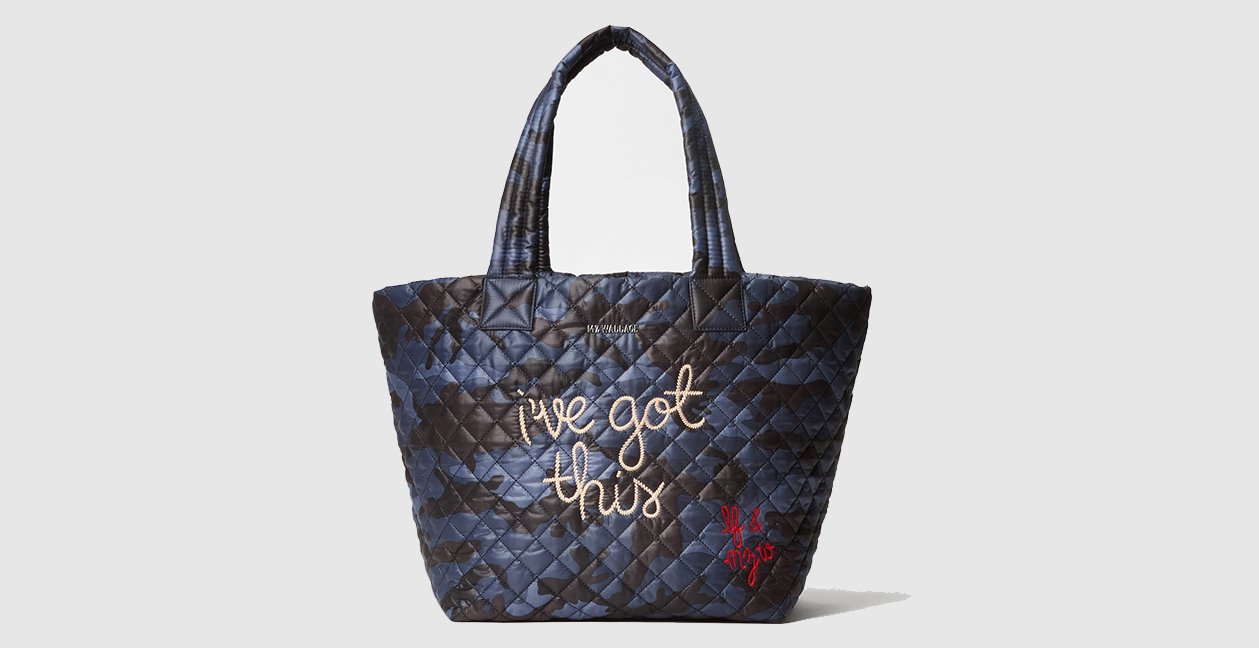
Hosted by MZ Wallace and Lingua Franca, the evening promoted the two brands’ collaboration on a camouflage Metro Tote bag embroidered with the line “I’ve got this.” The bags sold out in just a few hours, an important part of the designers’ goal of raising more than $100,000 this year for She Should Run, a nonpartisan organization dedicated to increasing the number of women running for political office.

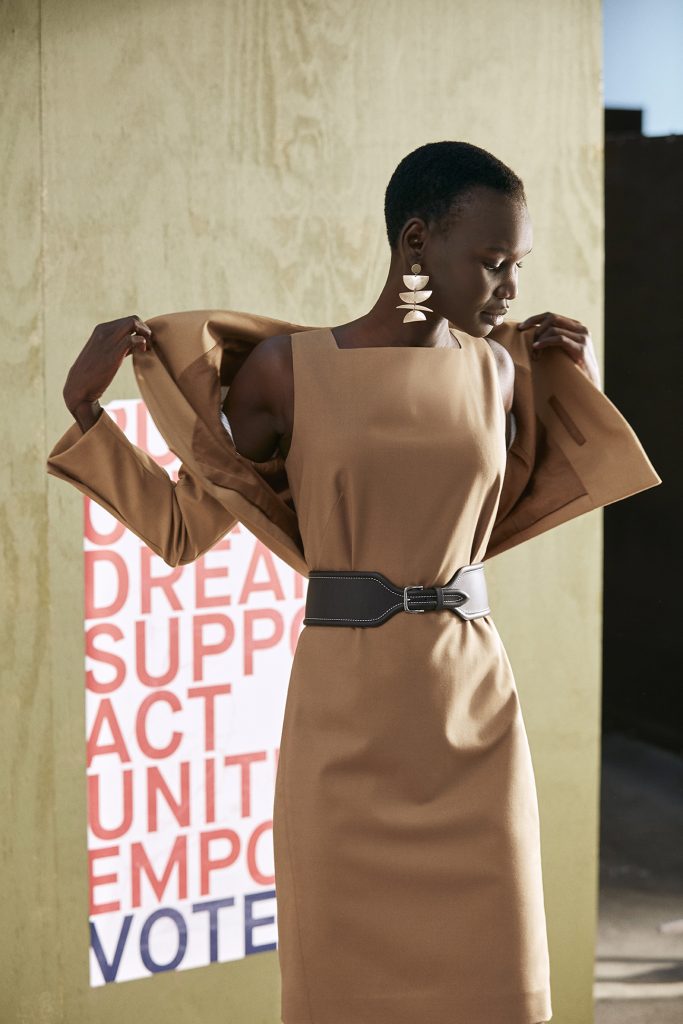
Two weeks ago, women’s wear company M.M. LaFleur volunteered to lend clothing to any woman running for political office. The company expected 200 replies. It received more than 1,100, partially spurred by Twitter plaudits from Hillary Clinton and Alexandria Ocasio-Cortez.
The three companies are part of a group of female-founded and women-driven brands using their marketing prowess to drive conversations about pay equity, political participation and climate change. From Eileen Fisher, long a pioneer in sustainable clothing, to Tory Burch and Diane von Furstenberg, women in fashion have found a voice, and a market, in addressing the sometimes controversial topics impacting their customers.
“Do I think Trump has anything to do with it? Absolutely yes. There’s more and more against him in fashion. There’s a lot about ‘vote now.’ I’m seeing so many garments with it, from couture to the low end,” says Robin Sackin, chairperson of the Fashion Business Management Department at the Fashion Institute of Technology (FIT) and an observer of the American fashion industry for the past four decades.
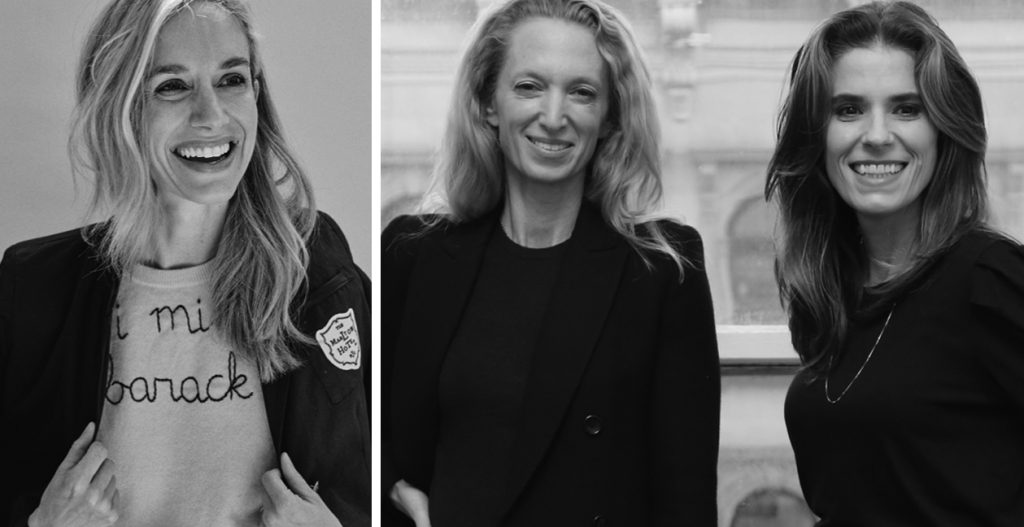
The Trump effect is real—and growing. MZ Wallace’s founders Monica Zwirner and Lucy Wallace Eustice first partnered with Lingua Franca’s founder and CEO Rachelle Hruska in 2018, with Hruska embroidering the phrase “give a damn” onto MZ Wallace Metro Tote bags. Launched just after Christine Blasey Ford’s testimony in the Brett Kavanaugh hearing, all 800 sold quickly, raising more than $100,000 and helping She Should Run add more than 4,300 women to the pipeline of women running for office.
“It’s still our most requested item,” says Hruska, known for designing luxury cashmere sweaters embroidered with phrases like “right matters” and “nevertheless she voted.” Hruska’s devoted celebrity following includes author Margaret Atwood, television reporter Jessica Yellin, musician Paul McCartney and actresses Cynthia Erivo, Julianne Moore and Jane Fonda, who recently wore a red Lingua Franca sweater emblazoned with the word “Outlaw” for a photo shoot.
Widely photographed and popular on Instagram, the sweaters are an extremely stylish form of protest, worn as fiercely by progressive women as MAGA hats are by Trump supporters.
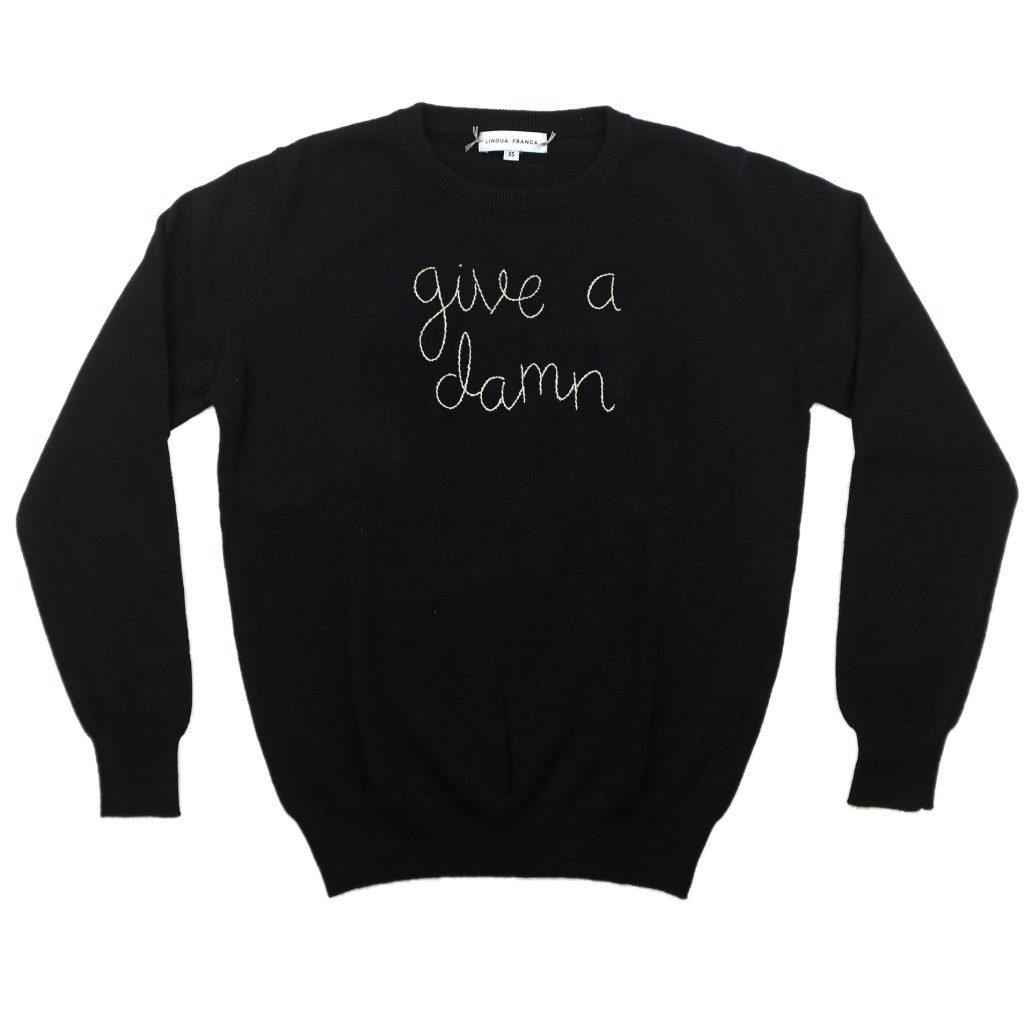
“The minute the 2016 election happened, I soothed myself by buying a Lingua Franca sweater that said ‘it was all a dream,’” says Nancy Friedman, 64, a recently retired public relations executive who owns two other Lingua Franca sweaters (“practice kindness” and “come together”), is eyeing a third (“we the people”) and just received the “I’ve got this” bag as a birthday gift.
“Lingua Franca’s designs really resonate with me,” says Friedman, who also buys her daughter RBG socks and her husband T-shirts from the Democratic National Committee’s online store. “I’ve been a political being for as long as I can remember, but it’s become more and more urgent.”
That sense of urgency is widely held by the affluent American women that fashion companies are courting.
“This is really about women supporting women and not picking a side,” says Wallace Eustice. “The problem with the political process is that conversation has stopped. You need both sides to come together to talk again, and that’s how we’re going to get back on track.”
Brands say that embracing political causes has increased dialogue with their customers and fortified their commitment to public discourse.
“In this day and age, where we’ve got a supposed billionaire as president and Bloomberg having said things in debates like ‘I bought those candidates,’ I have moments where I’m quite disillusioned with politics,” says M.M. LaFleur’s founder and CEO Sarah LaFleur. “Where is the honor in it? Is politics only for the rich? But then I hear from these women and it gives me a lot of hope about what politics could be like.”
A former banker and consultant who has also volunteered in refugee camps, LaFleur employs resettled refugees and is president of the International Rescue Committee’s young professionals board. For a week last fall, from Black Friday to December 3, LaFleur donated 100 percent of proceeds from the company’s best-selling black dresses to the IRC’s New York and New Jersey resettlement efforts.
Like Wallace Eustice, LaFleur, a registered Democrat with progressive values, stresses that she sees her role as supporting women, rather than as advocating for a particular party or cause.
“I have so much respect for women on both side of the aisle. In some ways, Republican women have it harder, with so little representation at the federal level,” she says. “One of our customers is a governor and has very different views from mine, and yet, I respect her so much. What I love about our customers is that we’re able to create a forum where opinions are exchanged respectfully.”
Still, LaFleur acknowledges, murky questions frequently arise. She will not dress any candidates who belong to hate groups or who oppose gay marriage, but other issues are tricky.
“With gun rights and pro-choice and pro-life, we’re supporting both sides of the aisle right now,” she says. “This may not be the final stance, but for now, we’re staying out of it.”
Hruska has also extended her work to some conservative clients, embroidering a custom “I miss Reagan” sweater for one customer and creating products for the Barbara Bush Foundation for Family Literacy. Still, her liberal leanings inform most of the company’s work and are central to the company’s origin story.
Hruska, who is also founder and CEO of the popular society website Guest of a Guest, began embroidering to calm her post-partum anxiety in 2016. Stitching fun phrases and words like “booyah” onto cashmere, she quickly gained a fashion following. The frivolity ended when Trump announced the travel ban in January 2017, and two of Hruska’s embroiderers, Iranian students studying at the Fashion Institute of Technology, sobbed in a corner of her store.
“These are just regular kids. I was so upset for them. I’m this white privileged person and had never had the experience of having politics affect me so dramatically and directly. We stitched ‘I miss Barack’ on sweaters that weekend,” Hruska recalls. “I started selling them on Instagram, with $100 of every sweater sale going to the ACLU. I put it up on a Friday and, that weekend, thousands of emails came in trying to order them.”
Since then, Hruska’s generated about $1 million for organizations including the ACLU, Every Mother Counts, Equality Now, Feed, the UndocuNeighbor Defense Fund, First Book and TIME’S UP Legal Defense Fund.
Like Hruska, Wallace Eustice and Zwirner support a variety of non-profit organizations and charities. Over the past decade, they’ve created limited edition bags for various causes, donating the bags’ entire net proceeds—about half a million dollars—to groups like the American Red Cross, the Conservation Fund, the America Red Cross, the Senegal-based non-profit Le Korsa, Girls Who Code, the Studio Museum in Harlem and the New York Public Library.
“When I read [about bigger companies] donating 10 percent of profits to something, I’m just like, come on. That’s so clearly marketing. If you’re going to give something, it should hurt a little,” Zwirner says. “It does hurt, because of course, we could be more profitable, but we also want to do this. So that’s a choice you make as business owners.”
Those choices have sometimes turned customers away. Zwirner and Wallace Eustice said they received some hate emails after they posted photos of themselves at the first Women’s March.
“People wrote: ‘I loved your brand, but I’ll never shop with you again.’ So, people definitely watch what you do. But our feeling was, if you don’t feel comfortable shopping with us, that’s fine. You don’t have to, but we’re not going to say sorry,” says Zwirner.
Zwirner’s unapologetic stance resonates with her colleagues.
Occupying a singular spot in the nexus between craft and activism, Hruska hosts several events at her two Manhattan stores each month. The night before announcing her presidential candidacy, Senator Kirsten Gillibrand hinted at it while promoting her children’s book Bold & Brave: Ten Heroes Who Won Women the Right to Vote at Lingua Franca’s Bleecker Street store. On April 14, she’ll return for an evening event with Texas congressional candidate Wendy Davis.
“Our events are important. You don’t have to pay, anyone can come and you can meet your senator,” Hruska says. “It started as a virtuous circle: we were able to hire women who needed work and donate to causes that were super important to all of us at the office, and also have this message to the world. This company is so much more than embroidered sweaters.”