Obesity is a modern curse–among society’s most vexing and widespread health problems. And technologists want nothing more than to address big problems with radical innovations. So the founders of Natick, Massachusetts-based Allurion came up with the Elipse, which makes you feel full so you eat less.
Weight-loss balloons similar to the Elipse have been in the market for some time, but in much less palatable form, so to speak. The balloons are liquid-filled devices placed in patients’ stomachs for extended periods. Two factors set Allurion’s apart: It doesn’t require a doctor to perform an uncomfortable endoscopic procedure to insert, and the patient doesn’t need to return to a medical practitioner for removal of the balloon, which dissolves in the stomach and is excreted naturally.
According to Dr. Christine Ren-Fielding, professor of surgery and chief of bariatric surgery at NYU Langone, balloons present an appealing option for many people who want to lose weight. They are safe and non-invasive, although they still require patients to work hard to change their dietary and exercise habits. “It’s a jump straight to weight loss, but the patient has to take the ball and run with it,” she says. (Or did she mean to say balloon?) Gastric bands which constrict the stomach are another common approach and have the benefit of lasting as long as 20 years. But they require surgery and several months of post-operation interaction with a doctor. Ren-Fielding says many patients don’t want to undergo the rigors of that approach, though they will try it if they’ve used a balloon first and not achieved the desired results.
Allurion co-founder Shantanu Gaur describes the company more like a Silicon Valley startup than a classic medical-device maker. It borrowed three core practices from the tech industry: a focus on user experience rather than solely on the product; keeping the consumer involved everything in the company does; and incorporating rapid feedback to make adjustments and improvements. “We understood early on,” says Gaur, “that that if we could create an experience around a weight-loss product, make it safe and effective but also make users feel like they’re at the center of a program, we’d be onto something new. Most tech companies grow because of their consumer-centric approach.”
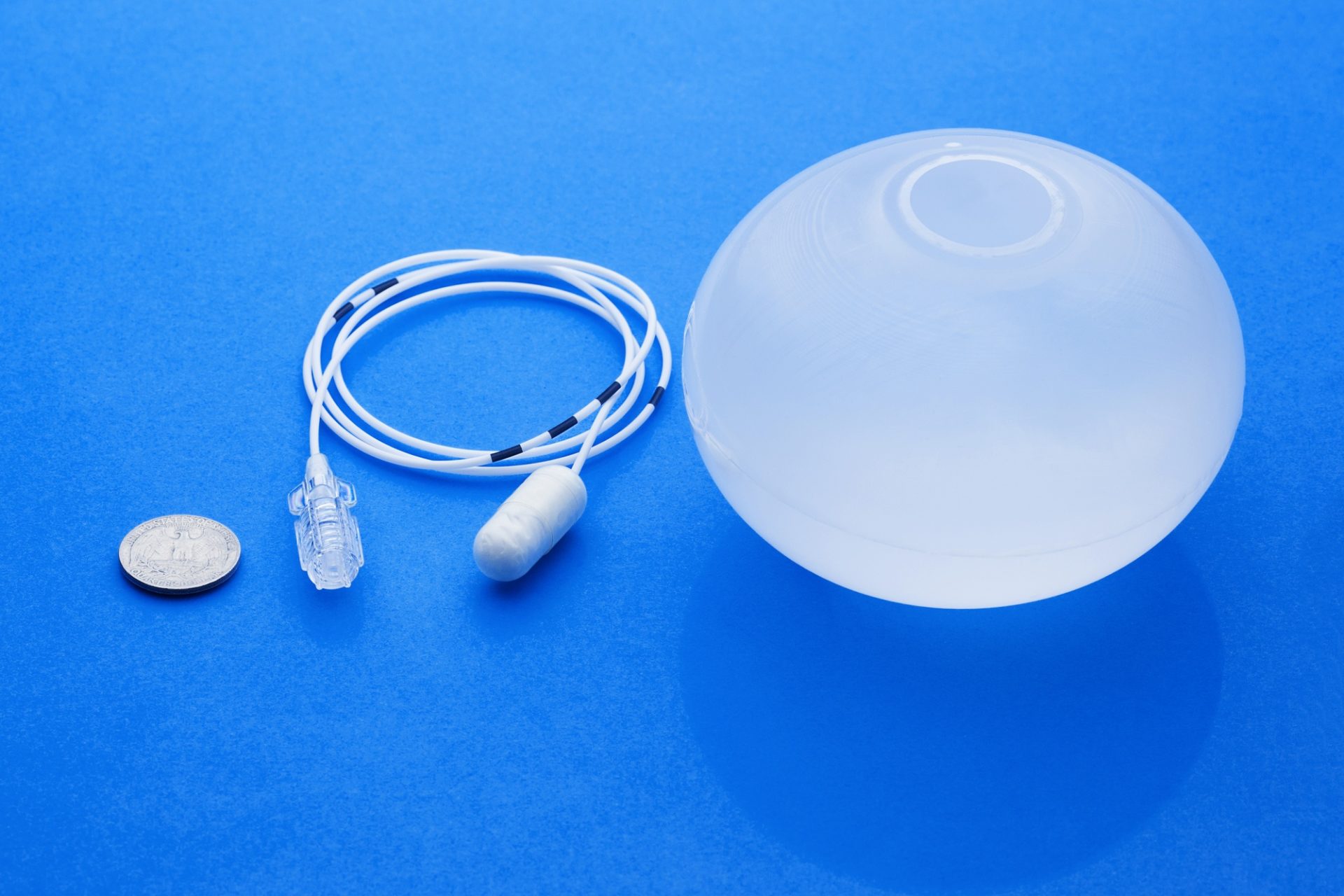
Instead of requiring a doctor to insert its balloon from the other end, Allurion users swallow it. This is where its several technological advances comes into play. The balloon is made of a thin clear polymer, compressed into a small capsule attached to a catheter. The balloon is filled through the catheter with 550 milliliters of liquid—primarily water. Then the catheter and capsule dissolve. After about four months, the liquid is released when a seal on the balloon degrades. The package travels through the digestive system and is excreted naturally.
The insertion procedure can be completed in about 15 minutes without putting the patient to sleep—or even in a surgical gown—by a nurse practitioner with physician oversight. Patients are given a Bluetooth-enabled scale to keep track of their weight with a smartphone app, and can participate in virtual meetings with nutritionists. The balloon has a small opaque marker so that it will show up on an X-ray should one be required.
According to NYU’s Ren-Fielding, advances like Allurion’s could make balloons even more attractive, as they further decrease the time a patient must spend at a hospital or visiting a doctor’s office. But because weight-loss patients come from a broad range of demographics, she says, many aren’t tech-savvy. She hasn’t seen much interest in the use of mobile devices to track progress or hold virtual doctor appointments, though she hopes that will change. Gaur responds that Allurion believes the sheer simplicity of its smartphone app approach, more bare bones than some others, makes it appealing and easy for anyone to use.
Allurion’s balloon isn’t yet on the market in the U.S. It is still under review by the FDA. But it’s available in European countries including Belgium and Greece, as well as in the Middle East. It has a particularly large customer base in Kuwait, where doctors have promoted it using social media.
Gaur and co-founder Samuel Levy met while students at Harvard Medical School and decided to find a new way to solve the weight-loss problem. Allurion didn’t follow a traditional development path. “Many pharmaceutical and biotech companies start with the technology and then find the right market for it,” said chief executive Jonathan Wecker. “That’s certainly a valid model. You develop something in a lab, license it, and see what happens. We started with a market need, a patient interest, and went from there. We were tech-agnostic at the beginning.”
An Allurion user can have another balloon inserted (after the first has been expelled) if necessary, with no health risk. But because insurance doesn’t cover gastric balloons, cost becomes an issue. The Elipse costs just under $5,000, while those that require an endoscopic insertion go for about $3,000 more, to cover the procedure.
Says Levy: “Obesity is a pandemic. We’re a disruptive company with an approach to managing it that involves listening to the patient.” To make a serious dent in the pandemic will clearly require a vast array of social policy and medical interventions, but Allurion’s creativity suggests there are more tools available than we may have thought.
Health + Science
The Most High-Tech Water You’ll Ever Swallow
Allurion’s rethink of existing “weight-loss balloons” could put a dent in obesity. Who knew that a sack of water in your tummy could be high tech? You just swallow it and they fill it up. Previous methods were less palatable.