French Polynesia is a very remote place. Its five archipelagos traverse approximately two million square miles of ocean in the middle of the Pacific. The isolated and widely scattered islands themselves, 118 of them, cover less than 1% of the Pacific Ocean’s surface. Reef-strewn and unchartered, the cobalt blue waters were a serious barrier to western exploration until Captain Cook “discovered” these gems in the middle of the 18th century.
Isolation has given the island territory its own culture, language and, of course, food and drink. There are no records of “pre-discovery” alcohol consumption. All fermentation and distillation came with European influences.
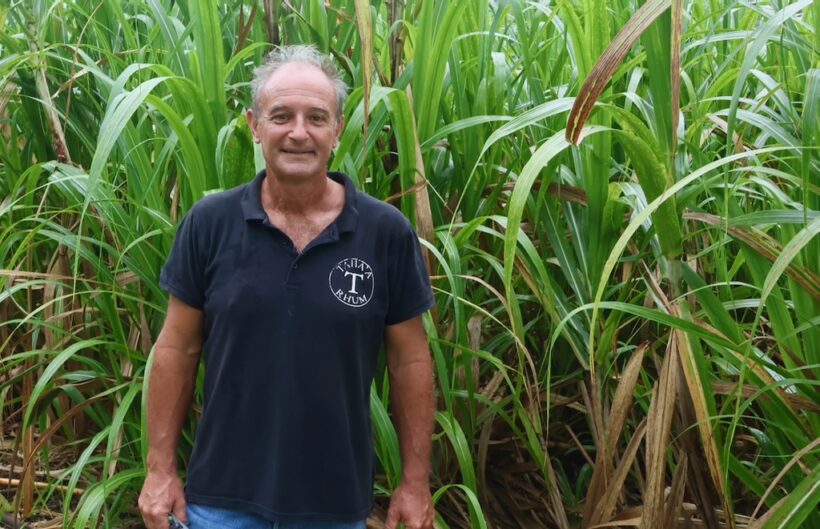
A jungle doesn’t seem like the sort of place one would find a sugar cane plantation but in a tropical clearing on the island of Taha’a, Pari Pari’s owner Laurent Masseron is instructing us on the minutiae of sugarcane terroir. Who knew rum’s source, sugarcane, had terroir? While he relies on four-five main varietals, in total Masseron plants 14.

Terroir comes not just from the cane, but also the soil. Masseron told Worth, “My fields contain three different types of soil: basaltic at the top of the hill; in the middle degraded basaltic, which began as stones before the ever-present rains disintegrated them; and, at the bottom, red ferralitic which is ancient coral and has a different pH than the two basaltics.”
This is not mono-culture and, as we learned later at his distillery, the varieties of cane combined with the three distinct soil options give Masseron a large palette to create individual flavor profiles for his rums.

A bigger mystery is what this energetic Frenchman is doing on an island so remote that, by his own admission, “If I need a small hardware part, I have to wait two weeks. It’s not advisable to live here if you aren’t long on patience.”
Taha’a is 24 hours from Paris, where, as an act of rebellion against his Bordeaux wine-centric parents, Masseron became an “anything but French” wine importer.
He was determined to prove his family’s xenophobic conviction—that only wine from France was fit to drink—wrong by showcasing notable wines from around the world. When his daughter was born, Masseron realized he didn’t want to raise her in Paris and, since spirits were in his DNA, the idea of making quality rum came to him. He’d seen sugar cane in Martinique and knew it came from Polynesia, so he decided to go to the source. It also didn’t hurt that he was intrigued by the sensuous, tropical lifestyle Polynesia has to offer.

Historical biologists believe that sugar cane traveled east to Polynesia from Papua New Guinea and Southeast Asia in prehistoric times, carried by canoe as part of a massive migration that introduced both plants and animals to the region. Howeverm it was a less sweet variety, and was likely used as swine fodder. It was not until the late 1700’s, when Captain Bligh, of Mutiny on the Bounty fame, introduced a sweeter variety, that it became a cash crop. Sugar was scarce and desirable and quickly catapulted to the world’s most valuable commodity. It is hard to appreciate the wealth that sugar, molasses, and rum created, but in the 18th century, it was the basis for fortunes that rival those of Silicon Valley today. Laurent estimates that 80% of the world’s sugar cane stock came from Polynesia.
Surprisingly, sugarcane is a perennial grass which shares a family with wheat, rice, and corn, the latter a source of commercial sweetener (corn syrup and high fructose corn syrup). As a grass, it propagates easily, and once established requires very little cultivation compared to other grass crops like wheat and rice.

Currently, French Polynesia limits the cane used for rum to indigenous varieties. But, as we learned from Masseron, it’s not as simple as randomly sticking a plant in the ground. For the best results, each parcel of land is paired with the specific variety that will produce the most complex juice. Elevation, sunlight, soil composition, and moisture all contribute to the art he is perfecting.
Unable to find land that met his needs on any of the larger, more populated islands, he eventually came to Taha’a for both plentiful rain and easy-draining volcanic soil.
Masseron had seen the environmental degradation that pesticide-laden farming wreaked on island soils and so was committed to accomplishing his goal sustainably. His vision extended beyond his plantings. He wanted to gently coax other cane growers to farm organically, so, once his business grew enough that he need to purchase cane from others, he insisted his suppliers follow his eco-friendly lead.
The result is that some of his rums have undergone the arduous, multi-step process required by the European Union and the French government to be certified organic. His ambitious goal is to have all of them achieve this high bar.
There are two ways to prepare cane for distillation. One is to ferment the cane juice. The result is clear-colored Rum Agricole with a complex flavor (because the unpasteurized juice contains indigenous yeast strains). This is the preferred French method; true afficionados often favor rum Agricole with its inherent terroir.
In British and Spanish regions, boiling the cane juice into molasses results in a rum that is richer, smoother, and sweeter, but, lacking the yeast, often also lacks the complexity.

Quality versions of both products spend time in oak barrels, which, unsurprisingly influences both the final flavor and color. Aging, up to fifteen years, for premium rums yields a drink that’s been compared to cognac.
Although, 20 years ago Masseron was the first growing sugarcane for rum, now French Polynesia has four distilleries. In addition to Pari Pari, two others have product lines that include an organic rum.
Walking through his facility, Masseron explained, “Distillation is a complex process. With over 20 different alcohol by-products produced, most of which will be discarded, the rum maker is almost like an orchestra conductor, tapping different flavor notes at different times in the process.” With so many steps, it’s not surprising that 1000 liters of juice yields only 100 liters of desirable alcohol.
Pari Pari bottles eight varieties of rum–four whites, which differ in their alcohol percentage from 40 to 62% (plus a new passion fruit flavor), and five amber selections. A hint of the barrels’ previous resident remains and so Masserons amber rums come in sherry, madeira, and sauternes. His amber offerings have won awards in international rum competitions held in Paris–a gold in 2020 for a 3-year-old rum and a silver in 2024 for a 5-year-old.
Masseron has achieved premium status. Bottles regularly sell out or are on allocation for prices pushing $100. They are easy to ship directly from his distillery to the United States.
Seeing the logistical and cultural difficulties Masseron faces from this remote island, we understood how hard won his success in a global market is. Not denying it, he assured us, “You always find the solution if you’re passionate.”