
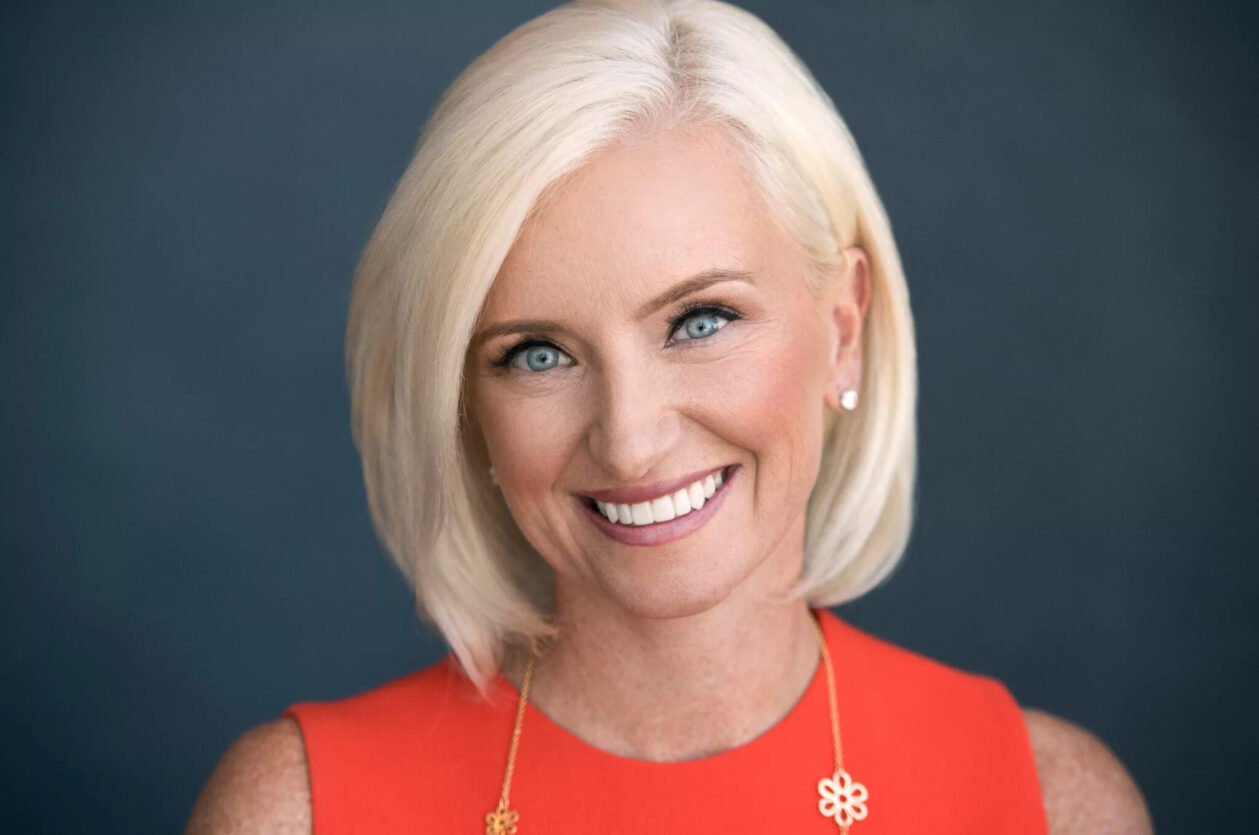
In the last year, stories about burnout have littered magazines, newspapers and social media platforms. Every day, it seems, there is a new story about how employees are anxious, tired and burned out from their jobs in the work-from-home era. Knowing this, one could argue that there has never been a more critical time to have enlightened leadership coursing through our companies. Carolyn Everson, who recently stepped down as VP of Facebook’s Global Business Group, is herself an enlightened leader who has been very vocal about the importance of leading with authenticity, vulnerability and empathy, especially throughout these chaotic and tumultuous times. Worth spoke with Everson about what enlightened leadership is, why it’s so important and how it can lead to better business.
Q: Tell me a little bit about your background and how you got to Facebook.
A: When I graduated from Villanova University in the early ’90s as a liberal arts major, this thing called the “World Wide Web” had only been around for a few years. So I certainly did not envision a future career in technology or at a company like Facebook.

I did know that I wanted to work at places that were mission-driven and that would provide me with an opportunity to lead people. I used to have this idea—a lot of people have it—that a successful career is one that always goes up and to the right. It works that way for some. It did not for me.
I worked for a few years after leaving Nova and then went to business school, where I came up with this idea that married a personal passion—my love of animals—with what I thought was a big market opportunity to sell pet supplies online. That was the beginning of Pets.com. I didn’t own the domain name so I had to find the owner, who ended up becoming my business partner.
Suddenly my idea started gaining traction and, of course, my professors, business school classmates and family all knew about it. Everyone at business school dreams of getting their idea funded.
And then, almost overnight, it was over.
Right after we secured our first round of outside financing, the lead venture capital investor brought in a CEO, and I flew out to California to meet her. It was one of the worst meetings I’ve ever had. And it was apparent almost instantly that we had radically different visions for the company.
I left, flew back east and by the time I got back to my dorm room, I found out I had been fired (by fax!) from my own company—two weeks before my graduation.
I sat in my room and cried. All of this work seemed to be for nothing. Pets.com moved on without me and today of course, people remember it for two things: They had a funny Super Bowl sock puppet ad and then went bankrupt soon thereafter.
Pets.com was an iconic failure of the dot.com era and it was honestly years before I was confident enough to talk about it. I didn’t even put Pets.com on my resume. On the other hand, the experience set me on the path I’m on today because it gave me so much exposure working at the intersection of media and advertising.
So I’m very grateful for the career path I have been able to travel. I had good mentors and good luck, and I got to work at some amazing places like PriMedia, Viacom, Disney and Microsoft.
I had actually only been in the Microsoft job for nine months when I got contacted by a recruiter in 2010 about an opening at Facebook. I was hesitant to even explore it because I knew if I left so early, I’d disappoint some people I really respected and cared about. But I also saw in Facebook a company that had that singular mission—to build community—and I knew in my gut I had to at least explore the opportunity. And when I sat down with Mark Zuckerberg and Sheryl Sandberg to talk about their vision for Facebook and for my role in it, I knew I wanted to go beyond just exploring. I wanted the job. And I am so happy I took it. It’s the best career decision I ever made.
One thing you’ve become known for as a leader is being empathetic. Why do you think empathy is such an important trait for effective leaders to have?
I always thought empathy was critical to being a good leader. But now, after our society has been racked by a pandemic, by racial injustice and with so much fear and anxiety, I think empathy has become an absolutely essential trait of effective and enlightened leadership.
Empathy is the simple, but powerful, act of a human being trying to walk in another’s shoes. Although it is simple to define, it isn’t always easy to exhibit or to embrace.
When people think empathy, they think of Oprah or their mom or their friend. They don’t necessarily think of CEOs or coaches or other leaders. But they should. If you really think about it, a leader is making a very audacious request of someone else: Follow me.
Well, if I am asking someone to follow me as a leader, then I owe it to them to try to figure out what they care about, what moves them and what I can say or do to get them to come along for this journey I want to take them on.
Becoming a more empathetic leader is a journey that never ends because there is no point at which you should stop being interested, engaged and invested in the lived experience of your fellow humans.
With Gen Z and millennials moving through the workforce, how do you think leadership is changing now?
The Gen Z and millennial generations demand more from their leaders and from the companies they work and buy from. They want you to reflect and share their values, and I think this is major driver of positive change in business and across society.
There was a time not long ago, where parents and leaders could give an order and explain it with some version of “because I said so.” That time is gone, and that’s a good thing. Gen Zers and millennials want to understand why decisions are being made and what goes into them. And I just think it’s very hard to do that effectively without embracing this idea of enlightened leadership.
So what is enlightened leadership?
My definition of enlightened leadership is simple: It means a leader who embraces the qualities that make us inherently human, like vulnerability, empathy and generosity. Every good leader I worked for has had these traits—most of the bad ones did not—and I’ve believed for a long time that people are desperate for this kind of leadership. This difficult last year has only deepened my belief, increased my sense of urgency and my desire to connect with other leaders who feel the same way.
As a society, we are in the midst of a very important “future of work” conversation right now. But it has to be about more than just where we will be working post-pandemic—in an office or at home. It also needs to be about how we lead. Even before the pandemic, I saw so many polls and studies saying the same thing: People were unhappy and burned out in their jobs. Post-pandemic, many just won’t be willing to go back to the status quo. I really do believe there is a human transformation, built around reevaluating what we all want out of our lives, happening right now that is every bit as important as the digital one.
So I don’t think it’s good enough to just get back to work. We’re missing a big opportunity—as businesses and as a society—if we don’t reimagine how we lead people.
How does one become an enlightened leader?
For me, enlightened leadership begins with a willingness to show up as a full person.
Before the pandemic, you could maybe uphold the illusion that there is “work me” and “home me” and that those could be two fundamentally different people. That’s gone now. We’re all Zooming every day into one another’s homes. Everyone on my team has seen me with bedhead and my dogs crawling all over me. So let’s give up the fiction that you can neatly separate work and life and balance them off one another. Our work and our lives are integrated, so I just think an enlightened leader needs to authentically be who they are no matter where they are.
I will be the first to admit that Facebook has a unique culture that encourages some of these elements of enlightened leadership. I mean our entire business is built on sharing, so I get that some of the approaches I take may not work for a leader elsewhere.
But every leader, no matter what industry you are in, has the ability to be more empathetic, more authentic, more vulnerable. You may express it differently than I do, and that’s exactly how it should be.
How can being an enlightened leader lead to better business and a better workplace environment (even virtually)?
For as long as I can remember—and before I even knew a name for it—I thought enlightened leadership was important. But it took me some time to work up the confidence to embrace it fully because it’s hard. Being vulnerable for example—which is a key component of enlightened leadership—is scary. Who knows how people will react?
In my experience, the reaction has been so positive. It loosens people up, lets them know they have permission to drop the armor, to be real and to be honest about how they are feeling. It just creates a happier work environment, be it in person or virtual.
And there is so much compelling research on how enlightened leadership—which tends to create happier employees—can meaningfully improve the performance of a business. It works, and it is worth investing the time to learn more about.
How do we get more leaders to embrace empathy, vulnerability and being human in front of their employees?
It’s hard because enlightened leadership does run counter to this traditional idea of what we think a leader is supposed to be.
We’re taught from an early age that leaders are supposed be these figures of unquestioned authority who have all the answers. And unfortunately, old habits die hard.
That’s why I think there are still a lot of leaders in public and private life who embrace the old command and control model of leadership. But I think the costs of this kind of leadership are really adding up. It’s not sustainable. As a leader, you can berate and bully your way to what looks like short-term success, but it just does not work over the long-term.
Some elements of leadership are complicated. Some are not. Good people want to work for good people. And that leads to good results that last.
Is there anything pertaining to leadership that I haven’t asked about that you wanted to mention?
We have a saying at Facebook that we are a learning organization that never graduates. And I love that phrase because curiosity is another critical trait of enlightened leadership we haven’t talked about.
I actually read some research recently that the average four-year-old asks their parent some 300 questions a day. They are constantly asking, “Why?” We all tend to lose that curiosity as we age. It’s like the more we know, the less we think we need to know. Fight that instinct at every turn. Just be a relentless reader, learner and seeker of new experiences and perspectives. It will make you more empathetic. It will help you more naturally see the world from a point of view outside your own. And it will prevent you from getting complacent, which in my world—technology and marketing—is the surest ticket to going out of business or being out of a job.