

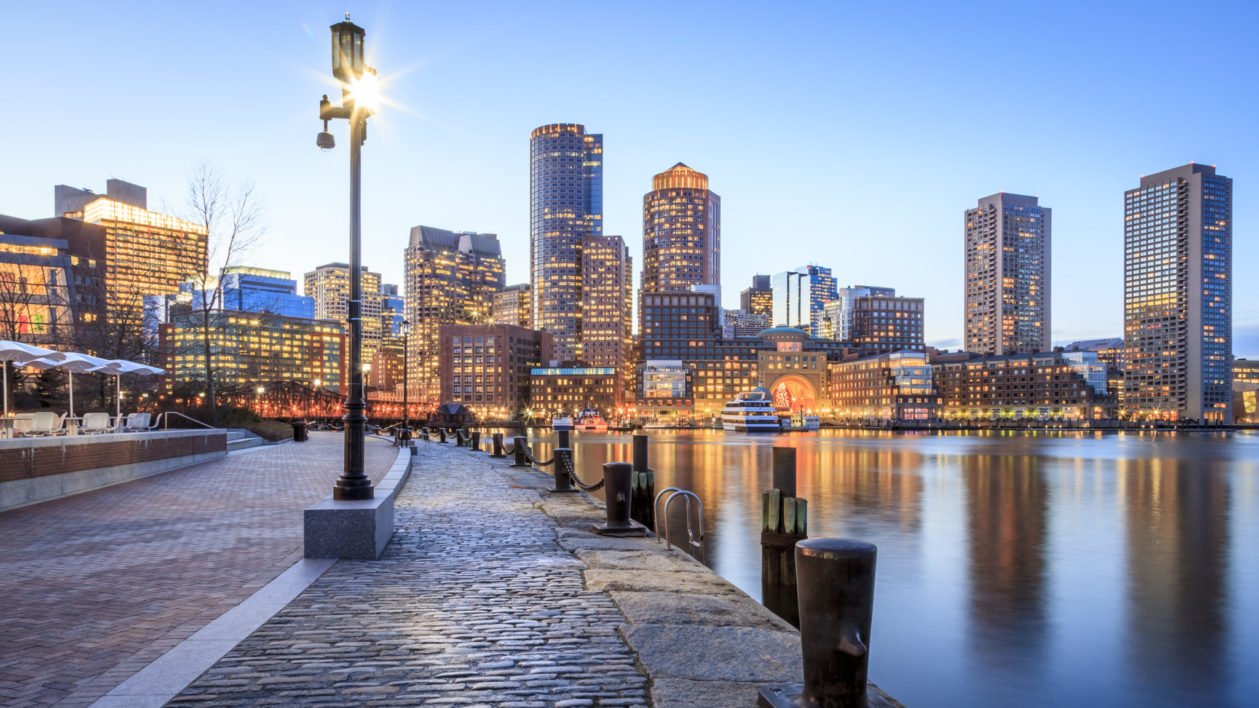
 Boston has endured several tumultuous eras, from being the birthplace of the American revolution to its seesawing fortunes as power and influence was wrested away by other U.S. cities.
Now Boston faces its most existential threat yet—the rising seas.
Ironically, Boston is experiencing a surge in waterfront development at the very moment its growing risk to disastrous flooding has become clear. The refashioning of Boston’s waterfront holds valuable lessons to other cities threatened by sea level rise—in terms of innovation but also wrenching concerns over displaced communities.
The economics are now optimal for developers to repurpose the post-industrial landscape of East Boston and other neighborhoods in the city but this epoch also comes comes with the added costs of the climate crisis.
“It is an unfortunate quirk of timing,” admitted Nick Iselin, the general manager of development at Lendlease. Last summer, the property company completed the first phase of its Clippership Wharf development in East Boston, on the Boston Harbor waterfront. Nearly all of the 284 apartments have already been snapped up, with a second site in the same project set to be completed this year. In all, there will be 478 residencies on the seven-acre site.

City authorities are planning around a contingency of 40 inches of sea level rise by 2070—a scenario that would inundate large swathes of Boston.
Historical Risk
The seeds of Boston’s vulnerability to the climate crisis was unknowingly sown as the city became a bustling trading port in the 1800s. The booming city tripled in geographic land area by filling in tidal flats and marshland with rocks and dirt, using this land for residential housing as well as sights such as Faneuil Hall and the New England Aquarium. Planes landing at Boston’s Logan International Airport rumble along filled-in land that was once a string of islands.
The core of the city is perched on low-lying land along a lengthy artificial shoreline—a perilous situation in an era when seawater is piling up along the U.S. East Coast from the heating-up of the seas and the melting of glaciers. Boston is now the world’s eighth most vulnerable coastal city to potential damages from sea level rise, according to the World Bank.
The sea that laps at Boston rose by nine inches over the past century, with diverse districts such as Dorchester facing the prospect of being drowned by the end of the century. Already, some Boston streets flood even on sunny days, just with the high tide.
Developers in Boston are attempting to stare down this challenge, however. Clippership Wharf is flanked by two other expensive developments in varying stages of construction, both using standard forms of reinforced seawalls and barriers to stop their investments becoming inundated.
But Lendlease is embracing an approach more attuned to nature, one that leans upon the idea of living with the encroaching water rather than waging war against it—an ethos more common in the Netherlands or Venice than the U.S. Clippership Wharf has Boston Harbor’s first “living shoreline”—a network of natural plantings, salt marshes, rocky beaches and wildlife habitats aimed at dissipating waves from storms and subtly taming the high tides.
You get from the condos to the waterfront via a series of tiered grassy embankments that bring you down to a publicly-accessible boardwalk overlooking a jumble of rocks and, on one side, the remnants of an antiquated seawall that has been partially given over to the water and seeded with salt marshes to provide a more natural buffer to the advancing harbor.
Seawalls, by contrast, often cause the erosion of land or beach in front of them and can simply push water on to neighboring properties. In many ways, this Boston development is a model for how America should be building on the coastline in an age of climate breakdown.
“We’ve repatriated the shoreline with native species, this is more like what it would have been 150 years ago,” Iselin said. “In four or five years you’ll see the salt marsh starting to take shape.
“I think it takes a certain caliber of developer to think that way, but I think more and more developers are. The challenge is not thinking that way, it’s figuring out a way to implement it because the solutions are more difficult, both from a regulatory perspective and from a cost perspective.”
The developers haven’t left too much to chance—Clippership Wharf has been elevated to 14 feet above the average high tide in the harbor, which waxes and wanes every six hours. Deployable wooden barriers are slotted into place ahead of a storm, while an underground car garage includes water pumps and an emergency back-up generator.
These adaptions caused consternation among city authorities about a gradient mismatch with surrounding streets but the inclines are fairly gentle and are still wheelchair-accessible.
A more potent concern is that the climate crisis is accelerating existing gentrification of what was once a solidly working class area. Apartments at Clippership Wharf will cost you about $5,500 a month for three bedrooms, with condos available to buy for as much as $1.75 million.
These new abodes are built on a site that was vacant for 30 years, a patch of contaminated soil left over from the heyday of the harbor being a frenzy of goods shipped on to wharves that stretched out into the water. Lendlease has clearly done a sterling job of opening up a waterfront path to the general public, but the “perception of gentrification is very real”, Iselin conceded.
‘We are a hub of immigrants’
“Boston has one of the more progressive city leaderships when it comes to the climate crisis—its Climate Ready Boston plan sets out the challenge in detailed and stark terms–but, still, low-income residents of East Boston worry that they will be the worst hit when the water starts lapping on to roads and into basements.
The city has had one near miss—Superstorm Sandy, which crunched into New York City in 2012, would have left many Bostonians hip-deep in water had it arrived at high, rather than low, tide. Some residents, not shielded by the expansive defenses and water pumps of the new developments, fear they won’t be so lucky next time.
“Where I live was built in 2003 and that was not built to be climate resilient—all the critical utilities are in the basement, which could flood,” said Magdalena Ayed, the founder of environmental justice group the Harborkeepers who lives in subsidized housing just a few hundred feet from Clippership Wharf. “The question is where does the water go (from the new development), will it go in and behind to us?”
Originally from Argentina, Ayed moved to Boston 14 years ago and has seen East Boston’s waterfront rapidly change into a place where only the relatively wealthy, perhaps working in Boston’s growing biotech sector, are able to afford. The new developments will only push up rents for everyone else, she worries.
Boston was built on the backs of hardworking people, we are a hub of immigrants—Ukrainians, Irish Americans, Italian Americans, Vietnamese, Latinos and North Africans,” Ayed said. “That’s still the case but it’s changing. I don’t even make a living wage, I wish I could afford to live in one of these new buildings but I can’t. I probably won’t be able to ever afford it.”
Ayed said that Lendlease “deserves a lot of credit” for thoughtfully protecting its patch of the shoreline but said she’s worried about the impact of flooding upon the elderly and less mobile in the public housing behind the new developments. In 2018, two nasty storms threatened to flood East Boston homes, with public transport grinding to a halt.
“The bigger question is whether we should even be building in these flood zones,” Ayed said. “The whole managed retreat issue is the elephant in the room.”
Leadership
Boston, a famously feisty city not prone to meek surrender, certainly isn’t contemplating the abandonment of its waterfront. The mayor, Marty Walsh, has committed 10 percent of the city’s budget to making Boston more resilient to climate change, through a series of efforts to raise pathways, erect seawalls and install natural barriers known as berms. A competing idea, to creating an enormous harbor barrier costing around $12 billion, has been shelved.
The task of transforming Boston into a modern, climate-adapted place while not pushing out its long-term working class is a conundrum that is set to play out in other cities along America’s eastern seaboard. The issue of climate gentrification is already starting to bite in Miami, for example, where minority communities long established on higher ground have complained they are being inundated by shiny new apartment blocks for wealthy residents who are seeking safer ground.
“As we look at resilience, equity has to be at the heart of it,” said Christopher Cook, Boston’s chief of environment, energy and open space, who pointed to several projects around Boston aimed at protecting low-income neighborhoods rather than displacing them.
“Success is giving everyone equal access to the harbor. The real benefit of nature based solutions is that they can be adaptive, you can give socially vulnerable populations a recreation space. Seawalls can’t do that. But we have to be concerned (about gentrification). If this is all just for wealthy people we won’t have been successful.”
Even for a city with a detailed plan, there are gaps to fill in. Boston can require developers to erect berms, for example, but who then is responsible for maintaining them? If developers are left to protect their own plot of land, how do you best ensure there is a coherent, joined-up response to sea level rise along the whole waterfront? Who pays for all of this?
Big cities like Boston can muddle through a lot of these questions themselves but the vast U.S. coastline faces a hopefully mismatched response to the swelling seas. There is no overarching federal government strategy to deal with sea level rise, a phenomena that’s on course to displace an astounding 13 million Americans, according to a University of Georgia in Athens study, with the Trump administration dismantling the few federal requirements to build with the climate crisis in mind.
“The challenge is enormous, so much so that it could be paralyzing,” said Cook. “We’ve taken on challenges over time, though, and this is just the next stage in this.
“But we do need strong federal leadership – frankly we needed it 10 years ago. Washington D.C. needs to focus on protecting coastal cities, because a lot of them don’t have the flexibility we do.”
This story is a part of Covering Climate Now’s week of coverage focused on Climate Solutions, to mark the 50th anniversary of Earth Day. The Guardian is the lead partner in Covering Climate Now, a global journalism collaboration committed to strengthening coverage of the climate story.