

Every year, EV proponents insist that Americans are this close to adopting electric cars en masse, the way they adopt wayward dogs and cats. Those predictions were dead wrong, again, in 2019. Oh, sales of pure battery EVs (not counting plug-in hybrids) did rise by 20 percent, to nearly 253,000 cars. Problem is, that was still less than 1.5 percent of a $462 billion new-car market that attracted more than 17 million buyers for a record fifth consecutive year.
Those 253,000 cars set their own all-time mark for EV sales. But the sunny numbers concealed potential storms ahead for global automakers. More than 150,000 of those buyers drove home in a single model, the Tesla Model 3, which was also the nation’s most popular luxury car of any type. If Tesla domination wasn’t crushing enough, the company surprised many analysts by moving up the scheduled start of production for its Model Y to summer, a compact SUV that Elon Musk himself believes will be Tesla’s most popular vehicle yet. And in 2019, not one electric challenger made a significant dent in the market. Audi’s slick-driving, $76,000 e-Tron SUV fared best with 5,600 sales. Even that paled before the 19,000 sales of Tesla’s Model X SUV.

No matter. Despite the Silicon Valley stranglehold, major automakers are bringing another batch of starry-eyed electric hopefuls to the stage in 2020. Those include high-profile contenders from Volkswagen and Ford, which have both placed multibillion-dollar bets on an electric future. Some, including the Porsche Taycan that I drove in Europe, are impressively engineered and appear fully competitive with Tesla—aside from not wearing a Tesla badge, the one competitive shortfall they’re powerless to overcome.
2020 Porsche Taycan

After driving Porsche’s first all-electric car over two days in Denmark and Germany, including repeated runs to 167 mph on the German Autobahn, I’ll declare the Taycan the best-performing, most technically advanced EV yet—and a thrilling new chapter in Porsche’s fabled history. That includes a time-warping, 2.6-second run from 0 to 60 mph in the Turbo S version, which sends up to 750 electric horsepower to all four wheels. The Porsche’s groundbreaking 400-volt electrical architecture is double the voltage of Tesla’s, a boon to both repeatable high-speed performance and lightning charging times. Pulling off the Autobahn and plugging into a robust 350-kilowatt fast charger, I juiced up the Porsche’s 93-kilowatt battery from near-empty to 80-percent full in a remarkable 20 minutes flat—just enough time to freshen up and grab a food-truck burger before the next blastoff. It helps that the Taycan looks wildly desirable, from its exotic silhouette to a richly minimal interior. A cabin highlight is a secondary infotainment screen that faces the front-seat passenger. That shotgun rider may be hanging on too tight to goof with a screen, but it’s the kind of ingenious design that characterizes the Taycan.
Base price: $105,150 to $187,610
2020 Mini Cooper SE

Tesla loyalists may scoff at an EV that can only cover 110 or 120 miles on a charge. But hear me out: The electric Mini still makes a case as a hyper-efficient, second or third car for a green-minded household. This is a stylish, luxurious, fun-to-drive runabout, including a peppy, 6.9-second squirt to 60 mph. The Cooper SE adopts an upgraded version of the powertrain from the BMW i3 (BMW owns the British Mini division); with 184 horsepower, 199 pound-feet of torque and a 32.6 kilowatt-hour battery pack below its floor. Hey, there’s only so much battery you can stuff into such a tiny car, but the Mini’s relatively short driving range is offset by advantages. They include a relatively inexpensive, compact and lightweight battery (at 484 pounds), which charges from near-empty to full capacity in just four hours on a standard Level 2 charger. An 80-percent charge on a 50-kilowatt DC fast charger takes 40 minutes. Take a generous $7,500 federal tax credit, and the electric Mini starts from barely $23,000, and less than $30,000 for a fully loaded model with diamond-stitched leather seats, a head-up display and plenty of luxury goodies. Now, consider that the Mini’s battery holds the electric equivalent of less than one gallon of gasoline, yet can travel at least 110 miles on that much energy. Attractive pricing aside, that makes the Mini a smart solution for daily commutes and errands with zero tailpipe emissions.
Base price: $30,745
Polestar 2

So, what the hell is a Polestar? It’s a fair question, and one Volvo hopes people won’t need to ask for long: Polestar is the Swedish automaker’s new electrified performance-car brand, including this Polestar 2, a Chinese-built, tall-riding luxury sedan that’s set to reach showrooms in June. (Volvo is owned by China’s Geely Auto Group). There’s also a Polestar 1, but you’re unlikely to ever see this automotive amuse bouche: The brand’s $157,000, plug-in hybrid halo car will see just 450 copies imported to the States over three years. The Polestar 2, in contrast, is a direct shot at the Tesla Model 3, with a promised, healthy 275 miles of driving range from its 78-kilowatt-hour, lithium-ion battery pack. Polestar claims a zippy 35-minute charge on a DC fast-charging hookup. This elegantly wrought, AWD sedan generates 408 horsepower and a robust 487 pound-feet of torque through dual electric motors, for a 0 to 60 mph run in 4.7 seconds. That’s well off the 3.3-second pace of the fastest Model 3, but still fleet by any performance measure. Competition should only increase in Year 2 of the Polestar 2, when a $45,000 model joins the $63,750 Launch Edition.
Base price (est.): $45,000 to $63,750
2021 Ford Mustang Mach-E
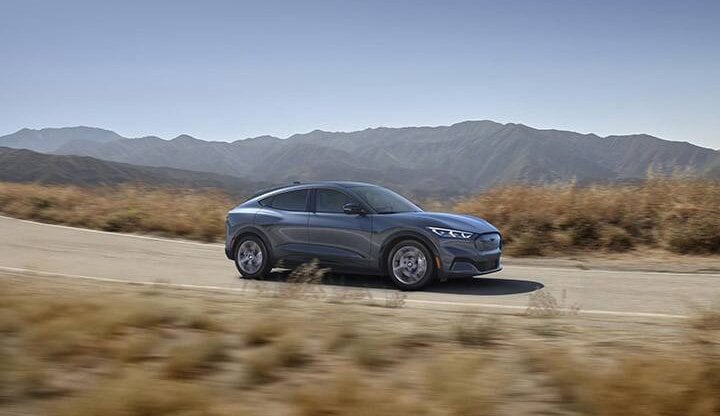
Traditionalists blanched when Ford bestowed its hallowed Mustang name on, of all things, an electric crossover SUV. But while there’s no muscled-up Mustang V-8, the consolation is zero tailpipe emissions and a 0 to 60 mph burst in as little as 3.5 seconds. That’s quicker than the current, track-storming Mustang Shelby GT 350R. That acceleration figure is for a top-shelf, $61,600 Mach-E GT edition with 459 horsepower and 612 pound-feet of torque. Standard versions will deliver up to 332 horsepower and 417 pound-feet when the Mach-E goes on sale late this year. Ford promises its five-passenger Mach-E will range from 210 to 300 miles, depending on the model, with a choice or rear- or all-wheel-drive. And Ford, which has placed an $11 billion bet on electric cars, including an upcoming electric version of its F-Series pickup—merely America’s best-selling vehicle for 38 straight years—is keenly aware of the need to chop down obstacles to mass adoption. Ford claims its FordPass, in partnership with several charging companies, will be America’s most expansive public charging network, with 35,000 plugs at 12,500 locations in the U.S. and Canada; that includes access to DC fast chargers from VW-backed Electrify America. Owners can also order a Ford-branded home charger online, and have it installed through Amazon Home. That 240-volt unit will add 32 miles of driving range for every hour on the plug, with owners waking up to a full battery just in time for coffee and the morning commute.
Base price: $44,995