
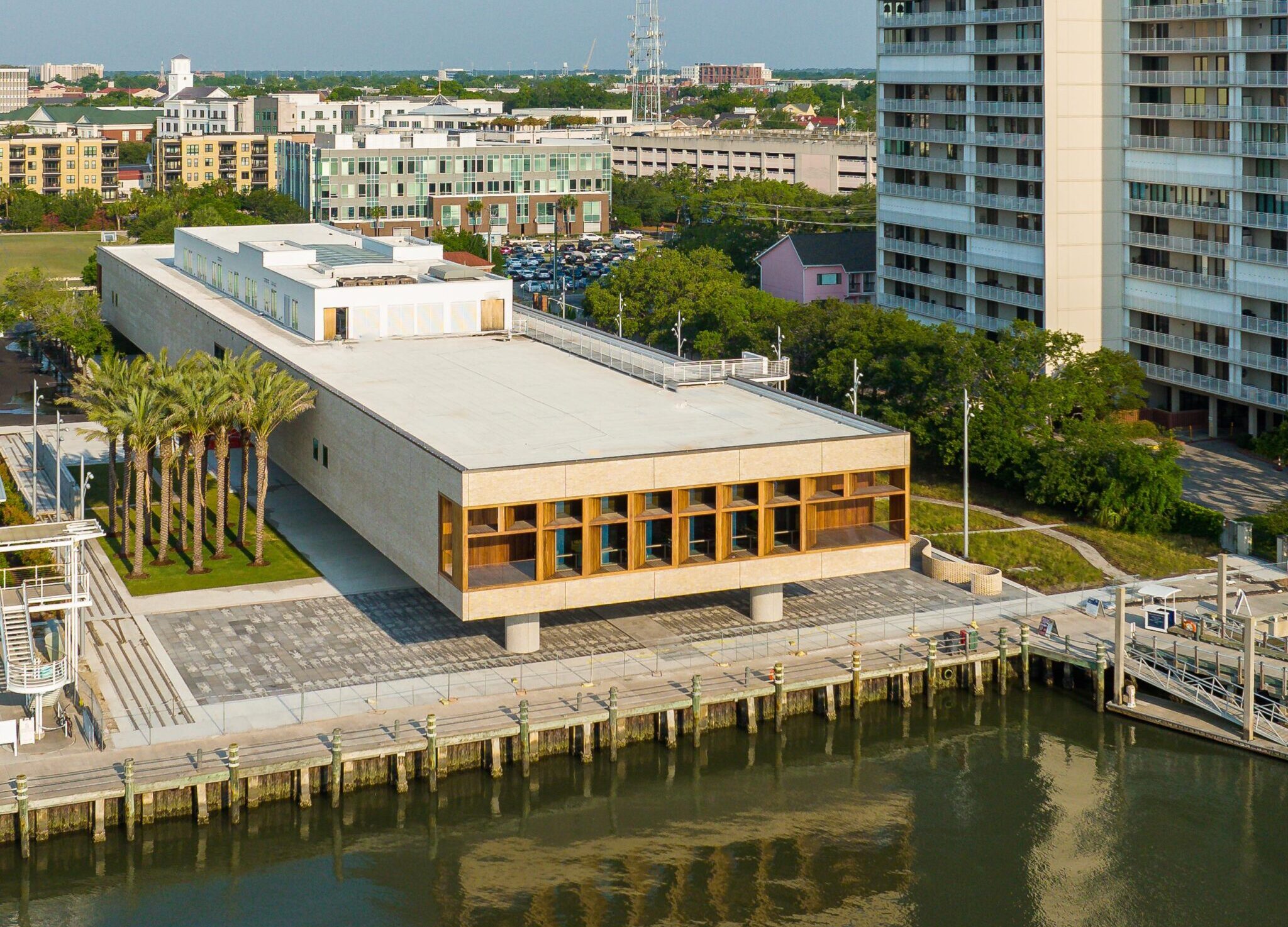
The International African American Museum in Charleston, S.C., is an unassuming structure, “a very quiet building,” according to its first proponent, former Charleston mayor Joe Riley. It lacks the dramatic visage of the National Museum of African American History in Washington, D.C. It doesn’t hit you with the horrific power of 800 hanging, coffin-like steel monuments at the National Memorial for Peace and Justice—also known as the Lynching Memorial—in Montgomery, Alabama. Instead, it sneaks up on you.
The journey on which the IAAM takes visitors begins outdoors. Overlooking Charleston Harbor, its long, slender form rests on 18 13-foot-tall pillars. The land underneath the building is a sacred space: About 250 years ago, it was the site of an 840-foot pier known as Gadsden’s Wharf, named after a local merchant and slaveholder. Until the new country’s prohibition on the slave trade commenced in 1808, Gadsden’s Wharf was the unloading site for hundreds of slave ships. Figures vary, but 40 percent of all enslaved Africans in the American colonies landed in Charleston, and an estimated 45,000 Africans were transported to this wharf in just the five years before 1808.

Quietly, the museum reminds you of that tragedy. It begins with a series of “Kneeling Statues,” childlike figures representing Africans who died in the slave trade. Closer to the waterline is a “Tide Tribute,” a relief embedded in the ground representing human beings shackled in the interior of slave ships. When the tide comes in, the water covers many of the figures. Not far away, visitors can process their emotions in an African Ancestors Memorial Garden, representing “hush harbors,” secret gardens where slaves would gather to share stories or practice their faith. The impact is powerful and heartbreaking.
Inside, the journey continues as the museum’s east side, pointing towards Africa, tells the story of how Africans were brought to American shores and what happened to them once they arrived. The west side explores the journeys of their descendants over the next centuries—not just their survival, but ultimately their success. A genealogy center will allow any visitor to research their ancestry. And on the top floor, in what is perhaps an unintentional metaphor for an ascent that has taken—is taking—centuries, is the office of Dr. Tonya Matthews, the museum’s president and CEO.
In the twenty years of planning for this museum, Matthews tells me, “The big question early on was, do you focus on a specific phenomenon, like slavery? Or do you do something more encyclopedic,” spanning the African American experience beyond slavery to the present day. To understand the experiences of enslaved Africans, Matthews says, “you’ve got to go back,” to their lives before slavery, “But you also have to go forward. Which means that we’re going to use [slavery] to tell a much broader story.”
Over the past two decades, as American society struggles with questions of racial justice, dozens of outstanding institutions devoted to re-examining Black history have been founded in the United States, ranging from the museums and memorials in Washington and Alabama to places like the Muhammad Ali Center in Louisville or the National Museum of African American Music in Nashville.
But the IAAM, scheduled to open on June 27th of this year, carries a particular burden of expectation. Because if Gadsden’s Wharf was a point of disembarkation for African slaves in Charleston, then Charleston, it could be argued, was ground zero for American slavery. Not only were the numbers of Africans brought here—an estimated 200,000—staggering, but tens of thousands of the enslaved were kept in the state to work and die in the South Carolina Lowcountry’s lucrative rice fields. Their labor and agricultural expertise created much of the wealth on which modern-day Charleston is built.
The Civil War started at Fort Sumter in Charleston, and South Carolina was the first state to secede from the Union. Even now, the shadow of race hangs heavy over this city. Forty years ago, Charleston’s famed Peninsula—the area most tourists think of when they think of Charleston—was about two-thirds Black, one-third White. Thanks to gentrification and the rising cost of housing, that ratio is reversed. Eight years ago, a young white man joined a Bible study class at Mother Emanuel AME Church in Charleston, a Black church founded in 1816, then shot nine parishioners to death. The shooting sparked a heartfelt effort on the part of many in the city to address racism and its ongoing legacy there. One way was to talk about it.
“This museum started as a dream,” says Helen Hill, CEO of Explore Charleston, the city’s destination marketing organization. “How can we tell this very important story in a place where it needs to be told?”
Joe Riley, who led Charleston as mayor for an astonishing 40 years, first had the idea for the museum after reading Slaves in the Family by Edward Ball, a 1998 book that detailed Ball’s exploration of his slaveholding ancestors. Riley, mayor since 1975—he is now 80—grew up in Charleston and attended segregated schools all the way through college. In 1968, as a young state representative, he introduced legislation to establish a holiday in honor of Martin Luther King. (It failed.) Later, as mayor, he organized marches to protest the raising of the Confederate flag over the South Carolina statehouse. Still, he later said, after reading Slaves in the Family, “I, for the first time, was really confronted with the enormous role that Charleston played in enslaved Africans coming to our country.”
Riley introduced the idea of a museum in a state-of-the-city speech in 2000, and a plan was adopted to raise $75 million from city, state, and donor funds to pay for a new museum. It has been a long journey. The budget would swell to over $100 million. The opening was repeatedly delayed ensuring that the building was ready. “There were a lot of non-believers,” says Keith Waring, a Black member of the city council who is on the museum board. “In both communities.” Two decades later, the dream is about to open its doors.
For Hill, the city represents a tangible extension of the museum’s emphasis on African American culture and accomplishment. Visitors to IAAM learn, for example, about the enslaved Africans who created the ironwork that adorns buildings throughout the city— and then “they can go out into the community and see it there,” Hill says. The IAAM explores the Lowcountry rice culture, and visitors can see the legacy of that culture at the nearby Middleton Place plantation. “We’ll tell that story,” Hill says. “That’s where the victory is—that despite the horrors, these [achievements] have survived. The legacy is there.”
“There’s a certain pride when you walk around Charleston,” says Keith Waring, “all these examples of architecture built by slaves. They had no electric drills, no hydraulics, no cranes. And some of these structures have endured some of the worst hurricanes that ever hit the East Coast and still stand. It took a strong people to do that.”