

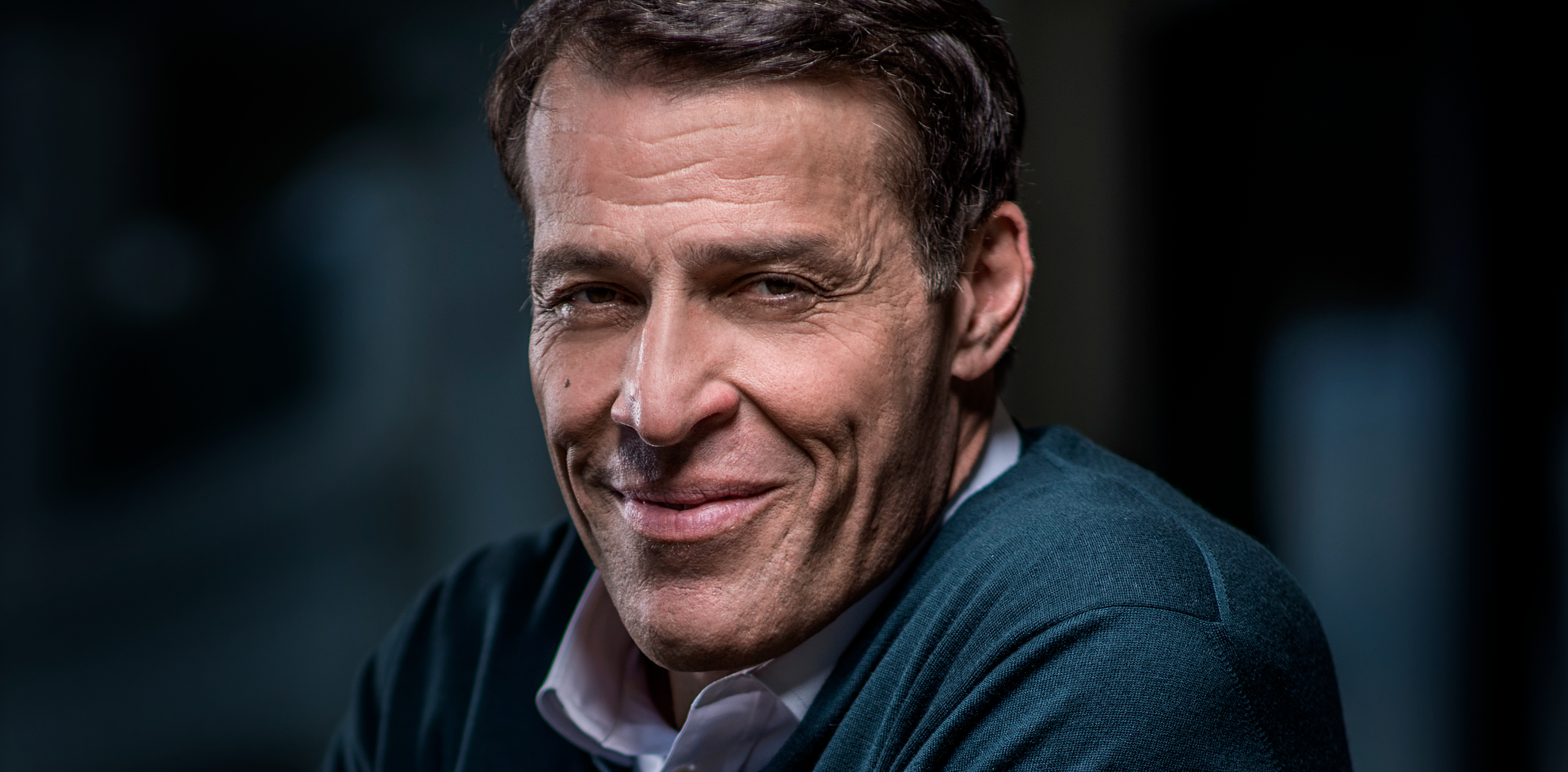
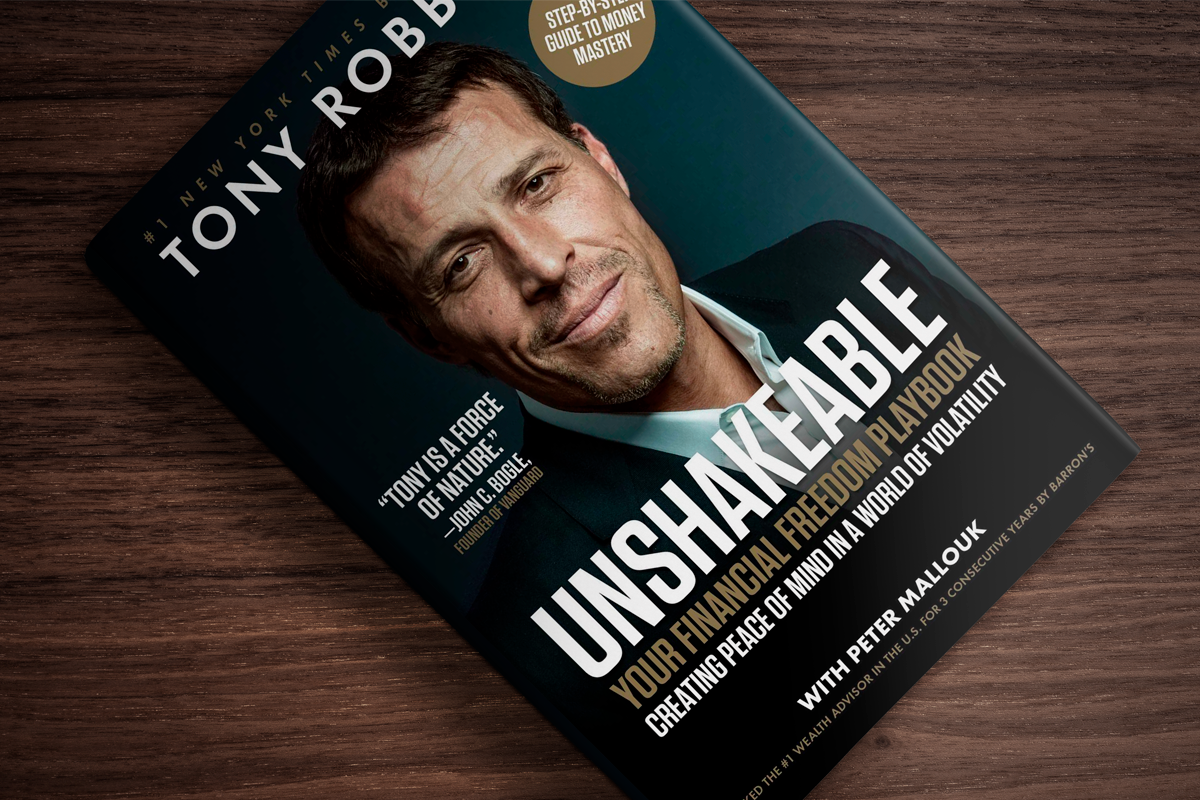
A few weeks ago, I was talking with Tony Robbins, probably the most famous life coach in the world, about investing and his new book, Unshakeable: Your Financial Freedom Playbook. It’s a sequel to his 2014 tome, Money: Master the Game, an exhaustive look at best practices in investing that Robbins says sold over a million copies. Unshakeable picks up where Money left off, taking aim at the wealth management industry as ridden with conflicts of interest and duplicitous business practices, a carny game in which retail investors are the marks.
I wanted to know how Robbins, who many people still remember as a brash young motivational speaker who peddled mantras of personal confidence and growth through cassette tapes and infomercials, decided to turn his attention to the crowded, contentious field of wealth management—and made himself one of the most powerful people in that field.

Robbins says his focus on investing and wealth management started in 2007, before the onset of the housing crisis and the Great Recession. “I knew what was coming,” he explains, because he worked with hugely successful clients such as hedge fund manager Paul Tudor Jones, who warned him that a financial meltdown was imminent. So, when the crash came, “I did unbelievably well. I was prepared. I had some of the best people in the world coaching me, and I made a fortune off 2008.”
Most Americans, of course, were not prepared for the financial crisis and did not make a fortune during it, a reality that bothered Robbins deeply. For decades he’d been trying to help average people, both one-on-one and in groups, address their finances with confidence and vigor. “I really believe that 80 percent of wealth is psychology, 20 percent is mechanics,” Robbins tells me. “If you don’t have the psychology, your mechanics aren’t going to be enough.”
But then, largely because of systemic failures over which they had no control, millions of people were financially devastated. “In 2008, 2009,” Robbins says, “I saw people losing their homes, half their net worth, overnight—and it was preventable. That drove me a little crazy.” Robbins’ frustration ramped up when he watched Inside Job, Charles Ferguson’s Academy Award–winning documentary on the financial crisis. “I just kept thinking, Somebody’s going to do something, right?”
“I had some of the best people in the world coaching me, and I made a fortune off 2008.”
Robbins and I were sitting in oversized lounge chairs on the patio of his home in West Palm Beach, Fla. It felt like an appropriate setting for a conversation about wealth. Robbins moved from California to South Florida three years ago in part because California taxes were consuming an enormous chunk of his income. His new home, for which he paid a reported $24.7 million, suggests that his financial status is intact. Protected by a perimeter wall on three sides, a motorized driveway gate and a security guard, the house has about 16,000 square feet of living space; 200 feet of ocean-facing waterfront; and a seductive infinity pool that ends 15 feet from a retaining wall overlooking a sandy beach and the startlingly close Atlantic. A steel flight of steps down to the beach has an electronic lock.
“I believe we all have a trigger point for money,” Robbins says. “I remember, at the beginning of my career, I made $38,000 a year. Then I made a million dollars a year. And the push to do that was, quite frankly, having a son [Jairek, now 32] on the way. I grew up very poor. I had four different fathers, all that pain, with no money. It made me decide—I’ve got to find a way to change this.”
Reclining in his chair as he spoke, Robbins looked fit and relaxed. He laughed often, swore when he wanted to and maintained, in his speech and demeanor, a sort of laid-back intensity: focused, but not stressed. Dressed in long shorts, a polo shirt, an Audemars Piguet watch and sneakers without socks, Robbins looked comfortable living comfortably. I asked him about the relationship between money and happiness. “There is no relationship between money and problems,” he says. “You can have zillions of problems and still be happy. And you can have $10 billion and still be a miserable son of a bitch.
“Money makes you more of what you are,” he adds. “It’s a magnifier of human personality. If you’re giving, you have more to give with. If you’re mean, you have more to be mean with.”
What do people most want his help with? “It’s relationships; it’s their bodies, what they’ve been through,” he says. “Sometimes it’s religion, sometimes it’s conflict in families. But it’s really hard to make a relationship work when you’re trying to figure out what the hell to do financially.”
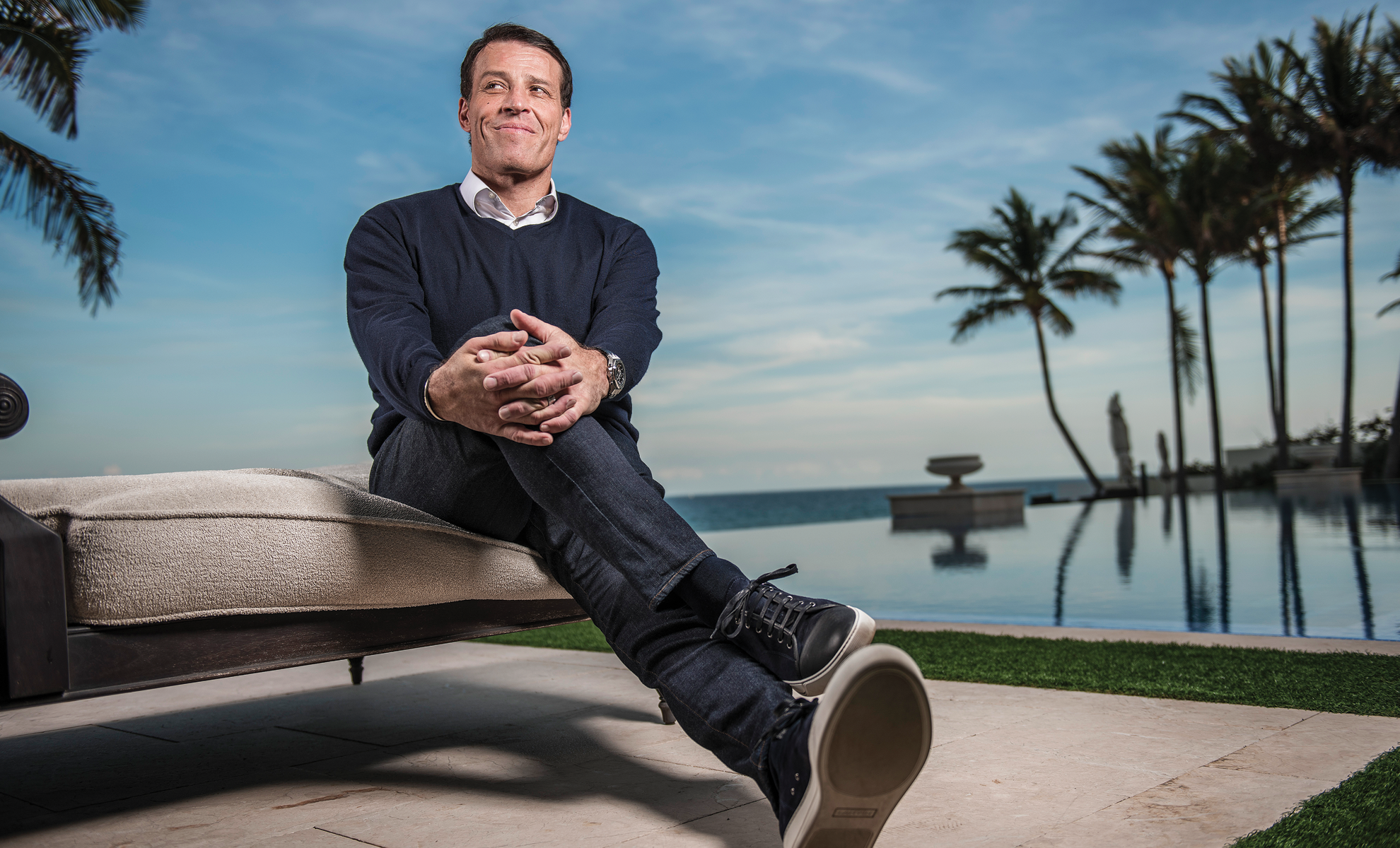 Tony Robbins at his home in West Palm Beach, January 2017. Photo by Josh Ritchie
Over the course of his four-decade career as, first, a strategist—Robbins prefers that term to “motivational speaker,” explaining that motivational speakers may fire you up, but strategists give you tools—and later a life and business coach, Robbins has always aspired to help his devotees make money: His early books boasted positivity-charged titles like Awaken the Giant Within: How to Take Immediate Control of Your Mental, Emotional, Physical and Financial Destiny! And at his current events, such as “Life and Wealth Mastery” and “Date with Destiny,” Robbins is unabashed: Money alone won’t make you happy, but there’s nothing wrong with trying to make more of it.
In Money: Master the Game, Robbins lambasts wealth management industry practices that can eat away at investor returns. He writes about the differences between wealth advisors who are registered investment advisors, or fiduciaries, and those who are brokers; the true impact of the high fees of actively managed funds; and the conflicts of interest rampant in an industry where brokers are financially incentivized to push their own or other companies’ financial products and the client never knows.
The title of the book gives away Robbins’ feelings about the wealth management biz: It’s a game, with its own set of barely disclosed rules, and if you don’t know that, you are bound to lose. “I was obsessed with the idea of helping the average person but also writing something that my [high net worth] clientele would find valuable,” he says.
Based on Robbins’ interviews with 50 prominent figures in the financial world, from Jack Bogle to Warren Buffett to Carl Icahn, Money: Master the Game was a well-received commercial smash. It was, according to the New York Times, “a distillation of just about every good personal-finance idea of the last 40 years.” The book would rapidly hit No. 1 on the Times bestseller list, where it would spend some nine months. Perhaps inevitably given Robbins’ status as an outsider and a critic, not all reviews were positive. “Infomercial king Tony Robbins wants to tell you what to do with your money. Be very afraid,” read a headline in The Guardian. The writer argued that, while Robbins’ critiques of the wealth management industry were spot-on, his recommendations for portfolio construction were not. Other critics pointed out that the book plugged a new wealth management firm, Stronghold Financial, which Robbins considered becoming a partner in before deciding against it. A snarky theme of some reviews: If you want to learn how to walk over hot coals, sure, listen to Tony Robbins. But take investing advice from a self-help guru? No. Leave that to the professionals.

Robbins points out that all the profits from the book go to a charity—the Anthony Robbins Foundation focuses on feeding the hungry, among other programs—and that he doesn’t claim to be a financial advisor: The book is really about conveying the wisdom of many of the most successful people in global finance. It’s hard not to wonder, though, if skeptical reviews even matter. Robbins’ fans are passionate, loyal and ubiquitous; he has almost 3 million Twitter followers, for example. And according to tonyrobbins.com, more than 4 million people have attended his live events and over 50 million people from 100 countries have been exposed to Robbins’ teachings through his “audio, video and life training programs.” These latter numbers are hard to confirm, but anecdotally they seem plausible. Robbins reaches people that elite financial commentators don’t. Just Google “Money Master the Game” and “review”—you’ll find dozens of analyses of the book on personal blogs, book club pages and DIY financial sites.
It’s impossible to quantify just how influential Money: Master the Game has proven to be, but it’s most definitely placed Robbins at the center of a growing conversation about change in the wealth management industry. He’s all over the place, on the cover of Fortune, in videos on Business Insider`, speaking at financial conferences (including one sponsored by this magazine in 2015).
Robbins has become a kind of shuttle diplomat, moving from elite to popular and vice versa.
The fact that a popular figure like Robbins has joined this debate is a sign of just how much pressure wealth management is under. It’s a business in the throes of a massive evolution, buffeted by post-financial crisis skepticism, growing consumer doubt about the virtues of active management, relentless fee pressure and disruptive technology, especially from robo advisors. As reformers like Robbins speak out and entrepreneurs launch paradigm-changing financial products and firms, the wirehouses that have dominated the wealth management landscape for the better part of the last century are under siege. Generally speaking, their response has been to co-opt some criticisms—offering their own robo platforms, expanding ETF choices—while continuing to avoid transparency on fees and throwing their weight around in Washington, maneuvering to roll back the financial regulations of the Obama years. Under a Trump presidency, they appear to have the support of the White House, which wants to eliminate a new Labor Department rule mandating fiduciaries for retirement plans and emasculate the Consumer Financial Protection Bureau. These moves may be merely an attempt to buy time, to fend off the long-term threat of grassroots pressure and technological change. But because most Americans don’t know a lot about investing, and because much of this debate happens in rooms to which the public doesn’t have access, it’s effective.
That is where Robbins comes in. He has the perspective of someone who has billionaires for clients—he charges them $1 million a year for coaching—but speaks to millions of middle-class Americans. There may be no one who straddles those two worlds the way Robbins does, and he has become, in essence, a kind of shuttle diplomat, moving from elite to popular and vice versa, able to represent each while retaining the confidence of both. “I’m trying to be one of the people who’s looking out for the average investor,” Robbins says. “I think I’m an advocate for the little guy. And yet, my clients are big guys too. So I see through both eyes.”
The result is a force for change that empowers individual investors but doesn’t demonize individual wealth managers—Robbins is careful to point out that there are lots of smart, conscientious people in the industry. “Is Tony driving change?” asks Peter Mallouk, the owner of Leawood, Kan.–based firm Creative Planning and the co-author of Unshakeable. “There’s no question. He can’t do it all himself. But he’s going to do more, probably, than anybody else.”
Robbins’ new book, Unshakeable, picks up where Money left off, but it is less a sledgehammer than an arrow: At 221 pages, it’s far shorter than the nearly 700 pages of Money. As a result, it’s far more focused. After an introduction from Vanguard founder Jack Bogle, who clearly considers Robbins something of a kindred spirit, the book launches into chapters on low-cost investing and the impact of high fees on the returns from 401k plans. The message is the same: Investors beware. Though Robbins is careful to point out that there are plenty of well-meaning, pro-investor wealth advisors at wirehouses, he maintains that their impact is limited, because the house sets the rules.
The critique Robbins develops in Unshakeable feels thoughtful, coherent and hard to contest; it’s a blend of insight into the inner workings of wealth management and investment common sense. But Unshakeable is likely to generate controversy not just because of its content, but because of the business arrangements underlying it. Though Robbins is again donating all the profits from the book to charity, it will still generate wealth for him. That’s because, before writing the book, Robbins partnered with a wealth management firm—Mallouk’s Creative Planning—and Scottsdale, Ariz.–based 401k management firm America’s Best 401k. At Creative Planning, Robbins is a board member and the “director of investor psychology,” which means he talks to advisors about clients’ emotional and psychological needs and attends company events. At America’s Best 401k, Robbins is a one-third partner, along with his son Josh Jenkins-Robbins, who is the company’s chief marketing officer, and founder Tom Zgainer, a longtime executive in the 401k management space. As Jenkins-Robbins explains, “When Tony started writing Money: Master the Game, he really didn’t have a monetization strategy; it was just years of research. But in that process he discovered there was tremendous opportunity for disruption.”
Robbins doesn’t try to hide these arrangements; he discloses them repeatedly, and, of course, Mallouk is his co-author. Robbins plugs both firms in Unshakeable, and inevitably some critics will argue that Robbins’ criticisms of the wealth management industry just happen to benefit his own financial self-interest.
That’s true, but it’s not ultimately a meaningful argument. Robbins’ criticisms stand or fall on their own merits, and the stories of how Robbins entered into those partnerships sound like the natural moves of an entrepreneur—Robbins is an investor in or part-owner of 31 companies, ranging from a Fiji resort and spa called Namale to NextVR to Planetary Resources, an asteroid mining company—blending conviction with opportunity.
Creative Planning came to him. Mallouk was a lawyer and consultant to wealth managers before purchasing Creative Planning in 2003. It had some $30 million in assets then; he’s since built it into a $22 billion firm by marketing low fees, fiduciary standards and a suite of services (legal, tax) not typically offered by wealth managers. After the publication of Money: Master the Game, Mallouk noticed that Robbins, through an online platform, was inadvertently recommending some firms that didn’t fit his investor-first criteria. (“They told us they did,” Robbins says.) “I called [Robbins’ office] and said you’re referring people to companies that don’t philosophically match up” with what Money: Master the Game advocates, Mallouk recalls. “They called back and said, ‘Tony wants to understand why.’”
Mallouk explained to Robbins that some of the firms Robbins was recommending employed what’s known as dual registration, or “hybrid,” advisors—advisors who are registered with the SEC as both fiduciaries and brokers, which is legal but ethically problematic: They’re putting the client first…until they aren’t.
Other wealth management firms were selling their clients financial products created and sold by companies they owned, which happened to have a different name. “I think [learning] that really blew him away,” Mallouk remembers. “It bothered him that he had sent people to some of those places.”
“All this left a bad taste in Tony’s mouth,” recalls his son Jenkins-Robbins. “He said, ‘It’s more risk for me to promote multiple firms than just one.’”
So Robbins proposed a partnership: If Mallouk would create a suite of services for investors with just $100,000 comparable to the one he gave clients with $500,000, then Robbins and his own wealth manager, a San Diego–based RIA named Ajay Gupta, would join the firm. Mallouk did, and they did. “I was extremely impressed with Peter’s platform—objective advice, no proprietary products, comprehensive planning,” Gupta says. “I thought this would be incredible for my clients.”
At first, Mallouk admits, he wasn’t sure about the idea of a partnership. “We’re a quiet firm,” he explains. “But we wanted to reach people we weren’t reaching. He’s been able to draw attention to the industry. When he says something, it reaches a lot more people than we do, and we know that.”
Tom Zgainer, the founder of America’s Best 401k, explains that in 2014 Robbins reached out to him out of concern that he was overpaying for the 401k program his own company, Robbins Research, was using. Zgainer’s firm promotes greater transparency and lower fees in its 401k management than are typical. “The fees for Tony’s plan were about 186 basis points, all in,” Zgainer recalls. “We got it down to 50 basis points.”
Zgainer explained to Robbins that hidden and exorbitant fees were widespread throughout the 401k industry, and that those fees were wiping out years of potential returns for investors who were counting on that money for retirement. America’s Best 401k, Zgainer said, reduces 401k fees for companies that switch to them by an average of 57 percent. “Tony said, ‘How do you think it would work if I started using my social platforms to promote this business?’” Zgainer recalls.
Those discussions morphed into an equity stake for Robbins and Jenkins-Robbins, who would also become CMO at the firm. “I started to promote them,” Robbins says, “and then I said, ‘Hey, why don’t we become your partners?’”
It’s a good deal for him, Zgainer says. “We know with [the publication of] Unshakeable we’re going to get a massive spike. Because people do what Tony tells them to do.” But it’s also a good deal for investors; Zgainer says that a significant majority of Americans with 401ks don’t even realize that they pay fees on those plans, much less how needlessly high those fees are. A broadside from Tony Robbins can help change that. “It is insane, the level of fees that we see,” Jenkins-Robbins says. “The level of abuse…”
In Florida, I asked Robbins if he considers himself a populist—not in the Trump way, appealing to both good and bad instincts of average Americans, but in the sense of believing that his mission is to advocate for people who aren’t powerful.
“I don’t know,” he answers. “I believe in democracy and I believe in equality of opportunity, and I just feel like this is an area that is so horrific and has so much consequence for people. The [wealth management] industry is full of great people, but…
“For me, the driving force is that I believe this is an industry that can be disrupted. I’m just one guy—there’ll be many disruptors. But the disruption is just bringing people the truth.”
For more information on Tony Robbins and Unshakeable, visit tonyrobbins.com and unshakeable.com; on Creative Planning, visit thinkingbeyond.com; and on America’s Best 401k, visit americasbest401k.com.
EDITOR’S NOTE: An earlier version of this story incorrectly identified the amount of money Creative Planning clients must have with the firm in order to access the suite of services available to clients who have $500,000 with Creative Planning. It is $100,000, not $50,000.