

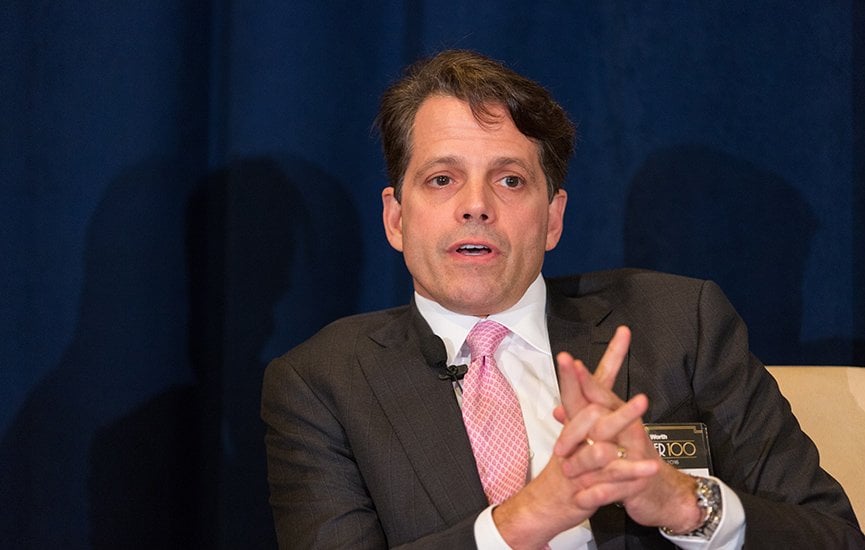
Love him or hate him—and there are people on both sides—Anthony Scaramucci is one of the most fascinating figures in finance. The founder of SkyBridge Capital, a hedge fund-of-funds, Scaramucci is also a founder of the SALT conference, the hedge fund industry’s most over-the-top annual gathering, in Las Vegas; co-host of Wall Street Week, the weekly talk show he brought back from the dead; and partner in Manhattan power lunch spot, the Hunt and Fish Club.
Scaramucci is also the author of three books, including his newest, Hopping Over the Rabbit Hole: How Entrepreneurs Turn Failure into Success (Wiley). It’s a brutally honest look at his entrepreneurial story, from a modest blue collar Long Island background to his founding of SkyBridge, the struggle to keep his business alive during the financial crisis and ultimate success.

This is an edited version of an hour-long interview with Scaramucci.
Q: Anthony, the last time I saw you was in mid-October, when you joined Worth as a speaker at our Power 100 summit in Greenwich, Connecticut. That was just two weeks before the election, and very few people thought that Trump would win. Now that he has, and you’ve been working on the transition team, how has your life changed?
A: Without exaggerating and no bullshit, it is bizarre what happens. You go into this echo chamber. All of a sudden you get hyper-insulated, where there’s a small group of people and you’re getting inundated with resumes and well-wishers and some nasty-pants people too. I have a lot more appreciation for people who work in government now than I did before.
Before we get too deeply into politics, let’s talk about your book.
It’s a quick read. You can tell I wrote it, right? That’s my voice in there.
Very much so.
My 81-year-old mom always thought that journalism was my calling.
The book is about entrepreneurship, but most people think of you of as being a finance guy. How do you describe yourself?
I guess you could say I’m a serial entrepreneur. I’ve got a restaurant, the SALT conference, podcasts….
So where does a book fit in?
I had a conversation with James Patterson—he’s writing these things he calls “90-minute books.” I wanted to write what I call a four-hour book. My joke is that if you picked it up in the airport on your way to Boca you could finish it on the plane.
It’s serious material, though.
I wrote the book because I just thought there was an interesting story to tell about the financial crisis as it related to our business, SkyBridge Capital. Our business really sucked. We were in decline, and it looked like I was going to fail. Most entrepreneurs, they read a glossy profile in a magazine, and what do they do when they discover that there’s a real life? It’s like Mike Tyson says, “Everybody has a plan until they get punched in the mouth.”
The situation for SkyBridge was that precarious?
Our business was dying. In, say, September or October of 2008, it wasn’t clear if we were going to survive. We had massive redemptions. So what do we do? I thought we were going to go into the third-party marketing business for hedge funds. We started a conference, because I thought that was almost like a capital introduction business.
You’re talking about the SALT conference in Las Vegas.
Yes. I had never gone on TV, so I started going on TV to promote the thing. I leveraged my life and took my savings and put it on that business.
That’s not exactly typical of people in the hedge fund world, who generally hate showing up in the media.
I think people in my industry make a mistake with the media. I think they’ve got to go out there.
Very few do, though.
Some of these guys have said, “I’ve got to get out there and try to rebut whatever.” But for the most part, no. I think it’s a mistake. It’s also been a mistake for Wall Street CEOs to take the flesh pounding from regulators, politicians and the politics of hatred.
What did you think of Elizabeth Warren blasting then Wells Fargo CEO John Stumpf over that bank’s wrongdoings?
I don’t often agree with Elizabeth Warren, but that was broad-based corporate incompetence, and I agreed with her assessment of the situation. In general, though, I think she is unfair. Recently she’s upped her attacks—[calling Donald Trump and his supporters] “racist, xenophobic.” She’s demonizing my industry. I don’t think it’s fair.
Have you ever talked to her about it?
I’ve asked her to lunch several times. She’s rebuffed every invitation. But that’s been the Trump economic team’s message: We’re not going to attack her personally or demonize her; let’s try to engage her.
Let’s get back to the book. What’s the title mean?
The way I always thought of a rabbit hole; it was like Lewis and Carroll: You think it’s a benign thing, and then you step into it and all these bizarre and psychedelic things happen to you. In business, to hop over the rabbit hole, you’re avoiding failure, mistakes.
So what was the rabbit hole for you?
Corporate bankruptcy and reputational harm.
Which, obviously, didn’t happen.
It’s really a rite-of-passage story that way. And, hopefully, it comes across where some of the stuff that happens to you in your life is providential. Any good entrepreneurs, if they’re being honest, will admit that any good things that happen to them, happen in part through providence. Then again, you can’t have the success if you’re not willing to take the risk.
You start the book with a story in which you’re introduced to a conference by Steve Wynn, and he gets your name wrong.
I wanted someone who is a young entrepreneur or a millennial to open the book and say, “OK, this guy wrote a real story where Steve Wynn didn’t even know who the fuck he was.”
One of the most interesting parts of the story is the way that you marketed SkyBridge to people who didn’t typically invest in hedge funds, qualified investors but with a low minimum investment of $25,000.
I went after the market in a nontypical way. I wanted to go where there was no competition, into the Midwest, into a Morgan Stanley office in Nashville or Tuscaloosa, Alabama. “Wait a minute, you’re the head of the company? What the hell are you doing here?” “I’m here because I want your business.”
And what was your pitch?
Here is an investment vehicle where we can get you a portfolio of hedge funds at a relatively attractive price with an attractive return. We’re asking five to 15 cents of your investment dollar coming to us. And that’s work. We now have 37,000 clients, where most hedge funds have only a small mix of corporate investors, pension funds and individuals.
Did your public visibility help?
No question about it; TV has worked. I can go to places now and get 200 to 300 people to come to dinner with me. We can talk about the economy, the hedge fund industry, what’s going on in the world. And then they say, “So why are you so heavily involved in politics?” Well, since the crisis, politics and politicians have really been heavily involved in the economy.
In addition to your political work, you have multiple businesses. How do you manage your time?
There’s a really good book by Stephen Covey called First Things First. In that book he tells a story: “I’ve got a pound of sand and a pile of rocks and this jar—how am I going to fit everything in?”
Well, if you put the rocks in first and then you pour the sand, it finds its way into the nooks and crannies and then everything fits. The rocks are the most important thing that you’re doing, and the sand will find its way into the nooks and crannies.
It’s that simple?
The second thing is that you cannot do what I’m doing if you do not have some perception quality in terms of hiring talented people. I’ve set up a system where I’ve got people who are actually CEOs underneath me. You can’t be a micromanager if you’re going to run this many different things.
You have to hire correctly. But if you’re wrong on the hirings, then you’ve got to be very quick to fire people. When it’s not working out, I’ve never had it happen that waiting longer is the solution.
Your book is painfully honest about your character flaws. In multiple instances you describe yourself as immature, insecure, hot-headed… What’s been the reaction to that from your peers on the Street, which isn’t known for being warm and fuzzy.
Most of my peers find me obnoxious and annoying. “Why is he bringing so much attention to our industry? Let’s just make money and keep to the shadows. That’s the way it works.”
Does that bother you?
I couldn’t care less about that. Where I have been gratified is the response from millennials. I’ve gotten some emails or handwritten mail or stuff on my Twitter account where millennials are like, “Thank you for writing this book. Thank you for being that honest.”
The point is, I’m a polarizing guy because of my fairly constant television appearances and being fairly outspoken.
You don’t sound very bothered by that. Have you always felt that way?
I remember sitting at the Lupus Foundation of America luncheon a couple years ago on a day when [financial journalist] Felix Salmon had written some nasty shit about me. And I’m sitting there with Donald Trump, and he’s looking at me like, “What’s wrong with you? You’re usually so upbeat.” He’s like, “You just got your cherry broken by some journalist. Shut the fuck up. Why don’t you pour yourself a glass of wine and relax a little?”
And I’m like, he’s right, I’ve got to have a thicker skin.
Some people would say the same thing about Trump.
He’s also not a great apologizer, by the way.
Do you see any of that changing now that he won the election?
I would say to you that that campaign persona and that bravado that got him over the finish line tapped into this [working class] discontent. And in a weird way, he has been humbled by the seriousness of this [victory] and has really dialed it back. I think he is really feeling the monumental nature of the job.
But he continues to lash out against his perceived critics on Twitter, and his cabinet so far isn’t exactly diverse.
[Editor’s note: Shortly after this interview, Trump announced that he would name South Carolina governor Nikki Haley to be his ambassador to the United Nations, GOP fundraiser Betsy DeVos to be education secretary and Dr. Ben Carson to be secretary of the Department of Housing and Urban Development.]
I think the jury’s out. If you didn’t vote for him and you don’t know him, I think those are obvious and important things to worry about. But if you’re up close and have a very close seat to the thing, you’re not as worried because you’re watching him [take the job seriously].
How do you see the role of his children evolving?
I know people don’t like the sons and daughters or Jared being involved with him. But to me, it’s like, you’re getting three or four for the price of one—in terms of how they interact, it’s almost like a unit. I told my oldest son, “If you have the arrogance of Donald J. Trump Jr., that’s what I hope for you.” This guy has zero arrogance. Donnie and I were in my NetJets plane yesterday with the Secret Service guys, and they’re piling onto the plane with machine guns. And Donnie stopped and said, “Can you believe I’ve got four guys with machine guns guarding my ass?” And he didn’t say it with braggadocio; he said it just like anyone would.
Anthony, you’ve been loyal to Trump over the course of this election. Is there anything you’d break with him on?
I’m not going to be a Trump apologist for four years. I’m sure he’s going to do shit that we don’t like. But I don’t know a president who doesn’t. These jobs are so goddamn hard.
Will Trump be good for Wall Street?
I think so because we’re trying to get [financial] regulation into a more normalized regulation. I view regulation as totally necessary, but like a ref in a championship NBA game, if you’re calling too many fouls you ruin the game. They’ve made it too safe, and the world is not safe. We have to send a message to our children that the world is not meant to be safe. For example, you have to allow community banks to lend to small businesses—and some of those small businesses will not pay those loans back.
And so again I am for practical regulation, and for containing some of the animal spirits of greed that can run amok in society, but you’ve got to get the right balance. We’ve had 10 years of no wage growth, and that’s because we’ve overcorrected for safety.
Is a job in the Trump administration in your future?
I have no plans to go down to DC—it’s not like I’m Jamie Dimon running a 250,000-employee firm, and I’m going to fill out my resume going down to DC. I don’t see myself in the first wave. I have a business that I love, and I have an obligation to my clients and my employees. Now, having said that, I could go two, three, four, five years from now, if there’s a second Trump administration.
And if he offers you a job before that?
I had this conversation with Mr. Trump, and it depends on what I’m offered. If he’s offering me to landscape the White House, my ancestors already did this. If he said, “Listen, I’m gonna give you this great job. You’re going to be sitting next to me, flying around on Air Force One with me, and the country needs this.” Then, of course I’m going to say yes.
For more information, visit hoppingovertherabbithole.com or skybridgecapital.com.