
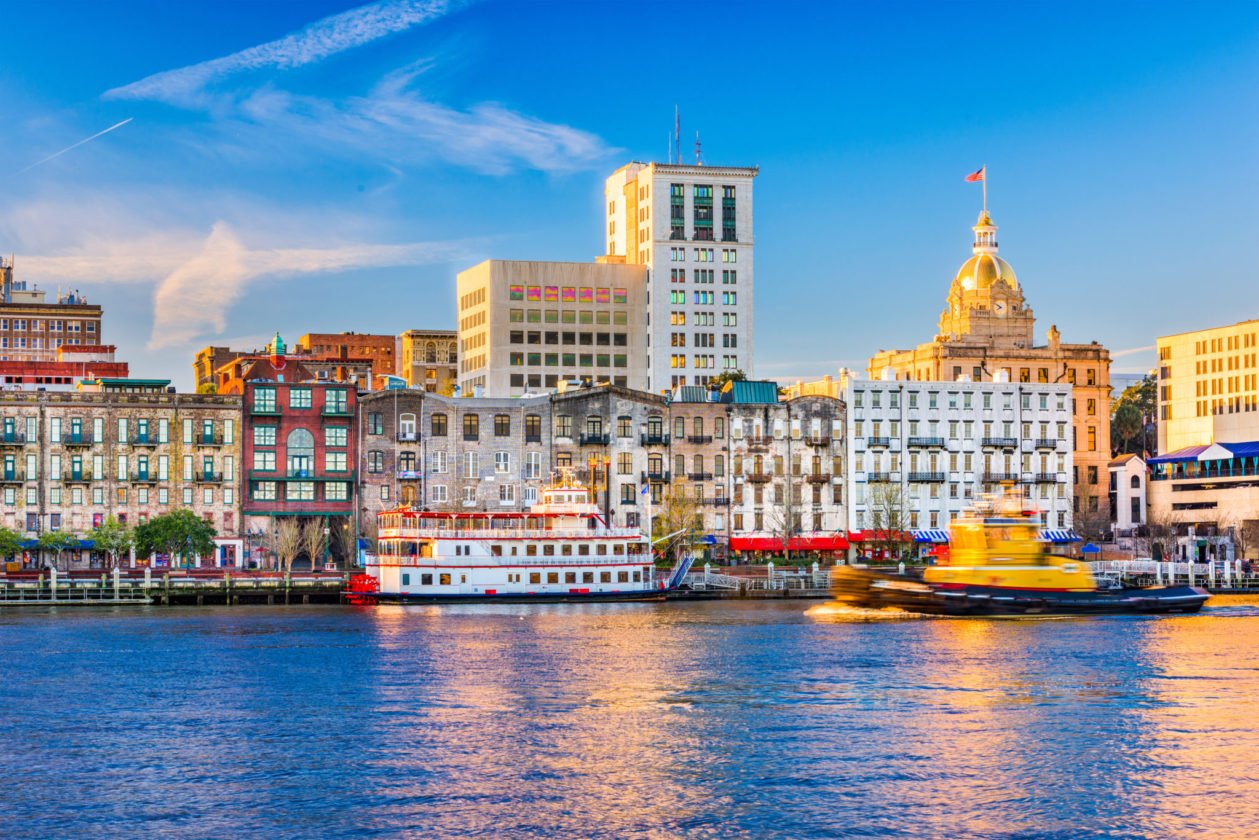
Twenty years ago, Savannah, the small southern city of about 150,000, was best known as a seasonal stopping place for older visitors with a modest local economy. In the two decades since, the city has changed profoundly, becoming a rising star in one of the country’s most economically robust regions. How did Savannah do it? Four crucial elements—the Port of Savannah, Gulfstream Aerospace, the Savannah College of Art and Design (SCAD) and the city’s beautiful historic district—were already in place. But a combination of smart planning and a little good luck has helped Savannah raise its game—and look poised to emerge from the coronavirus epidemic stronger than before.
In this oral history, key players recall the crucial events of a pivotal two decades, from 2000 to 2020.
The Beginning
Founded in 1733, Savannah has been surviving—and maturing—ever since.
Christian Sottile, Partner, Sottile and Sottile/Dean, School of Building Arts, Savannah College of Art and Design
Savannah is a place that’s like a live oak tree. It has a slow build, but as it reaches these moments of maturing, it becomes incredibly beautiful. A pine tree grows quickly, and you cut it down and it gets the job done. But a live oak…

Trip Tollison, President and CEO, Savannah Economic Development Authority
Twenty years ago, everybody was scared of Y2K and anxious about the whole new century. But the most critical point about these three crucial elements—SCAD, Gulfstream and the Port of Savannah—their growth and success all kind of started happening around the same time. SCAD started in the ‘80s and had steady growth, but really grew in the early 2000s. The same with Gulfstream and the Port. [Defense manufacturer] General Dynamics bought Gulfstream in the late ‘90s and started putting new resources into the company. They announced new products and expanded the workforce and really exploded.
Christian Sottile
In the early 2000s, Savannah created a 30-year plan that would end in 2033, the 300th anniversary of the founding of the city. It started with strengthening the core—remembering that a strong city is measured by the strength of its core—but also looking at the shoulders of the city. So, it talked about downtown expansion areas, where we take the city center and use it as a model to continue to build neighborhoods that are uniquely Savannahian. It has guided a lot of larger pieces of land close to the city center, which meant that the city can grow without being locked in time like a Colonial Williamsburg.
The Port
Under the auspices of the state-run Georgia Ports Authority, the Port of Savannah has become an international economic hub.
Jamie McCurry, Chief Administrative Officer, Georgia Ports Authority
In the 1980s and early ’90s, the Port was not nearly as big as we are now. We did have a very natural export base that we continue to benefit from—the agricultural and manufacturing base that we have in the South and Georgia in particular. But we didn’t have a ton of imports to balance against that, and you want balance. In the trade business, the more balanced you are, the more attractive you are. If a ship can carry as much in as they do out, then they’re making more money both ways. Savannah needed to build that import base. So SEDA [the Savannah Economic Development Authority] did something outside of the box—they helped create a ready-to-go industrial park, called Crossroads. Then in the late 1990s, Home Depot decided to put a million-plus square foot distribution center here. That was really a jump-starter for Savannah being seen as a larger opportunity for that consumer import trade.
Trip Tollison
The coolest thing about the Port is that it further proves the point that Georgia is the gateway to the South. We’ve got the world’s busiest airport in Atlanta, the fastest-growing port in Savannah…We’re the third fastest-growing port in the world besides two in China. In seven to 10 years, we’ll be the largest container port on the East Coast. In 2005, I don’t think we were even on the top 10 list of all the container ports in the United States.
Steve Green, Chairman, Savannah Airport Commission
In 2015, there was a work stoppage on the West Coast at the ports, and that forced a lot of traffic through the Panama Canal, and the Georgia Ports Authority staff were able to handle that massive influx of containerized cargo. That taught the shipping world that you could use an all-water route to the East Coast for containerized cargo and actually save money. Because it cost you so much less to bring them over water, as opposed to unloading at L.A.-Long Beach [two adjoining ports] and shipping them east by rail or truck. Everybody expected that when the work stoppage was over, all that cargo would go back to the West Coast. But it didn’t. That’s what set up the Port of Savannah for its great growth.
Jamie McCurry
When there have been interruptions in service at West Coast ports, each time it’s happened, it has benefitted East Coast ports, and perhaps Savannah more than any other—because when you’re coming from Asia through the Panama Canal, Savannah is the first stop. And we are by far the closest port to Atlanta.
Gulfstream Takes Off
Headquartered in Savannah, Gulfstream Aerospace is the leader in its field—and an ambassador to the world.
Angela Hendrix, Vice President of Marketing and Public Relations, Savannah Economic Development Authority
The big thing with Gulfstream was the manufacture of the G150, starting in 2005, which led to the expansion of their Savannah facility. That expansion included an R&D facility, 2,000 jobs and $40 million in investment over a seven-year period.
Trip Tollison
Gulfstream is the premiere brand for general aviation, recognized all over the world. It is the largest aerospace company in the southeastern United States. So, when [a prospective] company looks at that and says, “If Gulfstream has 10,000 employees in Savannah, and is very complimentary about our workforce…it shows other prospects that Savannah can do it. The other factor is a tourism market, with more and more people coming to visit Savannah. That helps the other tentacles of the economy. People come here, and then maybe they want to live here, or start a business here.
The Power of Visitation
Savannah boasts some 14 million visitors a year—but that number doesn’t tell the whole story.
Vaughnette Goode-Walker, Founder and Owner, The Footprints of Savannah Walking Tour Company
I’ve worked here in museums, tourism…I was the chair of the Tourism Advisory Committee for 10 years, and we were keeping back things like the double-D’s, the double-decker buses, and cruise ships, and things that the community did not want. The shift really came when Visit Savannah took up the mantle and started to welcome more visitors with the offerings that we do have. At one time, we had looked at what we have as seasonal visitors, people coming for St. Patrick’s Day or during the summer. But eventually we had people coming all year.
Joe Marinelli, President and CEO, Visit Savannah
You go back 35, 40 years ago, the only Savannah experience for tourists was the Pirate’s House [a local pirate-themed restaurant]. But the city leaders had a vision for the riverfront and transformed what was then nothing more than parking lots and train tracks and warehouses into something we now know as the River Street experience. And about 25 years ago, John Berendt wrote Midnight in the Garden of Good and Evil, affectionately known around here as “The Book,” which lived on top of the New York Times Bestseller List for 216 weeks. First it came out as a hardback, and the audience that reads hardback books began coming to Savannah. Then it came out as a paperback, and people that read paperbacks began coming. And then it became a movie, and people who watch movies…The book is still a bestseller in bookshops all around town, and you still see people carrying it and pointing to different things around the city.
Steve Green
Hospitality has always been a big industry here. In Georgia, only Atlanta has a bigger hospitality industry than we do. Our problem was that we undersold ourselves. We went after the leisure market, the T-shirt and flip-flop market, as opposed to Charleston, which went after the higher end of the market.
Joe Marinelli
I came in 2007 to run what was then known as the Savannah Convention and Visitors Bureau, later renamed Visit Savannah. The edict was, we’ve got to look at changing the demographics of our visitor to one who will stay longer and spend more while they’re here. That coincided with the new age of technology that allowed us to better understand our customer and talk differently with the different audiences we wanted to talk with—emails to certain parts of the country, for example, or by age.
Greg Kelly, Director of Operations, Savannah Airport Commmission
It’s always been the chicken or the egg as to which comes first, the infrastructure downtown that attracts visitors or the air service that brings them. But what Savannah had to offer in terms of air service in 2000 was very limited. Delta controlled most of the market, and the fares were relatively high here. We were typically in the top 10 of airports that had high airfares. There were several [airline] entrants over the years, trying to present some competition and give us lower fares. But they didn’t last until Jet Blue came in 2013. Their concern had been that Savannah was too close to Charleston, too close to Jacksonville, where they had flights. We made the argument that they would not be cannibalizing traffic but stimulating new traffic. So, Jet Blue made a commitment and brought low air fares here, and they have stayed. Then Allegiant saw that, and they bought into that notion. They’re now on their third year here.
Our enplanements—the number of passengers that pay to get on an airplane—have doubled since Jet Blue came. And we used to get complaints about airfares all the time—almost weekly. Since Jet Blue came, complaints have dropped dramatically. I don’t know if I had one phone call in 2019.
Richard Kessler and the Boutique Hotel
Local hotelier Richard Kessler brought the first boutique hotel to a city previously dominated by bed and breakfasts and middle-brow chains. Others have followed.
Christian Sottile
The hospitality piece has been another big driver for planning and new development. That takes us to [hotelier and Savannah native] Richard Kessler and his pioneering work in developing beautiful and very specific properties for the city—the Bohemian, the first hotel on the river—and pioneering the redevelopment of Forsythe Park with The Mansion on Forsythe. Twenty years ago, there used to not be a soul there in the afternoons.
Greg Kelly
When I [first] came here, there were gangs that controlled those neighborhoods, out past Forsythe Park. Now it’s a walking corridor, a biking corridor.
Joe Marinelli
Richard Kessler was the pioneer for bringing the boutique style of hotel here, with converting an old funeral parlor to what is now known as The Mansion on Forsythe Park. That led to him developing a brand-new hotel on River Street called The Bohemian. It featured the first rooftop bar in the city, Rocks on the River. The joke at the time was that somebody built a popular nightclub and bar and put a hotel under it.
Christian Sottile
Rocks on the River showed another way of appreciating the city. And now, of course, Richard has created Plant Riverside, a four-acre site in the heart of the city with hotels, restaurants, retail, dining. It’s so uniquely Savannahian—every detail is handmade from Savannah. Everything was brought to it with a local perspective. Plant Riverside shows a new change in the city’s relationship to the Savannah River.
Steve Green
We’re getting better and better hotels—The Perry Lane, which opened in 2018. Richard Kessler’s J.W. Marriot in Plant Riverside. We’re finally in that transition. Gulfstream owners who would fly in to have them serviced used to stay at Palmetto Bluffs in South Carolina, because they didn’t think we had a nice enough hotel. Now, we’re bringing that high net worth traveler here.
Culture—and Food—Take the Fore
Whether in film and television production, arts festivals or the restaurant scene, Savannah has become a small but dynamic cultural hub.
Beth Nelson, Executive Director, Savannah Regional Film Commission
Film and television production here has changed dramatically over the past 20 years. It used to be entirely location-driven, like Forrest Gump and Midnight in the Garden of Good and Evil, which meant that production here was sporadic. But in 2008, the state of Georgia passed a tax credit for productions filming in the state. And then in 2016, Savannah created a local incentive that gives productions a 10 percent rebate on local spend. That incentive encourages productions to not only hire local crew, but to use local resources. Instead of bringing in equipment and supplies from Atlanta, they look for it locally. We had one film, Gemini Man, starring Will Smith, that had a $173 million budget. They were very interested in our local incentive. It’s just a drop in the bucket in terms of their budget, but every bit means a lot.
Maria Zouves, Founder, the Savannah Voice Festival
There are about 25 festivals here. The Book Festival. The Music Festival. The Voice Festival. Savannah has become a city of experiences. So, it’s perfect for the travelers who loves a great culinary experience, a great cocktail, a sommelier who knows what he’s talking about. Look at The Grey—even now, five years after it opened, you still hear people talking about it.
Beth Nelson
We have more restaurants than we’ve ever had before, and the caliber and quality of the restaurants is just tremendous. The establishment of The Grey—when that survived and flourished, that really brought others.
Joe Marinelli
From the time I got here, I always believed that people came to Savannah to see Savannah, and when they got here, they also found that we had good culinary experiences like The Pink House or Elizabeth’s on 37th Street. But The Grey coming into the market and all of the press around that restaurant, chef Mashama Bailey winning a James Beard award in 2019—that was sort of the tipping point for that dynamic to flip. Now it’s let’s go to Savannah for their culinary scene, and we’ll enjoy Savannah while we’re there.
Christian Sottile
There’s definitely a wider audience that has become aware of Savannah, and The Grey is a big part of that. It’s grown locally, but it’s also aware of its position in the world.
Beth Nelson
The restaurant scene is a huge draw for productions, for talent, for actors. They love the restaurants, the boutique hotels that we have. Because basically if you’re filming a movie or TV show in Savannah, you’re living here for weeks or months. So, it’s nice to be spending that time in a great city. That’s one of those word-of-mouth things.
Trip Tollison
When we [from SEDA] travel the world, it’s a beautiful thing to walk into a room with a bunch of strangers, and someone’s going to mention one of three or four things. Someone’s going to bring up our port. Someone’s going to mention Gulfstream. Someone’s going to mention SCAD. And someone’s going to say, “Hey, I visited Savannah and it was wonderful.” And by the way, all four of those things are extremely favorable.
The SCAD Impact
It’s hard to calculate the importance of the Savannah College of Art and Design—except that it’s huge.
Christian Sottile
When you look at the core of the city, it’s hard not to look at the Savannah College of Art and Design. SCAD’s history in the last 20 years is an incredible story of an institution growing its global footprint, but at the same time strengthening its roots and its flagship in Savannah. That increased the beauty and the cultural vibrance of the city and attracts people to Savannah.
Angela Hendrix
SCAD was founded in 1978 and had classes in 1979—they had 71 students. President [Paula] Wallace became president in 2000. SCAD then went from a college with about 4,500 students in 1999 to about 12,000 now, at campuses in Savannah, Atlanta and France. SCAD offers majors that are in demand in the market, and President Wallace has designed the college to be flexible to meet those demands.
Vaughnette Goode-Walker
SCAD brought something to our city that was missing, and that’s young people, many of them staying here even after they graduate. They have filled up around 80 buildings since 1980, buildings that were just falling down.
Christian Sottile
In terms of historical preservation, Savannah really broke away from the pack in the last 20 years. The question was, do we memorialize our history or find ways to live with it? SCAD had a particular take on that: “We don’t want to put our buildings in formaldehyde, we want them to live and we want them to change.” Among SCAD’s building, the building that provoked that question more than any other is the SCAD Museum of Art, which took direct aim at this idea of preserving historic fabric and developing new designs. We were presented with a ruin [a brick railroad depot dating to 1853]. And the question was, “Do you put the ruin back together or ask what is the real use of this building today?” That was controversial in the preservation community because it used both sides of the spectrum reclamation and radical adaptive use at the same time. That’s a story about what Savannah offers to the nation in terms of thinking about our own fabric.
Vaughnette Goode-Walker
Primarily, my visitors don’t look like me, I just have to say that. I had families from Denmark who came in through Florida from Disney World. I get a lot of Canadians and British people. Again, that quote-unquote sophisticated traveler. But right now, because of the black history experience, people of color are coming to me. They’re trying to connect what’s happening now with what happened in the past. Who are we? So, then I thread the Savannah Civil Rights movement into the tour. I do the slave trade, the cotton trade, urban slavery here in the city of Savannah.
The Future
Despite the COVID epidemic, Savannah is poised for major growth in the next two decades.
Trip Tollison
One thing we’ve learned through this pandemic is the nature of working remotely. Folks have realized they can work from anywhere, and we’re still affordable. You can do just about anything you want here except climb mountains. We don’t have traffic. The fact that we’ve added so many new restaurants and hotels…The quality of life helps us tell the story. We’ve got our challenges, just like any other community, but Savannah has always had a healthy and diverse population. We have a strong track record of being open and inclusive. We all get along.
Joe Marinelli
We’ve got a billion dollars’ worth of development happening on the riverfront, with Richard Kessler’s Plant Riverside Project at one end, the Eastern Wharf project at the other end, the planned expansion of our convention center across the river…If we could fast-forward to 2023, 2024, to know that Plant Riverside is fully developed and blowing it out, and Eastern Wharf is a thriving, residential, retail and entertainment area, and to have the other side of the river starting to meet the potential that it has…And all of that is complimented by one of the great historic districts in the country.
Trip Tollison
Ten years from now, I think Savannah will maintain and cultivate all these things we’ve been talking about. From my perspective, I hope the gap between the haves and the have-nots is not as drastic as it is today. Ten years from now, I think you’ll see all of these sectors continue to boom and grow, with a better wage structure and better earnings for all employees.
Joe Marinelli
The best is yet to come.