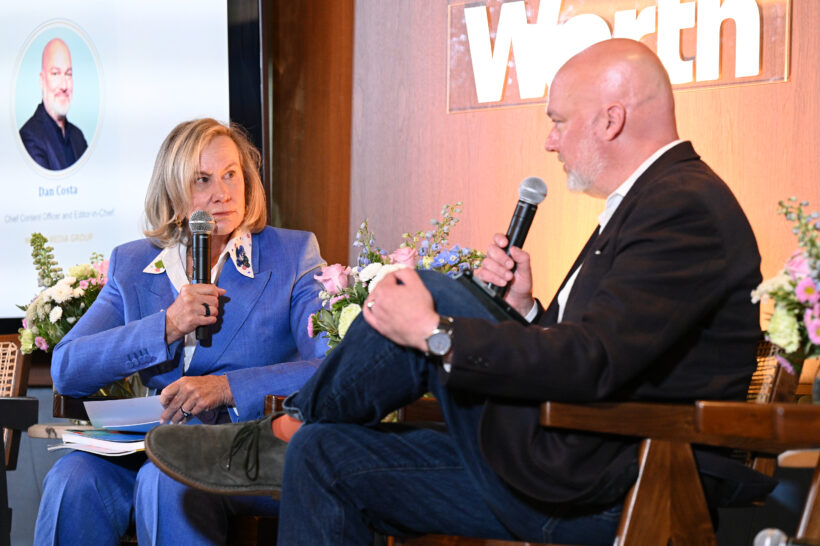
Laurie Tisch has been given the key to New York City twice. She says she can’t take credit for the first. “It was when the New York Giants won the Super Bowl,” she told me at Groundbreaking Women earlier this month. “We were New York Giants owners.” She claims the second was in December 2018. “I like to believe that I did get it because of the work that I’ve done in the city.”
Her work, focused on systemic change through arts and youth programs, aims to foster hope and demonstrate the potential for meaningful impact in NYC.
The tops of her hands
Tisch sat on boards for decades before she ran anything. The first was the Children’s Museum of Manhattan, 45 years ago, when it shared space with a firehouse on 54th Street. “It wasn’t philanthropy,” she said. “I had young kids and wanted to get involved in something.” Then came the Center for Arts Education, the Annenberg initiative that put the arts back into New York’s public schools. That’s where she met Vartan Gregorian, who had run the New York Public Library and Brown before taking over the Carnegie Corporation.

Gregorian’s line about asking versus giving reflects her philosophy of palms up and down, fostering humility and shared purpose that resonates with the audience.
She hadn’t planned on a foundation. “My father and uncle were self-made, so there weren’t many generations of giving. I didn’t know much about traditional foundations like Ford or Rockefeller. Seeing small family foundations up close through the museum inspired me to create my own approach, focusing on direct impact and systems already in place.”
The Laurie M. Tisch Illumination Fund launched in 2007 on one premise: your zip code shouldn’t decide what’s available to you. The interesting part is how it delivers. The family name is on buildings at NYU. Her own money goes mostly into systems the city already runs.
Public walls
Start with the hospitals. NYC Health + Hospitals treats more than a million New Yorkers a year. Its walls were bare. Beginning in 2019, the Illumination Fund commissioned murals at public hospitals and clinics across the system, 26 in the first round, with local artists working alongside patients and staff. These murals foster healing and community connection, tangibly improving patients’ experiences. A second round followed.
“We walked the walk,” Tisch said. “My director got COVID at one of the ribbon cuttings.” The fund put $1.5 million into the system’s Arts in Medicine program in 2019 and another $3 million in 2023, which makes it, by her account, one of the largest arts funders the public hospital system has.”
The hospitals are one piece of an arts-in-health strategy that began as a $10 million commitment in 2018 and now backs roughly 30 organizations. Dance for Parkinson’s at Mark Morris. Gibney’s workshops for survivors of domestic violence, more than 365 a year, reaching about 3,700 people. Programs for dementia patients at Mount Sinai. None of it is glamorous. Most of it happens in rooms donors never see.
Fields follow the same logic. In 2000, after a series of New York Times stories on the state of the city’s school athletic fields, Tisch’s father launched Take the Field. She gave him the idea. “I said that he can do for sports, as a sports owner, what Walter Annenberg had done for public schools,” she said. She introduced him to Chancellor Rudy Crew. The program raised roughly $140 million in public and private money and rebuilt more than 40 fields at public high schools. “The last field was built within a week of his passing.”
Twenty-five years later, she’s on the same ground. Play to Thrive, a $10 million initiative launched last October, funds coaching, mentorship, and access in youth sports, including a Street Soccer park in Queens that opened during the World Cup. The Aspen Institute report the fund commissioned on youth soccer in the region found 1,423 kids per available field in Queens, against 127 in Morris County, New Jersey. Among low-income families, 41% named cost as a major barrier. “There are lots of different pieces of it,” Tisch said. “It has to do with coaching and mentorship and access and opportunity.”
Palms up again
The circle doesn’t close. Tisch is co-chairing the $300 million campaign to move the Children’s Museum of Manhattan into a former church at 96th and Central Park West, 80,000 square feet, opening in 2028. She put in $50 million herself. The city put in $46.1 million. “I’m spending a lot of time like this,” she said, palms out.
That’s the structural point. Even the donors with the most control keep going back to asking, because the things worth building cost more than any one family will pay. And the things she chooses to build sit inside public systems, which raises a question the room didn’t ask: what does it say about the hospitals and schools that private money has to buy them art and grass?
Her advice for the women in the room came from her first meeting with Rockefeller Philanthropy Advisors, 18 years ago. They asked what she was passionate about. “I think, oh my God, I don’t know what I’m passionate about. I must be a terrible person.” She didn’t realize then that her curiosity and desire to improve community systems-like youth sports, hospital walls, and access-would become her guiding principles. Passion, on my account, is something you find on the job, through genuine engagement and curiosity.”