
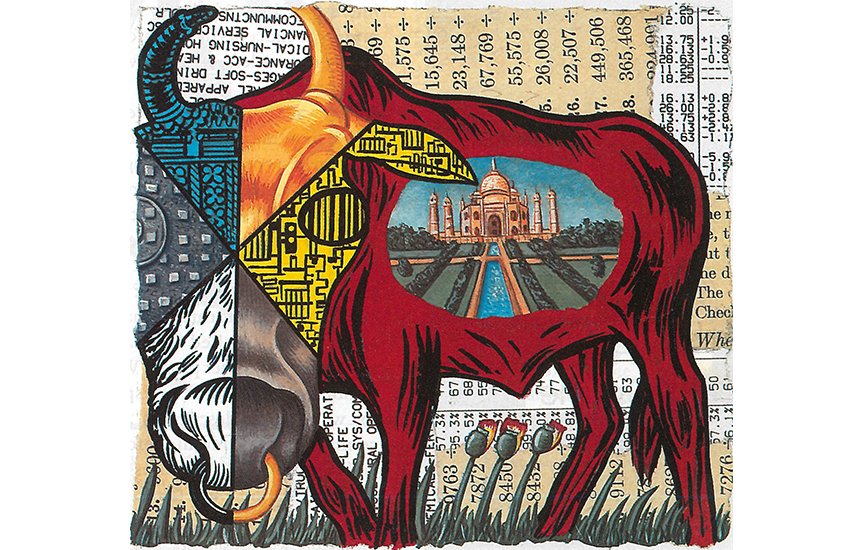
In the July/August 1998 issue Worth columnist Jim Rogers preciently defines India as an emerging superpower, predicting that in 20 years Americans would have their financial planning and tax preparation done by via the internet by an accountant in India—in less than 20 years, we are already there. He posits: “Which nation has the largest middle class? (Nope, not the U.S.) If you won’t know the answer, you haven’t been following one of the world’s most important economies.”
I’ve used this space before to express my conviction that the United States’ reign as the world’s only superpower isn’t likely to last. It’s quite clear that sometime in the next century China will eclipse the U.S. as the world’s dominant force. I’ve even suggested that American schoolchildren should start learning Chinese. China, however, isn’t the lone emerging superpower. There’s another nation—one I’ve written far less about—that is clearly destined to become a major player on the global stage: India.

India recently jumped to the forefront of world attention by exploding a few nuclear bombs. This was a rude wake-up call to what already should have been obvious: India is a force to be reckoned with.
Everyone knows about China’s huge population—1.2 billion people. But fewer realize that India isn’t far behind, with 950 million citizens. More important, India already has the world’s largest middle class—estimated between 150 million and 300 million people. It represents a huge, skilled workforce, an enormous market for consumer goods and an economic force that we all need to know something about.

For better and for worse, India owes its existence as a nation to Great Britain. The colonial British crammed a variety of cultures and religions into one pot, imposed English as the common language for business and politics, and introduced the concept of bureaucracy—a tool that the Indians have since elevated to an even higher level of mindlessness. (My visits to Indian government offices have been unique; it’s often hard to make human contact amid the dizzying mountains of official forms.)
India would be even further along economically if it hadn’t taken a wrongheaded detour during the Cold War, when it allied itself with the former Soviet Union. It took until 1991 for India to recognize this error and to reject economic statism. China, by contrast, began embracing free markets as early as 1979. China’s head start has given it a significant edge over India in economic growth. While China’s gross domestic product grew at an annual rate of 8.5 percent between 1965 and 1996, India’s growth averaged 4.5 percent.
Even so, India now has a larger economy than France, Britain, Italy or Brazil. It currently ranks fifth in the world, behind the United States, China, Japan and Germany. Unlike many emerging economies, India also has a legacy of democracy and a strong rule of law. Though corruption remains a problem, India has elections as well as universal suffrage. Its government operates under a parliamentary system. The president, elected every five years, is something of a figurehead. The true power rests with the prime minister and the cabinet, who must have the support of a majority of the bicameral parliament.
India was essentially bankrupt in 1991—at one point it had only enough foreign-currency reserves in its coffers to last three weeks. Impelled by necessity, it deregulated, unshackling business to develop the subcontinent’s wealth and talents. As a result, it now has $26 billion in foreign-currency reserves.
India’s new government, led by the Hindu nationalist Bharatiya Janata party, has a clear agenda to promote the interests of Indian industry and recognizes that India needs more foreign investment, not less, if its growth rate is to improve.
Yashwant Sinha, the finance minister and a new member of the Bharatiya Janata party, could be speaking for progressive finance ministers around the globe when he was recently interviewed by the Financial Times of London, which asked, “What is your message for foreign investors?”
“We are not Hindu nationalists as newspapers in the west tend to describe us….We are committed to economic reforms.”
“That we are normal human beings as any other,” replied Sinha. “We are not out of some other planet. We are not Hindu nationalists as newspapers in the west tend to describe us….We are committed to economic reforms. We will carry forward the process of internal liberalization much faster….We are ready to welcome foreign investment in a very big way in sectors which we feel it has a major role to play.”
In some respects, India remains two nations, one rural and one urban. Seventy percent of India’s population is still involved in agriculture, forestry or fishing. Yet India is also one of the most heavily industrialized areas in the world. Its leading products are textiles, iron, steel, machine tools and chemicals. Principal exports are cut gems, jewelry and software.

Perhaps its biggest strength lies in the collective brainpower of its middle class. Through the Internet, Indians are already scripting reams of software for Silicon Valley. Indian entrepreneurs are also building a Silicon Valley of their own, one that may rival California’s.
Twenty years from now, many Americans may have their taxes calculated over the Internet by a New Delhi accountant, their financial planning done by a firm in Calcutta, and routine legal work (such as a will or divorce agreement) done in Bangalore.
The Indian diaspora throughout the U.S., Europe and Asia will also produce benefits. Expat Indians send capital to their families and continue to do business with companies back home.
I think India will generate profits for investors over the intermediate term: five to 15 years. To make direct investments today, foreigners must either form an Indian company or establish a joint venture with one—an absurdity that will change before too long. There are several mutual funds that invest in Indian stocks. Depositary-receipt issues also trade on the New York and London markets. I’ve been especially interested in some of the better-managed Indian commodity plays. These could provide a double whammy, enabling investors to profit from both the burgeoning Indian economy and the coming worldwide lift in commodity values.
“I think India will generate profits for investors over the intermediate term: five to 15 years.”
Does India have problems? Of course. Most of its 280 banks have a negative net worth. There’s still deep and widespread poverty. And the caste system hasn’t been entirely eliminated.
It’s also an open question whether India can remain at peace with its neighbors. In an effort to keep their disparate republic knit, nationalist Indian politicians have continually provoked Pakistan, Bangladesh and China. The recent nuclear tests may be yet another example of this.
Over time, though, economic success has a way of making war look like an ever more costly proposition. My guess is that India will see the light.
Senior contributing editor Jim Rogers is an international investor and the author of Investment Biker (Adams).
Reprinted from the July/August issue of Worth.