No startup may embody the promise and pain of Europe’s striving startup scene more than Paris-based BlaBlaCar. Two of the guys, who founded it in 2006, had logged time in Silicon Valley and absorbed that region’s entrepreneurial culture. BlaBlaCar’s intercity ride-sharing service has now raised more than $300 million in venture capital and will soon be operating in 22 countries.
Yet getting there was painstaking. The company didn’t raise its seed round until 2009, and the first real venture capital came in 2011. Expanding across Europe involved baby steps to navigate each country’s distinct labor laws, financial rules, and cultural mores. And partly because it had no intention of targeting the United States, the company had to interest European investors, few of whom had sufficient resources to provide the large amount of late-stage funding it needed.
And for all that, things are way better than they used to be. “If you go back 10 or 15 years ago, it was much harder to build a big European business than it is today,” says BlaBlaCar co-founder Nicolas Brusson. “But it’s still super complex. And that’s a degree of complexity that’s not going to go away.”
Today, BlaBlaCar is hailed as a European success. But Europe wants more BlaBlaCars. A lot more. And fast. European politicians and business leaders want to rejuvenate stagnant economies, and they fear the growing high-tech hegemony of the United States. So they are pressing every lever they can to shift the region’s innovation economy into high gear.
Perhaps most impressive, especially to jaded Americans, is the degree European government leaders are embracing tech. “One of the reasons this has become more and more urgent is that we see the digitization of the entire economy,” says Margrethe Vestager, the European Commissioner for Competition. “In the years to come, we have to support [digital innovation] to make sure European industry can survive.” The EU itself has now become one of the chief suppliers of investment capital to the continent’s venture firms.
The initial return on these efforts has been positive. Startups and venture capital investments are on the rise. While absolute numbers still fall well short of the United States, there is a giddy feeling that a fundamental shift is happening, and that Europe is finally getting its startup mojo. “I’m seeing a radical change in the entrepreneurial mindset in Europe. People are thinking on a global level,” says Lars Fjeldsoe-Nielsen, general partner at Balderton Capital, one of Europe’s largest venture firms. “And I’m very surprised by how quickly that changed.” Fjeldsoe-Nielsen spent several years as an executive at Dropbox and Uber in the U.S., and advised WhatsApp, before returning to London in 2015.
How did Europe light this fuse? Offering a sweeping picture of European innovation is difficult. The approach to building a tech economy varies across the European Union’s 28 (give or take the United Kingdom) member nations. And yet European leaders have employed some distinct common strategies across borders to at least mitigate, if not overcome, some of the most galling advantages of Silicon Valley.
Europeans marvel at the venture capital plowed into U.S. companies. In 2016, U.S startups raised $69.1 billion, according to the National Venture Capital Association. “You could fit the whole European venture capital industry into a parking lot on Sand Hill Road,” said Nenad Marovac, chairman of Invest Europe, a VC trade association, and founder of London-based venture firm DN Capital.
In the face of this daunting gap, leaders of the European Union decided it needed a catalyst. The EU already had several programs to invest in small businesses, notably something called the European Investment Fund. The EIF had put €4.6 billion by 2010 into private equity funds across Europe. But starting in 2013, the EU began adopting a panoply of new programs like Horizon 2020, which aimed to pump €80 billion into research and innovation programs. There was also the Entrepreneurship Action Plan 2020 and Startup Europe, wide-ranging support efforts for entrepreneurs that included education, financial reforms, and the encouragement of networking and information sharing around innovation.
In 2016, EIF’s matching fund program invested €3.2 billion into 117 funds across Europe. The continent’s government has also created a €320 million angel fund to boost early stage investments.
One recipient of that money: Scottish Equity Partners, which was a lead investor in Edinburgh-based travel search engine Skyscanner. Last year, a Chinese company paid $1.7 billion to buy Skyscanner. Stories like this have attracted additional money from American investors. Invest Europe says European VC funds now are attracting double the amount of money from the U.S. that they did five years ago.
The EU and American money is being supplemented at the national and local level. Perhaps the most notable example is “La French Tech,” a program created in 2014 to stimulate the country’s startup economy. It includes global marketing programs as well as matching funds for startups via a state-controlled bank, and €200 million for startup accelerators across the country.
As the result of all these programs, the amount of investment capital raised by European venture firms jumped from €3.7 billion in 2012 to €6.4 billion in 2016, according to Invest Europe. The amount going into European startups grew, too, if somewhat less dramatically, from €3.2 billion in 2012 to €4.3 billion in 2016. An enormous gap remains with Silicon Valley and the U.S., but mobilizing these programs has sent a critical and very welcome signal to entrepreneurs and investors continent-wide.
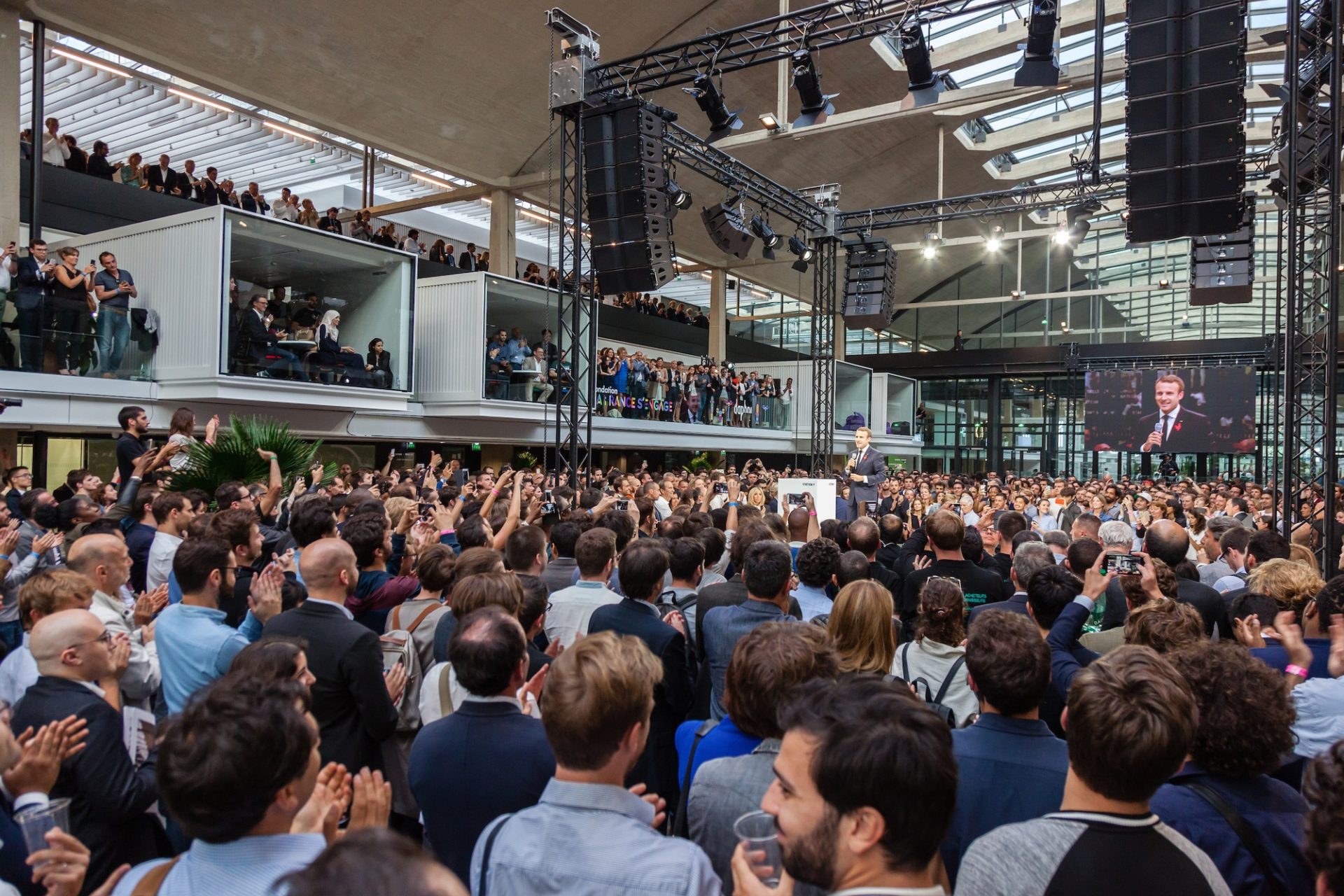
“When you see the government making tech a priority, it does have a huge impact,” said Roxanne Varza, director of Station F, a massive startup campus that opened this year in Paris. “There are so many more resources for startups.” (For more about Station F, see accompanying story.)
One of the great cultural barriers Europe has traditionally faced is that there haven’t been enough entrepreneurs with a healthy appetite for risk. With Europe’s cushy social benefits and the continuing hope among many for lifetime employment, few college graduates have embraced risky entrepreneurial careers. But in recent years stubbornly high unemployment among those under 25 has generated a “what-the-hell” attitude, so more are taking the leap.
Another important change in Europe has been a massive expansion in the number of accelerators and incubators, both publicly and privately funded. Some build all sorts of startups while others focus on a single technology or industry.
Gust, an online platform that manages fundraising for startups, reports that since 2015, Europe has had more operating accelerators and incubators than the U.S. and Canada. That year, 26 opened, bringing Europe’s total to 113. There are also now more startups based in accelerators in Europe than in the U.S. and Canada combined.
“We’re trying to build community that puts in place the foundation that can help an entrepreneur,” said Tom Wehmeier, a partner at London-based Atomico, one of Europe’s largest VC firms. It plays an active role in mentoring companies at Stockholm’s SUP46 startup hub. “People must embrace failure and take risks. To help them, you have to surround that person with the right people and role models and support.”
That’s not the only way to reduce the sense of entrepreneurial risk. In Germany, Rocket Internet has become famous (or infamous, depending on your view), for trying to create a startup factory. The idea is to take what the company calls “proven business models” and create companies for regions where those models haven’t yet been introduced. Skeptics, especially at American companies that have pioneered businesses Rocket then duplicates, call it a copycat model that thrives on ripping off the ideas of others.
Jan Beckers helped invent a new twist on this approach when he co-founded a “company builder” called HitFox Group in Berlin. It operates in three verticals: digital advertising, fintech, and healthcare. HitFox starts companies in various geographies. Then, as other opportunities are spotted in those same markets, it gives seed funding to new companies and invites them to share back office functions such as human resources, finance, marketing, IT, and legal support.
“As Germans, we like to control and mitigate risk,” he said. “HitFox tries to systemize the creation of companies by eliminating as many variables as possible.”
For a visitor from Silicon Valley, the second annual edition of the Viva Technology show in Paris this past June may have seemed odd. The sprawling conference floor was dominated not by tech names, but rather by sprawling booths anchored by giants of the analog economy, like LVMH, L’Oreal, Accor Hotels, and transportation giant SNCF. Within these hubs one could find an array of innovations, entrepreneurs, and startups supported by each big-name corporation. It documented a set of efforts few comparable American giants could duplicate, so far.
Viva Tech is a symbol of how Europe is counting on its big companies to help build a startup economy. For many years, it seemed that corporate leaders in Europe were content to go slow. Now government officials, academics, and policymakers from the EU level on down are scolding corporates for being laggards. At the same time governments are throwing incentives at them, like tax reforms and a governmental willingness to match their investments. Policymakers hope that by acting in their own self-interest, these companies will push even more venture capital into the system, as well as create another avenue for exits, as startups sell themselves to the giants.
The most recent State of European Tech report produced by Atomico noted the stunning fact that 65 of the 100 most valuable publicly-traded European companies are more than 100 years old. Only four are younger than 25 years, and they’re all Russian oil companies. By comparison, the five most valuable U.S. companies recently were all tech: Apple, Alphabet, Microsoft, Facebook, and Amazon.
But the good news, found Atomico, is that the number of startup investments by those same corporate eminences grise rose from nine in 2011 to 80 in 2015. And their acquisitions of startups jumped from one in 2011 to 23 in 2015. “We talk about a kind of corporate awakening,” says Atomico’s Wehmeier.
Accelerators help entice big companies to get their hands dirty. The Kickstart Accelerator in Zurich, created in 2015, bills itself as the “largest multi-corporate” accelerator in Europe. It brings startups from around the world to Zurich for an 11-week program where they rub shoulders with companies like insurance giant AXA or financial leader Credit Suisse.
Gavan Gravesen had been based in New York City, where he is co-founder and CEO of RAD, a 3-D imaging company. RAD has already raised money and is about to launch the first version of its product. But Gravesen swam against what has historically been a steady tide of growing European startups that moved to the U.S., and accepted an invitation to join Kickstart. That’s partly because one of Kickstart’s corporate partners is Switzerland’s ABB Robotics, a potential customer. “There is a view in the U.S. that innovation is not as energetic in Europe,” Gravesen said. “And that’s wrong. In machine learning and visualization, we see the same quantity and quality on both sides of the ocean.”
For all this progress and buzz, Europe’s startups face profound obstacles. There is still a big shortfall in late-stage funding, which eventually causes many startups still to drift toward the United States. And the emergence of numerous tech hubs has created a competition for talent and funding as well as a new spirit of local cooperation.
But the biggest hurdle remains that the traditional divisions of language and culture make scaling a company across Europe slow and labor-intensive. European entrepreneurs look with envy upon the massive, English-speaking U.S. market, where startups often grow explosively before going international.
And the continent remains fragmented in other, less obvious ways. While the EU helped erase many physical divisions, ironically many continue to exist in the digital realm. On issues like taxation, privacy, security and labor law, Europe has 28 sets of policies a startup must navigate. The EU did launch a Digital Single Market initiative in 2015, aiming to unify some rules, but progress has been halting. “It’s still a patchwork of different regimes,” said Robin Wauters, editor of research and news site Tech.eu. “You can’t speak of any policy without speaking of 28 policies.”
Anna Alex, co-founder and CEO of Berlin-based Outfittery, felt this problem acutely in the first years after the company’s founding in 2012. As the fashion firm initially grew, it kept all its stylists, employees and warehouses in Germany to avoid administrative challenges like opening a bank account in every new country and dealing with local taxation. Even so, the company had to be creative when shipping outside of Germany. Its drivers would go to the border, unload the shipment, and another courier would then have to reload it into a different truck to cross the frontier.
“It was a huge challenge to internationalize,” Alex said. “We’d like to be in more countries. We just couldn’t go as fast as we’d like.”
Despite the halting start, Outfittery has raised €50 million of venture capital, employs 250 people, and ships to eight European countries. Outfittery’s founders did what any entrepreneur anywhere must do: overcome every obstacle. More founders are finding the confidence to do just that, so the region’s startup velocity continues to accelerate. And so does the belief that Europe is building an entrepreneurial culture that engenders economic hope.
Chris O’Brien is the European correspondent for VentureBeat.
Business + Innovation
Europe Lights the Tech Fuse
Europe is taking tech seriously, from the EU on down. Startups are skyrocketing, with entrepreneurs emerging from disparate sectors. Established companies across the continent are paying attention, and France under Macron is notably a champion of investment and innovation.