

Bill Gates and his billionaire partners, through their Breakthrough Energy Ventures fund, want the world to achieve “net zero” carbon emissions by 2050.
Their mission: “At Breakthrough Energy, we are committed to supporting new technologies that change the way we live, eat, work, travel and make things so we can avoid the most devastating impacts of climate change. We believe that funding cutting-edge research; investing in new clean technologies as they evolve from idea to market; crafting smart, tailored and scalable energy policies; and forging deep partnerships among policymakers, innovators and markets will lead to positive solutions that will bring clean energy to all.”
One of their investments is in the energy-saving company enVerid. The planet seems focused on achieving efficiencies in transportation, via Tesla and a score of electric car, scooter and bicycle makers. Simultaneously, enVerid Systems, an American enterprise with roots in Israel, is focused on saving the planet by minimizing energy use in buildings because more energy is used for lighting, cooling, heating and air exchanges in buildings than in all the cars and trucks on the world’s roads. By removing contaminants from indoor air, instead of constantly bringing in outside air, enVerid reduces HVAC energy usage by up to 30 percent.


As Christian Weeks, the energetic, fit and trim CEO of enVerid told Worth, “Buildings are responsible for around 40 percent of carbon emissions, and HVAC systems are the biggest energy consumer in most buildings. Therefore, to have a meaningful impact on carbon emissions from buildings, we must make the heating and cooling of buildings more energy efficient. enVerid does this by cleaning indoor air in buildings, so that it can be recirculated or recycled rather than replaced with outside air, which is very energy intensive‚ similar to heating or cooling your house with the windows open.”
In November, enVerid was one of nine companies selected for New York’s Clean Fight accelerator program, which is focused on helping growth-stage startups with climate change technologies scale up their businesses in New York State. In 2019, enVerid’s technology was awarded the Product of the Year award at the AHR Expo, the world’s largest HVAC convention.
However, the COVID-19 pandemic has altered everyone’s priorities, and enVerid has responded to the challenge by using its expertise in indoor air quality to quickly bring to market new solutions for stopping the virus’ spread.
enVerid’s technology has always removed molecular contaminants, like VOCs and CO2. However, with COVID-19, people are focused on bioaerosols in the air. enVerid has responded by deploying local HEPA filtration and UV light technologies.
To this end, earlier this year, enVerid launched a new ceiling-mounted, in-room HEPA filtration system for classroom, common areas in office buildings and retail stores. It removes 99.99 percent of viruses.
enVerid is also expanding its indoor air quality monitoring solutions to include RESET monitors, a global data standard for air quality monitoring.
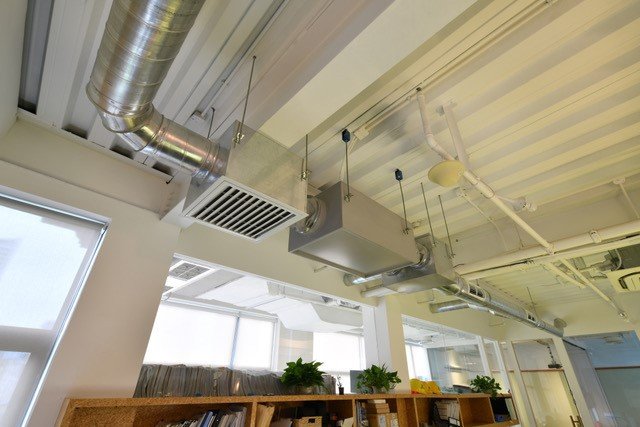
The ceiling-mounted air purifier units are superior to portable ones for a multitude of reasons. Uniformity of air flow and reliability are just two. Designed to be ultra-quiet, they minimize noise distraction to students or workers.
When coupled with UVC lamps that are available with the units, viruses are not only captured, but killed.
The enVerid Air Purifier is easy to install. Weeks added, “The units can be installed over a weekend or during a school break. They just require a power source and some simple ductwork and bracketing. Replacing and servicing filters is straightforward too.”
Obliviously, no one saw the COVID-19 pandemic coming, so all HVAC equipment manufacturers jumped to rethink and reengineer whatever they were selling and installing. In the case of enVerid, Weeks and his team of indoor air quality experts quickly developed a new solution for the North American market using existing HEPA air filtration and UV light technologies that have proven to be very effective with airborne viruses. The enVerid team quickly tested the new solution in third-party labs and rolled out a marketing campaign for schools and office buildings struggling to manage the impacts of COVID.
Weeks has a solid background in building technology and energy systems. He was made CEO in 2019 to scale up enVerid’s adoption. “Of course, once we get to the other side of this pandemic, we need to refocus on lessening the carbon footprint of buildings,” he explained. “We are still innovating in that area. We were and will continue to be in the forefront of the ESG transition in buildings. The energy that can be saved is truly game changing. We are talking about being part of annually reducing over 300 million tons of carbon emissions globally by 2050.”
One of the ways Weeks believes he can get enVerid’s HLR technology into everyone’s hands is with new tools, such as the enVerid COVID-19 Energy Estimator, which make it easy for building managers and engineers to compare the risk, cost, energy and carbon impacts of different HVAC ventilation strategies including those that utilize enVerid’s technologies. “The Estimator has been a very effective tool to quantify the real-world cost savings,” Weeks said.
Of course, no one company—even if it is backed by the world’s billionaires—can solve the quest for carbon reduction by itself. “Our innovative technology was developed through research partnerships with some of the best and brightest academic institutions in the country like MIT, the University of Southern California and the National Renewable Energy Laboratory,” explained Weeks. enVerid has received numerous awards from green building councils and New York State’s Green Building Initiative.
Worth (with tongue in cheek) asked Weeks how he felt not being Elon Musk who is basking in the spotlight for reducing transportation’s carbon footprint. He gave an answer notable for its modesty. “We are all trying to do the best for the planet. We are all using technology to walk back the dependance on carbon fuels that is so destructive. I guess it’s just sexier to drive a fast car than reduce load on HVAC systems in offices and schools…but it’s no less important to saving our planet.”