
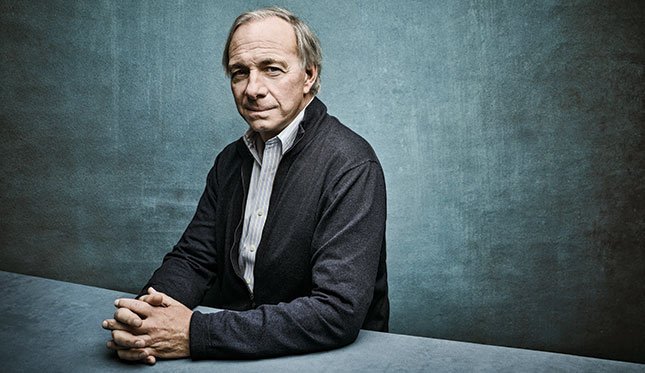
Ray Dalio is powerful in part because he founded Bridgewater Associates, which, with about $160 billion under management, is thought to be the world’s largest hedge fund. But as Dalio steps away from daily management of the firm, his power increasingly manifests itself through the vigor of his ideas and his passion for communicating them. Last year he released Principles: Life and Work, a sort of intellectual autobiography that became a number one New York Times bestseller. Now, to mark the 10th anniversary of the financial crisis, he has put out another book, this one with the less poetic but entirely accurate title A Template for Understanding Big Debt Crises. Worth spoke with Dalio about what we’ve learned—and what we haven’t—from the last financial crisis, and why he loves letting go.
Let’s talk first about Principles, the massive book you released last year that detailed your mantras for life and business, and particularly those goals of “radical transparency” and an “idea meritocracy.” Did Principles achieve what you hoped it would?
Way beyond. It’s sort of gone viral.
A year later is the country more, or less, close to becoming an idea meritocracy?
The response to the book has been terrific. But the size of that has been small in comparison to the general trend of our society. I would say there’s a trend away from thoughtful disagreement and idea-meritocratic decision making.
Is that frustrating for you?
I’m just trying to pass along things that helped me and leave it to others. If people are writing down their principles, being clear on them, whatever they are—that’s progress. They don’t have to be my principles. But I do think there’s a wave taking place now, particularly in cutting-edge organizations like next-generation entrepreneurial organizations, to make their organizations run more in this way. I just don’t think it’s changed the society as a whole.

In June of this year you changed the management structure at Bridgewater and instituted a new partnership structure. Is the new structure working for you?
Yes, yes, yes, yes. It’s wonderful. I’m in a transition phase in my life and my goal is to help others be successful without me. That was an important step in my direction. What it’s meant for me is the satisfaction of seeing people step up and continue that culture of meaningful work and meaningful relationships through truthful transparency.

Ray, when we first spoke a year ago, you stood in front of a whiteboard and talked about this issue of debt crises. What is it intellectually about this issue that has prompted you to focus on it?
Understanding debt cycles is integral to understanding everything that happens in finance and economics—everything that affects our lives, our incomes. Because our buying power comes largely through credit and credit cycles, and they’re not understood. But when you see the patterns and you understand the cause-and-effect relationships, one can understand those things. So on the 10th anniversary of the financial crisis I wanted to pass along the template that has worked well for me in anticipating these crises. [Bridgewater] did very well in the 2008 financial crisis, and in most debt crises, by understanding that template. It’s like a disease—I want to convey the cycle and what the disease is so that everybody understands it so that we reduce the chances of a bad crisis. And so that we have individuals and policy makers knowing how to navigate the next one that will come along. They will always come along.
Obviously this isn’t your first priority, but if you reduce the chances of a debt crisis, aren’t you also reducing Bridgewater’s chances of profiting from these cycles?
What we aren’t doing is conveying in there my algorithms, the exact timing or anything along those lines. There’s nothing in there…where we’ll lose our edge. It will mean, I hope, that debt cycles will be less severe and that policy makers will handle them better.
What’s your thinking on how policy makers handled the last debt crisis, which led to the Great Recession?
Policy makers didn’t anticipate it—there are things that they could have done.
We remember the last crisis and that’s not good enough. You have to remember the patterns.

See the complete 2018 Worth Power 100 list here.
What went wrong?
The central bank is responsible for all debt creation, and they tend to focus on inflation and growth and don’t follow enough the debt creation that goes for the purchase of investment assets. As a result, you get bubbles. So I think that they should pay more attention to whether the debts that are being created will be systemically threatening. By doing stress tests and pro forma financial projections the way we [at Bridgewater] do, I think that they will help to anticipate them and curtail bubbles.
How can the Fed not already know how to anticipate economic bubbles?
They are very difficult for a lot of people to anticipate. Most bubbles don’t have an inflation problem, they just look like a boom, and [policy makers] are worried about shutting off a boom. They don’t understand the difference between a boom and a bubble.
So what did you think of the federal reaction when the housing bubble did pop in 2008?
When it started to happen, they moved very quickly. The combination of people that they had—[then Fed chair] Ben Bernanke, who had studied depressions, understood quantitative easing. [Treasury Secretary] Hank Paulson, a CEO type. Bernanke is more introverted, less aggressive, Paulson more aggressive, more extroverted, and also will run to the fire. And [President Obama’s treasury secretary] Tim Geithner understands markets well and is a very balanced diplomat. Those three worked together bringing different skills and personalities on the one mission: to rectify it. And if you consider how fast things were happening, how chaotic things were, and how those three then responded, you have to say we were very lucky, particularly in a politically challenged environment.

Do you have confidence that there’s an equally skilled team in place now should there be a similar crisis?
I really don’t want to get into that kind of evaluation. But the next time around, I worry that the political fragmentation is great. We will have a debt crisis again, and when we have that debt crisis, I worry whether the parties will have the leeway to do the right thing.
You’re concerned that some of the postrecession measures are too restrictive.
Generally speaking, they put into place a number of protections that reduce the chances of a debt crisis happening but reduce the leeway that they have in dealing with it and every debt crisis happens in a somewhat different way to a different segment. The banking system has regulations and guarantees, but there’s always the development of a shadow banking system that’s outside of regulation and guarantees. That happens because if you’re not regulated, you can make more money. So because of that, it’s very important to realize that there has to be leeway to make decisions for vehicles that were never expected to have problems. That leeway is reduced by [new regulations] and that’s what concerns me. I think that there should be an economic emergency powers act, like the war powers act—that if the president of the United States, the head of the Federal Reserve and representatives of the two branches of Congress all agree that there is a crisis beyond the existing regulatory structure, and agree on what should be done, there should be the power to do that.
What could cause the next downturn?
The lesser effectiveness of monetary policy and economic polarization and populism. On monetary policy, while I don’t think that the debt situation that we have is like the 2008 financial crisis, I do think that when we have the next downturn central bank policy will not be as effective. The period that we’re in is very much like the late 1930s…the 1929 to 1932 debt crisis when interest rates hit zero was very similar to the 2007 to 2009 debt crisis when interest rates hit zero. And in both of those cases the central banks had to print money and buy financial assets and that causes asset prices to rise and contributed to wealth gaps [between those who own financial assets and those who don’t]. That’s led to populism because the wealth gap today is like 1935 to 1940. Populism means that, if you have a big gap in wealth, and you share a budget, so you have to decide how to carve up the pie, as you have an economic downturn, you have conflict.

Do you see another crisis looming?
I don’t see the type of debt crisis that I saw in 2007. It’s not imminent. This expansion might have two or three years left in it. But I do see problem areas. I see a lot of foreign borrowers of U.S. dollars who have their income in local currencies. I think that’s a problem in Turkey, Argentina, Brazil and to some extent India. And I see some minor areas—commercial real estate—but I don’t see that as systemically threatening.
Have we learned anything from the Great Recession?
The things we’ve learned are a bit helpful, but those memories are going to fade. We’ve developed a healthy fear of overindebtedness. We’ve made some important structural changes that limit the amount of leverage that can take place. I don’t think we’ve learned much about how debt cycles work, which is why I wrote the book. We remember the last crisis and that’s not good enough. You have to remember the patterns.
A Template for Understanding Big Debt Crises is available for free download on principles.com or $14.99 for the Kindle version and $50 for the paperback on Amazon.