Fred McDarrah had a 30-year love affair with a street. The clumsy, cluttered charm of Manhattan’s ever-changing 14th Street won the affection of the original photo editor of The Village Voice. In a “It’ll be a great place if they ever finish it” kind of project, McDarrah photographed every building on every block once every ten or so years from the 1950s to the mid-1980s. Amidst a city in dramatic flux, McDarrah’s images captured the art galleries of 14th as a generational red thread, a permanent Manhattan-henge of creativity and community.
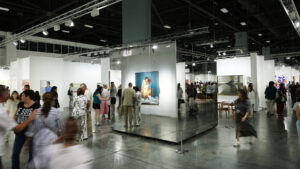
These days, such artist’s nooks are long gone, their storefronts surrendered to chain pharmacies, Chipotles, and tchotchke shops. The galleries are elsewhere. And you’re unlikely to find them. Storefronts are passe (as one gallery attendant said, “public stuff is so corny”). Nowadays the galleries are hidden from the hoi polloi as one of the art world’s purposeful ploys to preserve its mystique.


In her rollicking expose Get the Picture, Bianca Bosker discovers real estate is only part of “the machine,” a system designed by the art world elite to keep “Joe Schmo” away from the goods. Language, accessibility, institution, ritual, and capital are deployed with extraordinary and disturbing discipline. The goal: ensure anyone not baptized into the cult won’t get within an Anish Kapoor-sized bean of a gallery’s collection, and if they do, they will soon find themselves humiliated by their lack of initiation and show themselves the non-descript door. Bosker, both triggered and intrigued by such cultural gatekeeping, goes about a multi-year undercover project to understand the game’s rules. She finds both a self-serious world badly in need of a send-up and her renewed sense of adoration for the power of art.

This particular form of immersion journalism reveals and enacts Bosker’s values: cultural doors should be open to all, so she opens hers. As in A.J. Jacobs’ A Year of Living Biblically, or more seriously, David Shields’ Black Planet, the work is as much about the pilgrim as the holy land she’s traveling. And that sacred land is a social minefield, booby-trapped to break spirits and bend individual will to the requirements of “the Heads,” those individuals who play an outsized role in determining which artworks go from obscurity to the pantheon of illustrious cultural artifacts. However much an artist creates from their exceptionally gifted interior, they’re tied to the market “by an umbilical cord of gold” to use Clement Greenberg’s distressing visual. In Get the Picture, we witness what happens when art brings a paintbrush to a commercial firing range. The results are bruising for the players, maddening for the witnesses, and damning of the establishment’s self-importance. Bosker’s not as earnest as Nellie Bly, but halfway through her immersion, it’s clear she may, in fact, have embedded herself in the asylum.
Bosker’s funny (“Until now, I would have ranked color way down on my list of interests, right near the football and your decision to go gluten-free”). Her intellectual range is admirable. And her gumption is riveting and rare. But the more I read her clever prose, the retelling of her misadventures became less entertaining and more demoralizing. At a certain nadir of the narrative, Bosker sums up the plight of artists caught up in frigid waters of art fairs and auctions, who are “not emerging but submerging,” while in parallel lamenting what’s lost for the rest of us. Kept at a remove from beautiful and symbolic objects and bludgeoned by the belief we aren’t fit to interpret such work, we are separated from what the biologist J.Z. Young describes it as “a characteristic feature of the human way of life, as necessary to us as food or sex.”
Bosker’s book tilts more toward indictment than illumination despite her managing to surface an aphorism from the anomie. “Art is practice for appreciating life but also practice for creating a life worth appreciating.” A noble insight backed up by a requisite series of practical recommendations for experiencing art directly, unmediated by the forced context of wall plagues and obtuse commentary. Art enables a more beautiful life, Bosker claims, but the production, distribution, and access to such art are all owned by complex and cynical machinery that possesses so much less interest in beauty than commerce that its energies are predominantly spent in the de-democratizing of artistic experience.

It wasn’t just McDarrah’s ghost that haunted me while I followed Bosker’s misadventures. I mainly thought of Peter Schjeldahl and kept wishing that, on any page now, Bosker would bring him into conversation. Schjeldahl’s view of the art world was that of a community of unflappable, undaunted creators, networked through wild energies and dependent on the collective exchange of experiments and discoveries (and yes, even lovers). The work Schjeldahl confronts over decades of observations brings out such exuberant and vulnerable prose: he once described being “beaten to a pulp of joy” by a de Kooning show and claimed “Matisse stimulates the mind to analysis and then slaps it silly with audacities.” Schjeldahl’s roaming through a gallery is pure, unmediated pleasure and interpretation through the lens of marvel. It’s close to something McDarrah once told me: you’re standing in a studio, watching Norman Bluhm balance on a ladder, and only an hour later, remember you have a camera in your hands. The art world described in Get the Picture has no room for such honest, human frisson.
But Bosker’s a craftswoman herself: no narrative satisfies entirely if it leaves you in the desert. Part of the joy of Get the Picture is watching a human find her way back to the mystery and magic of art – ancient and modern, and even contemporary. The apostate pilgrim learns how to worship. By the book’s end, Bosker has shed the accouterment of those hidden galleries and exchanged the disinterested aloofness for genuine confrontation and even conversation with the art that had for too long been quarantined by codewords and context. In this freedom is the seeing Bosker had gone search for. Her discovery of it is ours as well. Schjeldahl would have been proud. “Looking at art,” he once told Jarrett Earnest, “is like, ‘Here are the answers. What were the questions? I think of it as espionage or ‘walking the cat back’ – why did that happen? And that? Until eventually you come to a point of irreducible mystery.”