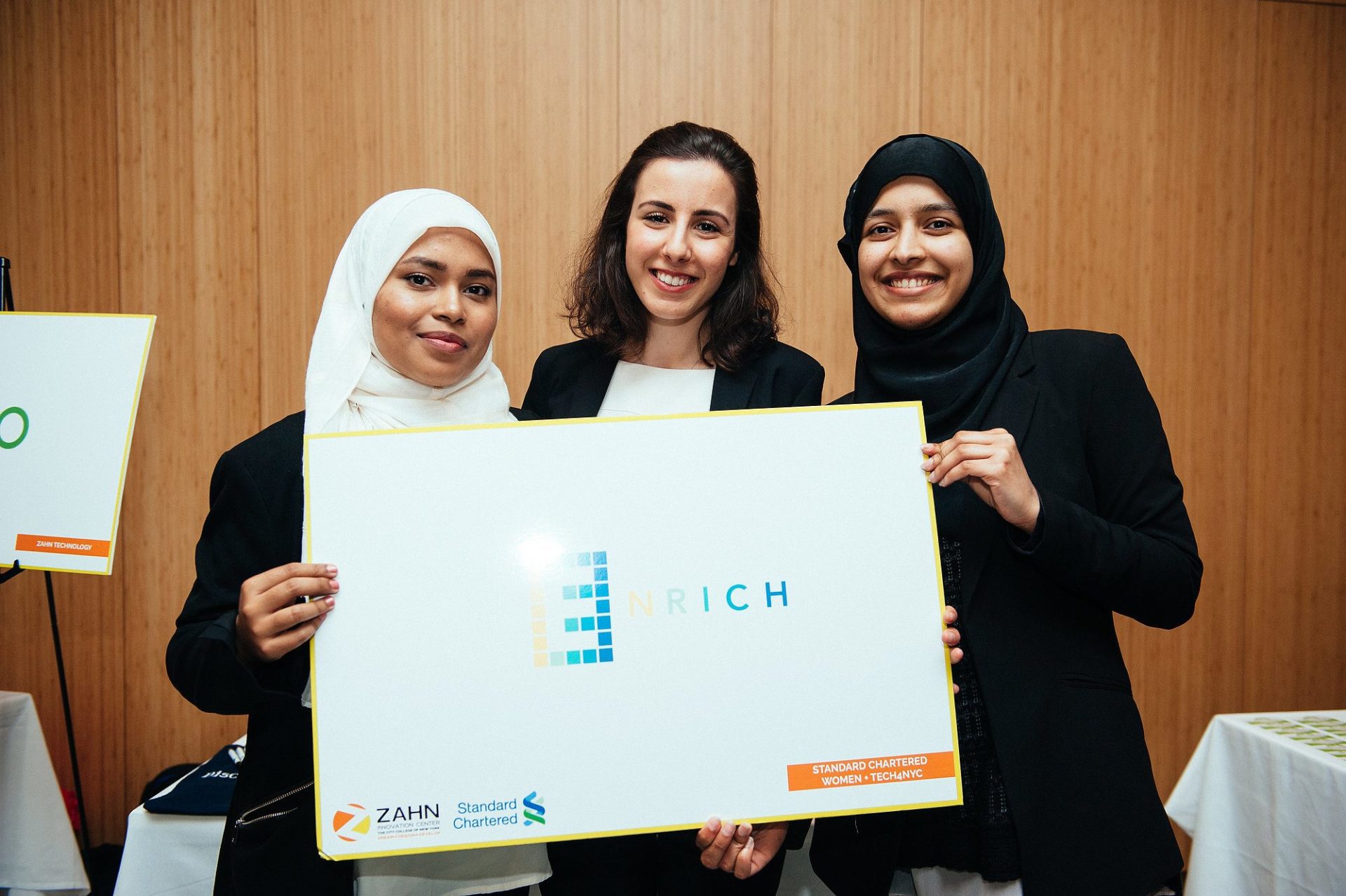
Just five months ago, I was studying computer science at the City College of New York, thinking about what I’d do upon graduation. I would have never guessed that I’d be where I am today—the cofounder of an early-stage edtech startup called Enrich that just won second place honors for the Standard Chartered Women+Tech4NYC Prize at the Zahn Innovation Center’s Startup Competition.
As a student founder who also happens to be a Muslim immigrant woman, I’d like to share my experience.
It all started with a project in my computer science class last semester. Our final project for the class was building an app, which was interesting enough, but Professor Michael Grossberg encouraged us to create a meaningful app that could solve a problem for someone.
For the first time, I felt like I wasn’t just creating something to get a grade; I was creating something to solve a real issue.
My thoughts gravitated to enrichment programs for kids. I used to work with the new York City Urban Debate League, where middle school students travel to take part in debates. These kids were excellent at public speaking—a skill that most of us lack. But for the three years I was there, it was always just the same kids participating. Why weren’t other kids joining, I wondered? Did they just not know about it?
My team and I set out to do some research, talking to parents in the city. Many of them tell us that if they knew about these programs, they’d enroll their kids. The current resources out there—pamphlets, flyers or lengthy internet searches—just aren’t convenient for time-strapped parents.
In particular, we found that immigrant families are missing out at a higher rate. That may be due to a combination of factors, like being new to the area or having a language barrier. These parents may need a resource that could translate information about these programs to them.
Enrichment programs—from art and music classes, to sports, to tutoring programs—benefit all children tremendously. But research shows that these programs are even more beneficial to children in lower income families. Typically, parents of lower income families work longer hours, and their children miss out on some of the extra learning that happens at home. They need after-school or weekend programs to make up for this.
I had found my meaningful app. But after working on it for a few weeks, I realized how much more I needed to learn. So I applied to City College’s on-campus startup incubator, the Zahn Innovation Center. Since it was launched in 2012, the Center has incubated 131 startups, which have raised and earned more than $12 million in capital. It takes a special interest in women and tech, as part of an effort to combat gender disparity in STEM fields.
After several interviews, I was admitted into the Zahn Center’s annual startup bootcamp and competition. For the next semester, I’d immerse myself in the world of entrepreneurship and Lean Startup Methodology, meet with mentors who could guide me through the ins and outs of running a business, conduct vigorous customer research, and pitch (again and again) until the concept for Enrich was refined.
The platform we built, and I personally coded, helps parents find, rate, and book after-school programs for their children. They can filter for programs based on type (sports, music, academic, etc.), age level, cost, location and more. Plus, parents can read reviews and ratings from other parents. Eventually, the platform will be available in multiple languages to support a diverse audience.
The program culminates in a Demo Day, where the startups pitch to judges for a chance to move on to the finals. My team was so focused those first months that it seemed like it came in a flash. You see, at the Zahn Center, you’re working with a cohort of about 25 startups. Even though you’ll be competing against them, it’s easy to get caught up in the communal aspects—everyone is constantly bouncing ideas off of each other, trading skills, and giving feedback. The idea of entrepreneurship can be intimidating—you’re starting something from scratch. But if you know you’re not the only one, it’s easier to step out of your comfort zone and see the potential of your idea.
Our cohort reflected the broader City College student body: many of us were first generation Americans, and the first in our families to go to college. Some of us worked part-time to help pay for school. I guess you could say that the classic American dream was very much alive in all of us.
For the Enrich team, entrepreneurship is work that doesn’t feel like work. It feels like more, because we’re pursuing our passions. Everything, even the little things like putting together a pitch deck, feel more rewarding because there’s some true purpose.
This passion is what drove us to Demo Day. There was a lot at stake: The judges would choose two startups from each of four competition tracks to move onto the Final Pitch event, where the finalists would pitch again to win first place ($25,000) and second place ($5,000). Enrich was competing against other women-led teams in the Women+Tech4NYC track. That morning, we walked into the pitch room confident in ourselves and our business. I remember shaking the judges’ hands with purpose and feeling incredibly prepared for their questions.
After pitching, we set up our Expo table and spent the afternoon meeting with the hundreds of community members, faculty, and students who came to Demo Day. To our surprise, many of the visitors told us how much they benefited from after school programs, or how they wished they would have had a platform like this for their children. By the end of the day, we were exhausted and our voices were shot, but we were thrilled to find out we would move on to the finals!
At that moment, the stress of getting ready for the final event hit us, and we felt that we suddenly had so much to prove. As a team made up entirely of women, we felt like our fight was bigger than us. I thought about all the women I’ve looked up to, all the role models out there, and imagined that someday I’d be a role model for others. There’s a little pressure that comes with that, but it made us work extra hard in the two days leading up to the Final Pitch.
That evening the auditorium was filled to the brim. Sitting backstage, I was unable to focus on the crowd or engage in small talk. The nerves were overwhelming, but I pushed through them. My team and I walked onto the stage with renewed confidence. It was our time to let Enrich shine.
In the end, the judges chose our competitor as the first place winner. But we still walked away with $5,000 for our company. More than that, we walked away knowing that, in a few short months, we created something of value, something meaningful. We’ll be participating in the Zahn Center’s summer accelerator program, and will have a chance to pitch real investors when that culminates in the fall. Win or lose, I now know that entrepreneurship is something that I, and others like me, can pursue. And that’s priceless.
Khadeeja Din studied computer science at the City College of New York and is a cofounder of edtech startup Enrich.
Business + Innovation
How Entrepreneurship Built My Confidence as a Woman in Tech
A few months ago, I was a Muslim immigrant woman studying computer science at the City College of New York. I didn't guess I would help found prize-winning edtech startup Enrich. It helps students and families find after-school and other enrichment programs. I've found it deeply meaningful.