

It’s that time of year again: Major League Baseball’s All-Star break, a time when harried traders swap their quote screens for Kindles, abandon their stand-up desks for lounge chairs and kick off their shoes for flip flops. The All-Star break is also the time when I again ask this question: Can money buy a winning baseball team? Without salary caps and league parity, Major League Baseball is the professional sport closest to a free market; in theory, then, you should get what you pay for. But the interesting reality is that is not always the case—and that’s why we love to write about it.
Major League Baseball is challenged this year. League-wide attendance is slightly more than 27,000 per game, according to the Wall Street Journal; that’s off 6.6 percent, or 2 million fewer fans than last year. Most of the pain is being felt by the handful of teams that are simply not competitive this year. In the history of this study, no single team has ever sported a winning percentage lower than .300. This year two teams, the Baltimore Orioles and the Kansas City Royals, carry that dubious distinction, with winning records of .289 and .298 respectively. As of this writing the Orioles and the Royals are on pace to post fewer than 50 wins this season. Since divisional play started in 1969, only the 2003 Detroit Tigers managed to limp in under the 50-win limbo stick.


The number of strikeouts are soaring, according to ESPN. In fact, there have been more strikeouts scored this year than hits, as the overall MLB batting average has declined nine points since the 2017 season. The cognoscenti may find pitching duels exciting, but sun-drenched, beer-soaked baseball fans want to see more runs, preferably long balls. Happily for them, home runs are on the rise. The count has ratcheted higher every year since 2014, and 2017 posted the best season total this millennium with 6,210 home runs. The 2018 season is on pace to deliver 5,760 homers this season, which would rank it second since 2000.

American League
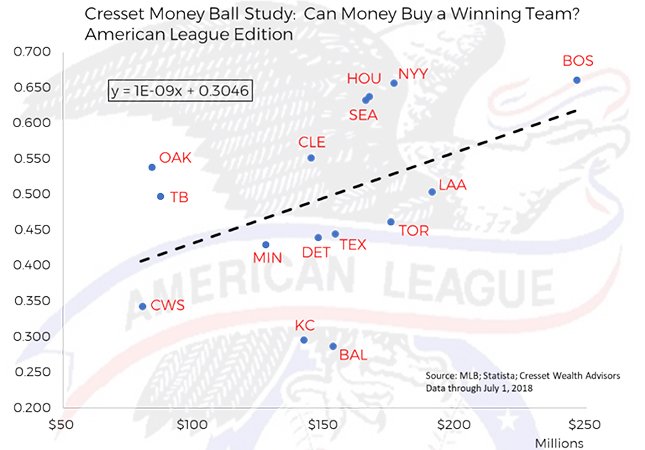
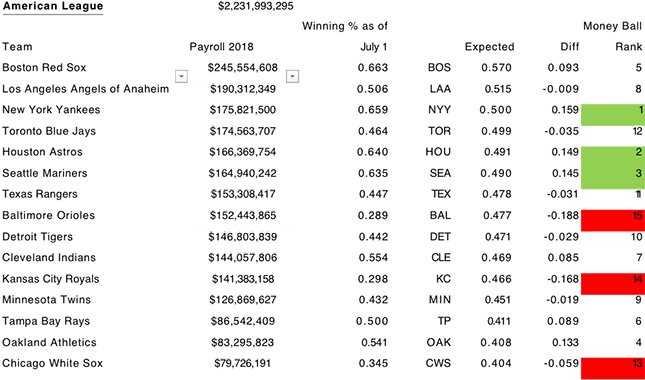
American League payrolls are well over the $2 billion mark this season, with the Red Sox handing out the heftiest paychecks. Boston’s payroll started the season at $246 million, but based on their 57-29 record, they’re getting their money’s worth. Our regression model is upward sloping, suggesting that more money equates to more wins. Our model suggests that it would cost American League teams about $6.5 million of additional payroll for each additional win in 2018.
Let’s examine the American League teams that are delivering more than their payrolls would suggest.
Winners
 Love them or hate them, the New York Yankees are punching above their weight this year. Pitched in a mid-season battle with the wily Red Sox, the Pinstripers are carrying a payroll that’s nearly $70 million lighter than that of their Beantown rival. Pitching ace Luis Severino has pitched five scoreless outings this year. The 24-year-old’s fastball is averaging 97.7 mph, highest among all starting pitchers. Maybe it’s the short porch in right field, but the Yankees lead both leagues with 138 home runs, even with a .250 team batting average. Their slugging percentage, however, is a league-leading .461. The Yankee’s payroll implies a record closer to .500.
 The 2017 World Series Champions are at it again, delivering a winning percentage of .640 on a $166 million payroll. The 55-game winners are leading the American League West by a half game over the surprisingly potent Mariners. Astros third baseman Alex Bregman has had a spectacular June as a clutch hitter. Bregman and teammate Evan Gattis are tied for first in the majors in RBIs, at 30 in June. The team ranks third with a batting average of .261. The Astros are equally dominant on the bump, sporting a team ERA of 2.84, the lowest in the majors. Houston pitching dominates the league with 901 strikeouts. The team is delivering Cadillac performance on a Chevy budget.
 For a town better known for football, Seattle is playing host to a contender in the American League West. The 55-32 Mariners are ranked among the top 10 teams in hits at 770, and fourth in wins. The team’s starting pitching is competitive despite Erasmo Ramirez’s injuries, but it’s the Mariners’ relief staff that is carrying the team. Seattle’s closer, Edwin “Sugar” Diaz, leads the majors with 33 saves. But with Diaz having appeared 45 times already, perhaps Manager Scott Servais is going back to the well too often. Hopefully Ramirez’s return will take some pressure off in the second half of the season.
Losers
 Some people would call it a rebuilding year, but I call it a regrouping year. The Sox have the skimpiest payroll in the league and it’s reflected in its 2018 track record. Their ballpark attendance ranks 26th out of 30, with just 17,555 fans on average at home, or about 45% of capacity. Even though the Southsiders lead the majors in stolen bases, they also strike out the most: they are currently tied with the Rangers at 820. Second baseman Yoan “Yoyo” Moncada has a respectable .229 batting average but has fanned 122 times. On the other side of the ledger, Sox pitching only has 635 strikeouts. Fielding? The Sox rank second in errors behind the St. Louis Cardinals, at 67. Perhaps it’s good fortune so few fans are witnessing the Sox’s disaster in person.
 What an ignominious decline from 2015 when the World Champion Kansas City Royals were at the top of their game. June was the worst month in Kansas City’s 50-year history as they dropped 21 of 26 games and fell woefully 20 games behind the division-leading Indians. The Royals have struggled on the offense. The team is last in the majors with only 68 homers; that’s fewer home runs than those hit by Boston’s JD Martinez (26), Yankee’s Aaron Judge (24) and Cleveland’s Jose Ramirez (24) combined. Expect to see Kansas City offloading talent going into the trade deadline.

The Orioles, beset with injuries this season, play host at a continually half-filled Camden Yards. Setup man Darren O’Day is the latest player out for the season. Closer Zach Britton has struggled with his comeback from the disabled list and the team’s offense continues to flounder. At .227, the Orioles hold the lowest batting average in the majors. They’re ranked 29 out of 30 in runs and RBIs at 299. At the same time, Baltimore carries the third-highest earned-run average at 4.82. With the trade deadline approaching, expect the Orioles to deal their prized shortstop, Manny Machado, as the team embarks on rebuilding.
National League
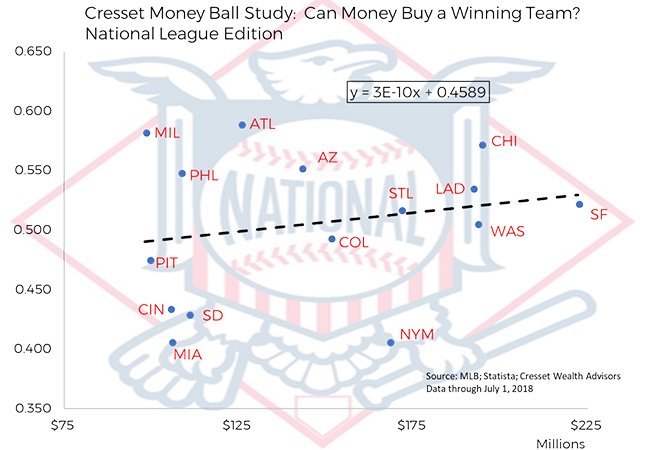
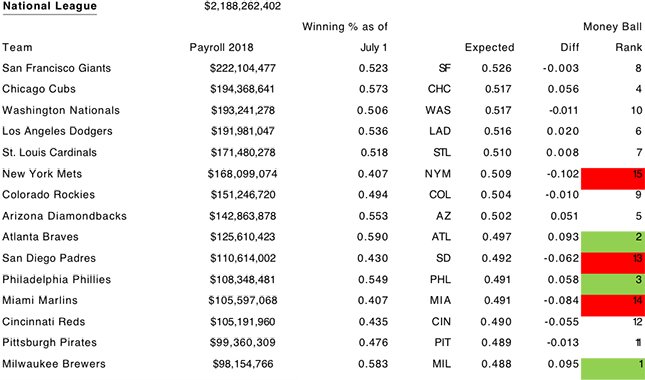
The relationship between payrolls and winning in the National League are not as closely linked as they are in the American League. The range between winners and losers is narrower too. There are no teams with winning percentages below .400, although the NY Mets are close. At the same time, no team is running away with all the wins. No team is above .600 as of this writing. Does this suggest parity in the National League? Hardly.
Winners

Once again the Brewers have one of the best records in the league with the lowest payroll, at just under $100 million. They’re currently leading the Cubs in their division even though Chicago doles out nearly double the wages. Milwaukee was in a similar position last year only to peter out in the second half of the season. Pitching is a strength: the team is tied for fourth in earned run average at 3.55. Pitching ace Chase Anderson is among the top 10 in lowest batting average against (BAA) at .204. On offense, first baseman Jesus Aguilar leads the team with 19 home runs. Our model suggests the Brewers have won eight games more than their payroll would suggest.
 The Braves have the best record in the National League while carrying a median payroll. Like Milwaukee, Atlanta has garnered eight more wins so far this season than their payroll implies. The team is tied for fourth with a batting average of .260 and is sixth in RBIs at 406. The Braves could be a serious contender in the home stretch, but they will have to bulk up their bullpen. The team is ranked toward the top of the totem pole in save opportunities, but has only a middling performance in saves. Expect the Braves to be active in the trade market later this month. I think this team could go deep in the post season.

Philadelphia is a game and a half behind Atlanta and have won five more games than their $108 million payroll would suggest. Their schedule has been tough: they have played 20 of their last 23 games against teams with winning records. Philadelphia’s pitching is improving. The team is among the top 10 in both strikeouts and saves. Right-hander Aaron Nola leads the team with a 2.41 earned run average. Zach Eflin sports an impressive 7-2 record this year. The Phillies will be a team to watch in the second half of the season. General Manager Matt Klentak expects to make some moves this month to improve the team’s chances. There’s talk that the Phillies will acquire three-time All-Star Manny Machado from the Orioles before the July 31 non-waiver trade deadline.
Losers
 At 38-51, the last-place Padres are about five wins below what our model implies. The team has an equally dismal record at home and on the road. Their hitting is weak. The team ranks poorly on team batting average, at .234, and 28th out of 30 in on-base percentage, at .299. The team’s pitching is more respectable, ranked toward the middle of the majors. It’s likely the Padres will fold their tent and deal several players before the trade deadline. The five team members most likely to be traded are pitcher Brad Hand, recently signed right-hander Craig Stammen, 5-6 pitcher Tyson Ross, right-fielder Travis Jankowski and pitcher Kirby Yates, who has been on and off the disabled list this season. Expect a second-half nosedive at Petco Field. It won’t be pretty.
 The 36-53 Marlins are in transition. The team’s new owners, including Derek Jeter, tendered every asset that wasn’t nailed down. Scoring is elusive. The Marlins rank 28th in home runs, at 72, and 26th in RBIs. Pitching is mixed although the bullpen is respectably stocked with young talent. Miami plays host to the fewest number of fans: average attendance at Marlins Park is 9,753, about 26% of capacity. The bobble head giveaways aren’t cutting it; the Marlins must up their game. Near term, expect them to deal. We do not think the beleaguered Marlins will snap their 14-year postseason drought this year.
 It must be tough being a Mets fan this year. The 34-49 Metropolitans are squandering their $168 million payroll. According to our stats, the team should be 43-40 at this point in the season. Their offense is tepid, and the team’s .231 batting average is ranked 28th in the majors. They’re 25thin RBIs and dead last in hits, at 647. New York has great starting pitchers, including Jacob deGrom, who leads the majors with a 1.84 ERA. Unfortunately, Noah Syndergaard has been sidelined since May 25. Left-hander Jason Vargas has been on the disabled list since June 20. Their bullpen hasn’t stood up to the additional pressure. With each passing week, the Mets become a more likely seller of talent into the trade deadline. New York has suffered 23 losses in their last 29 games. While the team is likely to hold onto its prized possessions, deGrom and Syndergaard, starter Zack Wheeler, no stranger to trade rumors, could be on his way out.
Jack Ablin is CIO of Cresset Wealth Advisors.