
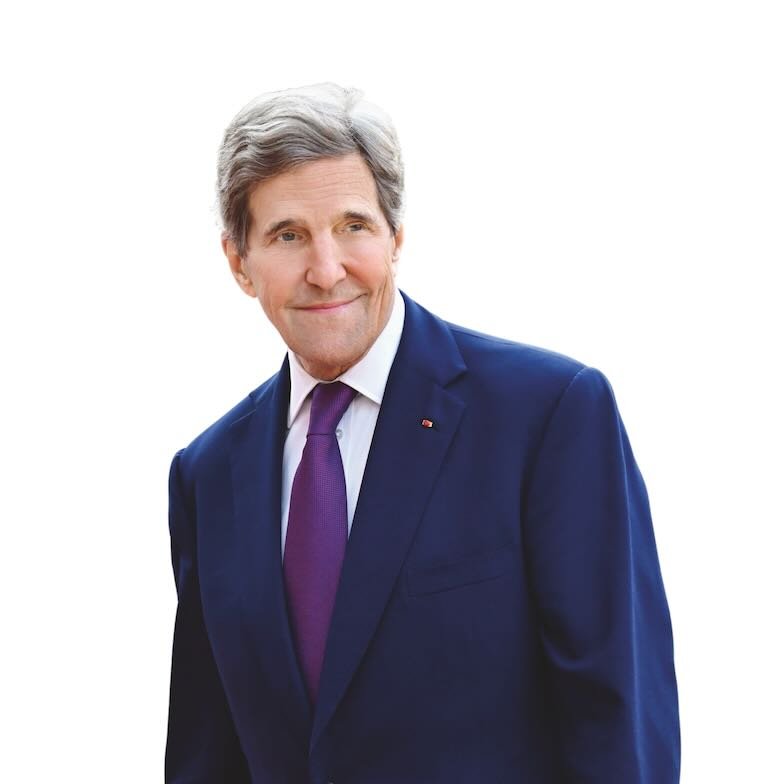
In small, elite community of failed presidential hopefuls, John Kerry diverges sharply from the norm. Many veer towards lucrative speaking engagements, consulting jobs, or, at best, advisory roles in subsequent administrations. However, Kerry’s career has followed an arc of ever-increasing impact that puts him into his own category. This unyielding commitment to public service and a global vision for climate stewardship makes him an obvious choice for the Worthy 100 List.
After losing the presidential election in 2004, Kerry returned to the Senate, continuing to build on his more than two decades of legislative experience. He took on critical roles, chairing committees and spearheading initiatives on issues ranging from foreign relations to climate change. In 2013, he was appointed Secretary of State under President Obama, a role that would serve as a prelude to his current position and aspirations.
During his tenure, Kerry was instrumental in negotiating the Iran nuclear deal. He also laid the groundwork for the Paris Agreement on climate change. His unwavering focus on arguably the most urgent global crisis of our time sets Kerry apart.
Climate Crusader on a Global Scale
Kerry’s latest role as Special Presidential Envoy for Climate under the Biden administration has given him a unique platform to mobilize national and global efforts. One of his first acts was to rejoin the Paris Agreement, reversing the previous administration’s decision and signaling a renewed American commitment to global climate goals. Kerry’s diplomacy has not been limited to state actors alone; he’s been instrumental in involving the private sector, notably engaging CEOs of major corporations to consider the role they can play in achieving global carbon neutrality.
Kerry’s work has been revolutionary in driving climate financing. He has advocated for reform in multilateral development banks, called for greater private-sector investment, and even thrown his weight behind controversial ideas like voluntary carbon markets. His approach to removing various risks—political, insurance, and financial—from climate investment is poised to entice more private sector money into green ventures.
A radical yet pragmatic mind, Kerry has also been influential in structuring the Energy Transition Accelerator—a targeted carbon credit system that incentivizes the closure of coal plants and other fossil fuel burning facilities, complemented by the deployment of renewables. This aligns with his vision for a more effective way of channeling concessionary funding towards sustainable goals, as traditional methods are proving too slow to meet the urgent demands.
Kerry doesn’t see climate change as a solely a technological or financial challenge but integrates social and geopolitical elements into his strategy. For instance, he is deeply aware of the need for fossil fuel-dependent countries to transition responsibly. He’s openly discussed the limitations of carbon-capture technologies and acknowledges that the ultimate goal has to be aligned with the scientific roadmap to limit global temperature rise.
The Bigger Picture
Kerry’s unwavering belief in the power of collective human action is what distinguishes him. He views the fight against climate change as the “new industrial revolution,” a phase of unprecedented innovation and job creation where the private sector has as much of a role as governments do.
In an age of increasing polarization and retrenchment into nationalistic concerns, John Kerry is a statesman for the world. His focus on climate change goes beyond the parochial concerns of any single nation; it is a vision for humanity.