

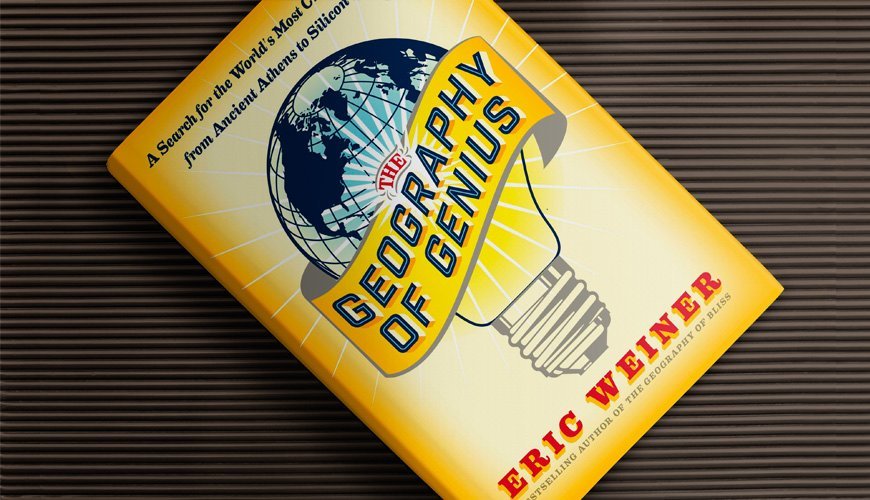
In Eric Weiner’s latest book, The Geography of Genius — A Search for the World’s Most Creative Places from Ancient Athens to Silicon Valley, the former NPR foreign correspondent seeks to understand what has made some cities hotbeds of creativity and innovation and others intellectual duds. To do this, he traveled the world to spots that at various points in history have produced great creative flowerings, including Athens, Hangzhou, Florence, Edinburgh, Calcutta, Vienna and Silicon Valley. We caught up with him to talk about what he learned.
SO WHAT EXACTLY ARE THE COMMON CHARACTERISTICS BETWEEN CITIES THAT HAVE A SURFEIT OF GENIUS?
There is no one formula for what makes for a place of genius. It’s not completely random either. There are certain qualities. I came up with what I call the three Ds, which are diversity, discernment and disorder.
LET’S START WITH DIVERSITY, THEN. WHAT DO YOU MEAN BY THAT?
You need to have diversity. Places like Athens and Florence were ethnically diverse, but they also had a diversity of ideas. It was an open marketplace of ideas that were tolerated.
AND DISCERNMENT?
You have to pick the good ideas from the bad ones. That’s the problem I have with the notion of tolerance for everything is good for a place of genius. I don’t think that’s necessarily true. And you have to discern talent, too. That’s the kind of discernment that Lorenzo de Medici showed to spot the nascent talent in young Michelangelo.

SO BASICALLY WE’RE TALKING ABOUT THE SOCRATIC METHOD TO WEED OUT WEAK IDEAS.
Right, or questioning your assumptions or what ideas you hold and seeing what stands at the end
HOW DOES DISORDER FIT IN?
The disorder part speaks to the messiness and the chaos that’s often involved in these places. They’re usually not particularly orderly places, whether it’s the Agora in Athens or the streets of Vienna right after the city had exploded in population. It could be personal disorder too. Beethoven’s desk was a mess, as was Einstein’s. Sometimes messiness is just sloppiness, but sometimes it sparks ideas.
HOW DOES THAT WORK?
There’s this idea that psychologists call a schema violation, which is when either you or people around you are doing something out of order, like having pancakes for dinner. Being around that does something for our brains that sparks ideas.
CHANGING GEARS A LITTLE, THERE’S A TREND THAT EVERY SMALL CITY IN THE UNITED STATES WANTS TO BE THE NEXT SILICON-WHATEVER BECAUSE THEY HAVE THREE STARTUPS AND A HIGH-SPEED NETWORK.
One thing that these Silicon Valley wannabes have in common is that they all fail. It’s like a general citing the last war. You’re assuming that technology and what’s made in Silicon Valley is what’s going to be the next big thing. We can’t see the next big thing because we don’t know what it is yet. Silicon Valley really isn’t about technology, it’s about an ecosystem for ideas. Not necessarily for creating ideas because not that much was created in Silicon Valley. The cell phone was invented in Illinois, venture capital in New York; all these things that we associated with Silicon Valley were not invented there
SO WHAT ACTUALLY MAKES IT DIFFERENT, THEN?
What makes Silicon Valley is this ecosystem of ideas. You come there with an idea and people will immediately decide if it’s a good idea, first of all, which is discernment. But then they will plug you in. They know what to do with this idea if it’s a good one. If it’s a bad one they’ll kill it; if it’s a good one, they’ll nurture it. It’s hard to create that out of nothing in Dubai or Allentown, Penn. It’s like trying to grow a certain microbe in a different environment. It may not grow.
MY FEELING IS THAT THIS IS SOMETHING THAT’S ESPECIALLY POPULAR IN PLACES THAT ARE TRYING TO REINVENT THEIR ECONOMIES, LIKE DUBAI.
The problem with the Gulf States, for instance, is they’ve tried to create “Education City” and “Media City.” You can’t plan for serendipity, and you can’t create spontaneity, and they’re basically trying to do that. They’re saying, “We need to have spontaneity, so let’s have a meeting to discuss ways to have spontaneity, and 2 to 3 p.m. can be spontaneity hour.” It’s almost that absurd, although not quite. You can’t create this randomness, but you can create the conditions that lead to it.
HOW EXACTLY DO YOU CREATE THOSE CONDITIONS, IF IT ISN’T JUST PUTTING IN SOME FIBER AND SOME CO-WORKING SPACES?
There’s this notion of density. Urban density is the most important component in making a creative city. But I don’t think it’s just density; the South Bronx back in the ’80s was very dense but not very creative. Prisons are very dense, but they aren’t very creative.
BUT CAN’T YOU WRITE WALDEN AND LIVE BY YOURSELF ON A POND SOMEWHERE?
Yeah, but you have to go to Boston to get it published. Beethoven would go off to outside of Vienna and go hiking in the woods, but he would always return to Vienna because that’s where his audience was, that’s where his patrons were, that’s where his music was.
THIS EXPLAINS THE EXISTENCE OF INDUSTRIES LIKE VENTURE CAPITAL THAT ONLY REALLY EXIST TO DISCOVER PEOPLE.
Or nurture them at least. The venture capitalists are essentially the Medicis of Silicon Valley. Venture capitalists can make mistakes, and the Medicis made some mistakes too, but by and large they were a set of people who had money and the ability to discern.
SO WHY DIDN’T YOU INCLUDE NEW YORK IN THE BOOK?
It sounds like it has a lot of these traits. There were a lot of places I could have gone. I could have looked at Berlin or Paris of the 1920s. I thought the whole Hemingway in Paris thing had been done, most recently with the Woody Allen movie Midnight in Paris. I wanted to have a chapter in the U.S. in the 20th century. I thought what place really symbolizes the creative energy of 20th century America? It is Silicon Valley. It brings us right to the present.
AT THE END OF MIDNIGHT IN PARIS, THOUGH, DOESN’T THE WOMAN WANT TO GO BACK TO THE 1890S?
She wants to go back to the Belle Epoch, yeah.
RIGHT, BECAUSE THAT’S WHEN SHE THINKS IT WAS REALLY CREATIVE.
Look, the Ancient Greeks—who we think were the original idea people—were nostalgic for when Homer lived, which is several hundred years before when Socrates lived.
IT’S THAT WHOLE CONCEPT OF THE METALLIC AGES.
Right, the golden age. This is why, frankly, it was so hard to write about Silicon Valley, because the chapter’s not over yet. All the other places I looked at have been bookmarked with an ending. That’s how you recognize a golden age. That’s one question I ask in the Silicon Valley chapter: Can we tell if we’re in a golden age when we’re in the middle of it, or is it only afterwards?
SO IS IT A GOLDEN AGE?
Silicon Valley can be a pretty arrogant place where people certainly think they’re living in a special place and a special time. But trying to gauge Silicon Valley in the scheme of these other places like Athens and Florence… Does it fit? The jury’s still out on that one.
Simon & Schuster, January 2016, $26.95, 368 pages. More information here.