Description: Design now matters as much in an insurance business as in an online app. Interfaces are as much about education as access. These three companies achieved unbelievable engagement from customers because of their design.
The following transcript has been lightly edited and condensed for ease of reading.
Speakers: Susan Dybbs, Collective Health | Christina Janzer, Slack | Bryan Mason, VSCO
Moderator: Albert Lee, NEA
(Transcription by RA Fisher Ink)
Lee: Good morning. So my name is Albert Lee, I’m the design partner at NEA, the venture fund. I’m thrilled to be here to host what I know will be a lively and informative conversation about what goes into making products that are deeply engaging and loved by their users. More specifically, what’s the balance between utilizing user data and user feedback versus pure product vision and intuition.
So the experts with me today are Bryan Mason, who is the CEO of VSCO, a photo editing tool used by creators everywhere. Christina Janzer, who is the director of resource and analytics at Slack, everyone’s favorite enterprise collaboration tool. I’m sure many of you have checked in today to your Slack channels. And Susan Dybbs, who is the VP of product and design at Collective Health, a modern healthcare platform that partners with employers to create custom solutions.
So I thought we’d maybe kick it off with you, Susan. You know, healthcare from the user experience standpoint is pretty broken. Generally opaque, hard to navigate, yet it’s one of those user journeys where people are the most vulnerable and, you know, you could say most in need. And one of the things that you all at Collective do is you create these custom healthcare platforms and partnership with employers, and one of the things that I’ve heard a lot about is actually the employee experience. I actually hear the word love.
Dybbs: Yes.
Lee: That we love this experience, and we don’t really hear that a lot in healthcare. Can you share a little bit about—you’ve been there since the early days—how you all identified and designed for those key moments where people really are extremely vulnerable and actually stressed? Like how do you guys land on that experience?
Dybbs: Yes, I mean I think we’ve all had experiences, whether us personally or someone we love has had unfortunately not so great healthcare experience, and Collective Health was really founded that to actually improve that. So fundamentally, our platform and product experience is really founded on user research, and so really understanding not just what someone needs from a website, but really understanding, when someone’s going through chemotherapy, what is their care journey like. What are the different paint points that are actually getting in the way of care? When someone’s going through a potentially stressful but also a little bit more joyous moment, where someone is pregnant for instance, how are they getting access to maternity benefits?
And so we actually do a deep understanding with user research and understand that journey across that care experience and figure out what are those key pain points that we can solve for. And what actually makes a better experience actually varies. Sometimes it’s actually just getting the right data. The healthcare industry is notorious for being opaque and just finding out the information you need to find out is actually really difficult. And sometimes it’s actually writing. So how do we actually translate this gnarly healthcare jargon into something people understand?
And then sometimes it’s actually just a moment of delight, like how can we surprise someone and actually give them that special moment where we’re supporting them in the care and actually have something that’s either a little bit humorous or something that’s actually surprisingly supportive. And so that’s how we’ve approached designing our products.
Lee: It makes me think a little bit—there’s a been a lot conversation around how writing has become a kind of key design discipline in a lot of ways. I ‘d just be curious, Christina, Bryan, in either of your experiences at your respective companies, that sort of tonal human quality, how critical is it to the work that you all do?
Janzer: It’s absolutely critical. So product writing is a really important discipline within Slack and it’s the introduction that a lot of people have to the product. It’s like their first—it’s like the hello and it’s like the, you know, this is what the product is all about and this is sort of the tone that we want to set. And so it’s become a very integral part in how we think about our entire design process and what is the tone and the voice that we want to use with all of our customers.
Mason: For us, content strategy is both long form content, copy, and visual. As a photo company, we are very visual creators. Our content strategy team has writers as well as artists and we have always had a very curatorial voice for content on our platform. We highlight great work and we talk about great work and the way in which we are supportive of our community is core to what the company was founded on.
Lee: Actually so maybe a build on that is one of the things that’s been really fascinating to me about watching VSCO evolve is that you’re simultaneously both a one-on-one pro tool, photo editing, and it’s a single player experience. But at the same time, you have this really vibrant community that eschews a lot of the trappings of traditional social networks. How do you all balance the listening to your community and what it is that they needed versus where you all think the product should be going? What does that dialogue look like?
Mason: It’s interesting and it’s evolved over the last few years. The company was started by professional photographers making tools for pros, and then the community evolved out of wanting a safe, supportive place to post that work. Instagram is great for broad distribution but there’s a lot of difficulty with public comments, public likes and the social capital. So on VSCO, the work stands for itself. Those values where there are no public likes, no public comments, if you follow or message, that’s all private. As a value statement of the work stands for itself and it’s a safe place to be, expressive and creative, that’s become more and more attractive to this younger generation and now we have tens of millions of users all over the world and 75% of them are 25 or younger. So it’s really moved from this very professional tool to this very young, highly creative, capable community.
Lee: Pretty much anyone who takes photos has touched VSCO in some way.
Mason: We all have great cameras in our pockets.
Lee: Right. How do you talk to them, this sort of global audience? Like where do you go to gain those insights or have that conversation?
Mason: So we talk to them in the app but we listen to them by meeting with them face to face. So we’ve done some insight studies where we go to the cities where we have the largest number of paid users. We have a subscription model. We don’t sell ads or we don’t sell their data. We have a premium subscription. So we’ll go to Moscow or Shanghai or London where we have high concentration and just listen and figure out what their needs are, what their sort of truth, their desire to be creative and make sure that we reflect that in our product. We also have a photo studio in the office and open up to—so we have creators in the office every day shooting.
Lee: Cool. Thank you. So I might actually build on that, and Christina, bring it back to you. You sort of—you see all the research that comes into Slack, both from a—we were just talking backstage—both from a qualitative and a quantitative standpoint. And it sounds like you’re engaging in conversations with users all the time. I’m actually also curious for you all, is there ever a gap between what people are asking for and where user behavior is going, like you might actually see in the analytics and in the datasets coming back, versus where you all think the product might need to go. Primarily because, as legend has it, Slack was an internal tool born out of actually on the hunt, building out a gaming company. And so there’s DNA there that brought fun and delight into enterprise, and probably a lot of pride of ownership in a way, kind of how the products evolve. So what happens?
Janzer: Yes, yes. So I’m happy to answer that question. If you don’t mind, can I just talk about the delight thing for a second?
Lee: Do it, please. Yes.
Janzer: And then I promise I’ll get to your question. So I think it’s always so interesting to talk about delight, especially in the context of enterprise tools. Because like where does delight belong at work? Like are you supposed to be delightful at work? Are you supposed to have fun at work? And I actually feel very strongly that delight has a very important place in the work context. And it’s not necessarily just about having fun. I actually think that delightful tools can really improve productivity.
And the example I always like to use is the emoji. The emoji is, you know, maybe silly or maybe fun, but we’ve actually found that—so one of the big concerns that we hear from research is this sort of fear that written communication is going to be misinterpreted. And so if I write this long note to my team, are they going to really understand what I meant? Are they going to misinterpret my tone? They’re not going to see me present it face to face so they’re not going to be able to see my facial expressions or my intonation or anything like that. And we’ve actually found that when people use emojis in their communication, it actually reduces that miscommunication and that actually increases productivity. So it’s kind of fun to think about how delight can actually like be a productive tool.
But back to your original question, so I think it’s really easy to think about product development as sort of like this linear path where you do research, you find out what user needs are, and then you build a product and then you test it and then you launch it and everything’s great and, you know, check it off the list. And I think probably a lot of people here would know that it’s more of a cyclical process, it’s much more chaotic than that. And you know, you do research, you iterate, you build, you find more research, you realize that you were working on the wrong thing, so you completely scrap it. You know, and it’s sort of like this ongoing process.
And I think in that way of thinking about how customer feedback is just sort of part of your DNA and part of your ongoing process versus just a thing that you check off along the road to launch is really important. Because I think it’s almost impossible to fully predict how someone is going to use a product until you actually launch it. And so we do a lot of research up front. We do as much as we can to really understanding customer needs, customer pain points, opportunity areas, and we try to be as informed as possible, but at some point, you kind of just need to take a leap and see what happens, right? And you need to launch it as sort of the next important step of the journey. And I think a lot of people will see launches as this opportunity to sort of celebrate and move on, but I would say that the launch is actually kind of like—
Dybbs: The beginning.
Janzer: Yes, the beginning. Exactly, it’s the beginning.
[LAUGHTER]
Lee: And the first act.
Dybbs: Yes.
Janzer: And the first act. And so really listening to how are people using this feature. And they’re going to use it. I guarantee they’re going to use it in ways you never predicted. And those ways that they use it, that’s where the real needs are. And so we see these sort of work arounds and hacky behaviors where people are using our product completely different than what we anticipated. And I think the key is how do you listen and respond and iterate really quickly as a really key part of that research cycle.
And so a kind of a simple example on Slack—this is a while ago, so we’ve since fixed this, but people needed a way to sort of indicate their status and what they were doing. And we saw this a lot internally at Slack but we also saw it with our customers. And so what would happen, and I’ll use myself as an example, because I did this all the time, is I would actually change my name on Slack, so my first name was Christina and then my last name would be Janzer-on-PTO-until-Monday.
[LAUGHTER]
And so that was the way I would indicate to people I’m out of town, don’t ping me, or if you do ping me, don’t expect me to respond. And that was such a clear signal that there was a user need that we hadn’t met and people were sort of hacking the product in order to meet that need. And so I think being able to constantly look out for those opportunities and those pain points is really important.
Dybbs: Yes, and I think what’s interesting is that you can research something to death, right? I mean, there’s kind of two things, where you don’t do any research and you have no idea who your customers are and what your users need. And then you have the “We’re just going to do academic research,” right? And that can go until kingdoms come, because you can always learn more information. But there’s nothing like putting something in someone’s hands to actually test that. And something that we do is really have hypotheses around our products. Like we have a vision and we have experience principles to help connect people, to help connect the dots. Okay, so we want to help people navigate and get care. And then you start looking at, okay, so we created this whole get care application and we’re like, well, there’s lower engagement then we thought. I wonder why? And then you start tweaking it.
And for instance, we thought we had a hypothesis, we designed something and we saw lower engagement then we thought. Then you start iterating on that based on the analytics, which I think is really interesting, and then most recently with our launch, we had I think about a 300% increase with engagement with it. Because we can’t, to your point, just launch something and then forget about it. That’s the beginning stage, right?
Janzer: Yes.
Lee: I mean, I love how you all are kind of pointing out to us they key needs of identifying the emotional pain points and the sort of truffles in the user journey, so to speak. I would be curious, and actually for all of you, is do you ever run into moments where what is right for the user, so to speak, kind of brushes up against what’s actually good for the business and where the two aren’t necessarily completely aligned?
Mason: We do all the time.
[LAUGHTER]
For sure. We have a subscription product. It’s $20 a year. We crossed a million paid members in the first of the year. We just crossed two million paid members. It’s growing like crazy, which tells me I could probably charge more money. And I hear from our investors, “We could probably charge more money.” But our mission is to help everybody fall in love with their own creativity. So keeping our tools as affordable as possible, especially given the global nature of our audience, has been a priority. And so yes, absolutely. We’re leaving money on the table to satisfy our mission.
Lee: Lovely. Yes?
Janzer: We see this a lot of as well. One common thing that we’ll see is, when you use our free product, you sort of reach a limit in terms of the number of messages that you can send. And so some unfortunate work arounds, which are actually bad for us but also bad for the user, is that they’ll start putting a lot of their more important messages elsewhere as a way to sort of work around that limit that we’ve set. And so there’s got to be a better balance there, right, that enables a better user experience and also is better for us.
Lee: Okay.
Dybbs: Yes, I think in a challenge where we’re B2B2C, so we actually sell to employers, but we kind of think of our base as the member experience, so what people are doing and how do they access care. So we’ve also encountered companies that maybe have a really complex benefits strategy and plan design. For instance, I don’t know if any of you have ever had different benefits where you only have certain prescription coverage up until a certain point and then you have to mail order and something like that. When you actually look at it, it’s like, well, I don’t even understand that and I work in this industry, right? So how is anyone trying to get a prescription drug going to do that?
And I think what’s helpful, speaking of data, is that now that we’ve been around for several years, we can actually say to those customers, “Hey, this actually isn’t going to impact your bottom line. Here’s what we recommend.” But there is a balance between customer service of our clients as well as member service of the end user, which I think is a really interesting channel and balance. And I think using data and having also the finance guys crunch the numbers to say, okay, well what is the actual impact of this change, I think makes a big difference.
Lee: Right. Cool. This is going to be a lightning round question because I want to make sure that we have some time for Q&A. And Susan, I might actually start with you, is you have this really neat role where it’s product and design. We don’t see enough of that, I would observe. Is there such a thing as too much design in a company?
[LAUGHTER]
You know, where we privilege it too heavily? I would observe that all your companies have benefited from really giving design a seat at the table, but I’d be curious to—
Dybbs: Yes, I mean, think it depends what you think of as design, right? So if you have a traditional sense of design as graphic design and just kind of that end typography, then okay, well, that could—you don’t necessarily need that all the time. But I think it’s all about solving problems. And I think you have to figure out—design is just another tool, right? So what do you actually need to solve that problem? And I think historically, there hasn’t been enough design, right? And now we’re kind of going in the other direction. And I haven’t yet seen a company that has too much design. I will say that where you don’t want to get to is having design not have matched resources from the edge and product sides, so you can overdesign something without really understanding the constraints, but that has to just do with resource planning.
Lee: Christina, anything at Slack?
Janzer: Yes, I mean I think that there’s definitely—I don’t know if I can think of specific examples at Slack, but I definitely think that there are opportunities to overly focus on design to the detriment of the user. And so if there is a real user problem that you need to solve or a challenge that people are having, sure you can spend years and years coming up with the most amazing, beautiful, perfect design. Or you can do something that’s maybe not perfect but is going to solve the problem faster. And what’s the tradeoff there? And so I think design is obviously, you know, this is part of what I do. It’s very important. But I think it’s just one piece of the puzzle. It’s also what is feedback telling us, what is the research telling us, where is the product trying to go? And I think you have to kind of balance everything together to make the right tradeoffs there.
Lee: Tradeoffs and dependencies. Bryan?
Mason: They said it right.
Lee: Okay.
[LAUGHTER]
Mason: It’s all about balance.
Lee: Perfect. So I think we’ve actually got two minutes if there are any question from the audience. Yes? Over here. Back there?
Audience 1: [drops 0:18:29.4] from People-Centered Internet. How do we do design that’s actually good for communities and not just individuals?
Lee: I feel like, Bryan, you might be well suited to answer that.
[LAUGHTER]
Mason: That’s interesting. So we spend a lot of time looking at sort of world positive messaging. And what our community has told is that sort of photography, videography, long form content, is how they explore their world and tell the story about their community. And so we focus a lot of attention on giving them tools to find other like-minded creators such that they can form communities both offline and online. And again, we can focus on the world positive version of that, but ultimately, they’re going to decide what to do with tools independent of our direction. So all we can do is guide and express some optimism.
Janzer: I think just from the research standpoint, I think one thing that we focus a lot on is not just research on individual users, but also understanding team dynamics and company dynamics and company culture and how that sort of might impact the way that you communicate or work together, because it’s not just about how I use Slack. It’s about how I use Slack with the people that I use Slack with.
Lee: In many ways, you are a community building platform within organizations.
Janzer: Yes.
Lee: Maybe one more question here?
Audience 2: From a perspective design, following on what you guys were just talking about, do you think that sometimes the best design also has to be really ugly? I think that most Americans, you know, don’t live in San Francisco. They don’t spend their life on the computer and they love big buttons, they love busy things—Amazon is pretty ugly. It’s very usable. One of my favorite sites is booking.com, extremely ugly and super awesome. What is your perspective on kind of whether or not you can have a super effective site that is something that people can really use that also is really beautiful?
Lee: We have time for one 30-second answer.
Dybbs: I mean, I feel really passionately about this, so—so first of all, I’m classically trained graphic designer, so there is a part of me that is pained in generally walking around life when there is bad typography, so know that. But quite frankly, it’s all about what the outcome you need to drive towards. So if you need your site to be incredibly fast because you’re going after a third world country, I guarantee you that the typography won’t matter as much as actually getting something that people can use over their phones.
And so I think about it more as what kind of problem are you trying to solve, and some of that is with beautiful typography and some of that is with just clear language or getting something really fast or iterating quickly. And so I think, you know, there’s that statement that you don’t want perfect to be the enemy of the good. And I think that’s really important because sometimes what you need is having something very beautiful and sometimes you need to have something that’s very utilitarian and has really great usability but maybe the typography or the kerning is a little bit off because of something with the technology.
Lee: We could keep going all morning. But thank you all. Thank you panelists.
Kirkpatrick: Thank you Albert and team. That’s great.
[APPLAUSE]
Participants


 Ethics + Responsibility
Melissa Stevens on How Strategic Philanthropy Is Replacing Traditional Giving
Milken Institute's Melissa Stevens on how philanthropy is evolving during the largest generational wealth transfer in modern history.
 Ethics + Responsibility
The AI Boom Is Creating an Energy Crisis Nobody Is Ready For with Milken Institute’s Rachel Halfaker
Rachel Halfaker of Milken Institute discusses AI, climate finance, energy infrastructure, and the future of American development.
 Ethics + Responsibility
Building Trustworthy AI
As AI systems influence hiring, health, and democracy itself, the demand for explainability and accountability grows urgent. This conversation moves beyond ethics decks to real mechanisms—audits, liability models, and transparency tools—that ensure technology earns public trust.
 Ethics + Responsibility
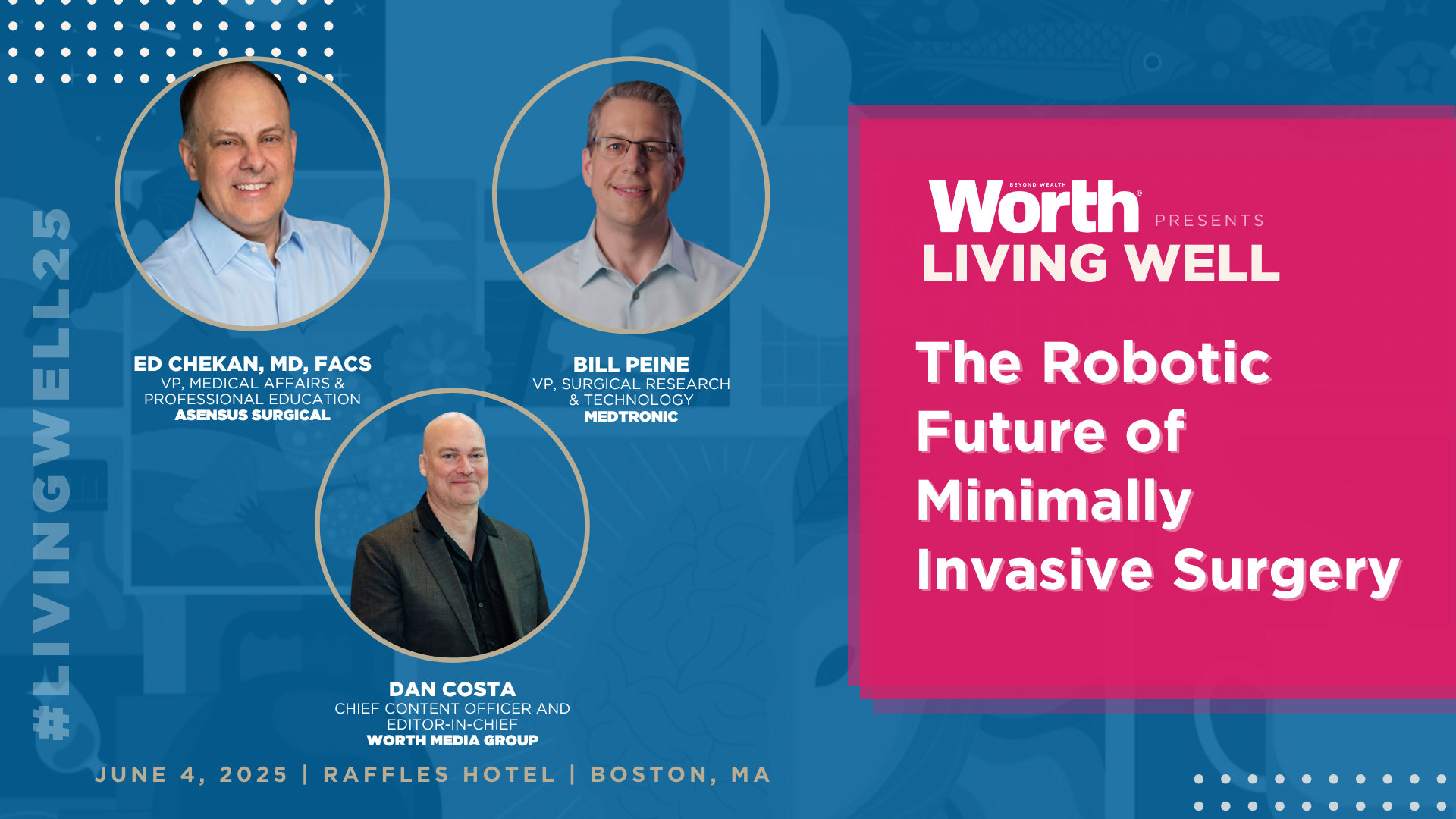
The Robotic Future of Minimally Invasive Surgery
What happens when artificial intelligence meets robotic precision? Dr. Ed Cheken and Bill Peine will reveal how smart surgical systems are reshaping training, performance, and patient safety.