

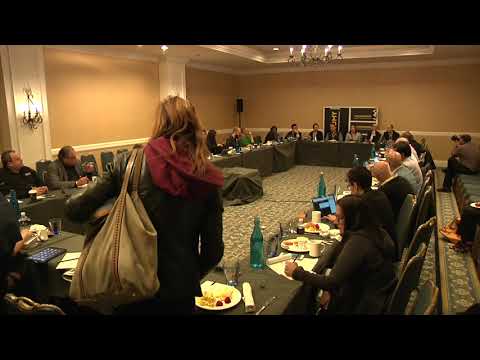

Session Description (breakfast session): With the spread of disinformation and sophisticated techno-manipulation, we’ve learned a lot in the past year about the negative impact of technology on democracy. Now what? Certainly the solution does not lie with either tech or government alone. Can the institutions of society come together to prevent the demise of democracy?
The full transcript is also available in PDF form here.
Fine: Good morning everyone. I think I speak for all of the panelists up here when I say we’d like to thank you for coming up very early for some very light discussion.
So I’m Jon Fine. I’m the Executive Director of Editorial for Ink Magazine and Ink.com. I’m not sure we need any sort of long intro given all that we’ve heard in several panels at Techonomy this year already. But just to bring it together.
The great tech platforms of the day on which we live a great deal of our lives, Facebook, Google, Twitter. I think we can broadly agree that in the election and in political discourse in general, they’ve been weaponized, hacked. Executives were dragged to the Hill in DC last week—or some of their minions were. This has had great effect on our lives. We know the problem, we’ve talked about the problem. We’ve heard this as an ongoing theme throughout the conference. Here, believe it or not, we’re going to try to figure out what to do.
So to borrow a term that danah boyd said on stage yesterday, “We need antibodies in the tech ecosystem.” And if I could extend that further with some sort of Dean Ornish-y talk, you know, there’s a lot of bad bacteria in our tech biome. We’ve got to regenerate the good stuff. We’ve got to figure out probiotics—I’m going to stop this metaphor right now.
But seriously, let’s think creatively here, what can be done to fix this? What institutions can be employed, can work together? What do we need to invent? We’re going to be going to the audience early and often. Please raise your hands, I’ll call on you throughout. I’m not going to wait for Q&A at the end. The one thing is I’ll ask you to be concise and I reserve the right to be somewhat impolite in enforcing that. That goes for all of you guys too.
So I’m going to introduce our illustrious panelists, starting over here. This is Larry Norden, he’s the Deputy Director of the Democracy Program at the Brennan Center, which is one of the premiere voting rights organizations in America right now. I’m personally a fan, of Larry as well. He works on issues ranging from money in politics to voting access issues. He’s the lead author of the book, The Machine of Democracy: Protecting Elections in an Electronic World.” So Larry’s already figured all this out.
We have Molly Turner. She’s a lecturer at the Haas School of Business at UC Berkeley. She focuses on urban innovation there. Prior to that she was at a small startup called Airbnb for five years, where she created and led the public policy and wrote some of the world’s first sharing economy regulations.
In the middle, we have Marc Rotenberg, who’s the President and Executive Director of EPIC, the Election Privacy Information Center.
Rotenberg: That’s not what it’s called.
Fine: Really? What is it?
Rotenberg: Electronic Privacy—
Fine: Electronic—well I can’t read my notes. Electronic Privacy Information Center. He’s also a lawyer and he teaches information privacy law and open government law at Georgetown.
We have Minnie Ingersoll, she’s the COO of Code for America. Prior to that she was an early product manager at Google where she created and built its Google Fiber division.
And at the far end we have Tim Hwang. He’s the Founder and CEO of FiscalNote. FiscalNote helps globally skilled organizations manage their relationships with governments. Tim has also held positions in local government in his hometown in Maryland’s Montgomery County. He’s also been named to the “30 under 30” list at Inc and Forbes.
Panelists, let’s start with this thought: There are one or two town squares in political, electoral discourse. They’re not really policed right now. How should they be policed? Tim, why not you?
Hwang: It’s a heavy question to start with.
Fine: Okay, what did you have for breakfast?
Hwang: [laughs] I didn’t have anything yet. But having thought about this question for a little while now, I’m not of the opinion that the problem really is the technology platforms, and I think we talked about this on our call before. For me, you know, I think that regardless of the technology platform that you’re having people discuss their issues on, the underlying issue lies with the people, right? And the connectivity of the people and their communities. I think that when you see the outcome of the election, really a lot of it just a reflection of the anger and the emotions that people have of being disconnected from their economies, through automation, through a lot of the movement of corporate investments from sort of operating expenses and labor to capital expenses over the course of the last 10 years or so. And so it was almost inevitable that the technology platforms are going to reflect the anger of the people, regardless of whether it’s Facebook or Twitter or something with incredibly new technology. People are eventually going to sort of be drawn to content and to platforms that really sort of align themselves with those interests.
Fine: Fair enough, okay, people are horrible. I mean, we can sort of agree that. But what we’re talking about isn’t just, you know—well, actually, no, let’s extend that. All right, so are we defining the problem wrong? Is the problem just too much democracy? Larry.
Norden: I do think the question is what is the problem? You started out by saying we know what the problem is, but I think identifying exactly what we think the threat is helpful. It’s kind of a necessary prerequisite for figuring out what solutions—
Fine: How do you define it?
Norden: Well, I think you could define it in a number of ways. At the Brennan Center, we have looked at this issue and other issues from the frame of foreign interference in elections—not because I think that that’s the entirety of the problem, but it’s a helpful frame both politically, also in grappling with some of the difficult issues around. We’ve been discussing over the past couple of days a lot of the issues. The bubble that people are in, that you can feed people misleading information and that they’re drawn to things that make them angry. Foreign interference and looking at what the Russians have done—because they’ve, not just in the United States but in other countries, had multi-pronged attacks on institutions of democracy—can be a useful way to look at that and also you don’t necessarily, when you’re addressing those issues, bump up against some of the more difficult first amendment issues.
In answering your question, your initial question about, you know, how should the platforms be policed or should they be policed, I think there are some easy answers to that, and there are more difficult ones, from my point of view. And an easy one, and Marc mentioned this a little bit and so did Joyce in her discussion, is political spending, political ads.
We have a framework for that broadcast TV, and for print media, and for whatever reason, Congress and the FEC in their infinite wisdom, decided to exempt the internet from that. And I think, you know, the framework there is we should be covering what are called electioneering communications, and having disclosure of who’s paying for ads, in the period before elections, that mention a candidate or that mention issues that are related to the election. And we should deal with the issue of what are called ‘dark posts’ if they are issues of national importance, political issues, all the time. We should be seeing if somebody is—you know, if the Russians or anybody, the Koch brothers, are sending posts to people telling them that if they go vote, you know, they’re going to have to pay their parking fines, or if they fill out the census form the information is going to go to ICE. Like we should know if those advertisements are going to people. We would know if they went on TV and there should be some record of who paid for them.
I think that part is easy. There’s, as many other people have mentioned over the course of the past couple of days, it gets more difficult when you’re talking about content that is not paid that people are just sharing with each other.
Rotenberg: I think the way you pose the problem is really interesting and before we get to solutions, we should talk a bit about the metaphor, because you described the social platforms as a town square. I would describe them as a company town. And I think the experience of most internet users is that they’re effectively moving from one company town called Google, to another company town called Facebook, to another company town called Twitter. And all of these platforms set the rules. They decide what you see and when you see it. They determine the circumstances under which you connect with others. They extract as much commercial value as they can from their participants. And they’re entirely unaccountable. So let’s at least begin with a clear description of what these online environments look like. They’re almost the exact opposite of the traditional town hall public meeting place, which by definition are public institutions. They’re maintained by government. And they certainly welcome private participants, and private participants including businesses have grievances and they seek to advance their interests. All of that is fine.
But we’ve actually flipped this entirely upside down. And what’s suffering, what’s really at risk, I believe—I, like Roger, had my “what have we made” moment. I see the collapse of democracy in the online world. I see it on multiple fronts. It’s not just that the companies are seeking to stay beyond regulation and accountability; we’ve accepted this. And we’ve accepted it because we’ve bought into the myth that technology solves problems, that competition solves problems, that regulation slows innovation. And at each step along the way we’ve moved away from accountability from the rule of law and precisely the type of town hall tradition that I think we need to restore.
Fine: Minnie, I’m curious where your take on this is, from your time at Google, and from the conversations we’ve had about this previously.
Ingersoll: Yeah, I think that Larry was making a very good point, it depends on what consider the problem. So if the problem is that Facebook and Google are controlling what you see and when you see it, that’s a different problem than if we’re talking about foreign interference. And I heard someone say, you know, “We’ve got this problem with foreign interference. We should break up these companies, they’re too big. We’ve got to break up Google and Facebook.” But you know, that solution doesn’t follow that problem, right? Like if you’ve got a strong adversary trying to hack you, then it doesn’t make any sense, like, “Let’s break up Google and make it less able to combat the foreign interference,” right?
Now if you think that the problem is actually a different problem, like the main problem we’re trying to solve is that Google is controlling what you see, when you see it, then you kind of go back a little bit to what Tim was talking about, which is are Google and Facebook really a reflection of our society? Or are they contributing to what we see? Are they controlling it? Or is that we actually have people who don’t have basic digital literacy? And we actually have sort of a population that is disillusioned and not well-served?
So, I guess, I don’t disagree with what Marc is saying, but I think we have craft our solution based on the problem.
Fine: Sure. Why don’t we stipulate that everything we’ve talked about is part of the whole. I mean, foreign interference is a huge problem, but what we’re dealing with are platforms that have an inordinate amount of control in what we see and how we communicate and what crosses our feeds.
Molly, you’ve been nodding your head a lot. I’m curious where you are on all this.
Turner: Yeah, I mean the internet and these platforms are some of the greatest vehicles for the expression of speech that we’ve ever had, since the beginning of time. But the irony is that many people think that they’re quote-unquote “undermining it.” I don’t believe they’re actually undermining free speech; I believe that they’re undermining civic discourse, which is equally as problematic in many ways. But I think that a similar paradox, having been very intimately familiar with how the legal minds in a lot of these platforms think, is these platforms are protected by the Communications Decency Act, so that any speech that occurs on their platform, they cannot be held liable for. Which means that they’ve developed these habits over many years, with many lawyers who are real First Amendment champions, that they should be not be controlling the speech on their platforms at all.
And so it’s a really big leap for them to go from, “This is just the most amazing platform for speech that’s ever existed,” to “Now all of a sudden, we have to be the arbiters of what speech is good and is bad.” And we’re starting to see Europe requiring them to do that, and there’s a lot of growing pains there. And my big question is: Do we really want them to become the arbiters of speech? I don’t know. And frankly, I don’t know if there are any other better solutions, right? Do we really want the crowd, the users of these platforms to decide what’s good speech? Like, users think that a name like Boaty McBoatFace is the best name for a boat.
[LAUGHTER]
Fine: You and I are going to have to disagree. That’s a great name, I’m sorry.
Turner: And then finally, like frankly, the government’s not so good at this either. The FCC has allowed radio and telecommunications company to create these massive monopolies that aren’t really conducive to civic discourse. And they haven’t been so great at policing indecent speech either. So honestly, I don’t see a really great solution here.
Fine: Thanks. That’s very helpful.
Norden: One thing I thing I will say, though, is that, you know, there are complaints from people who use Facebook and Google that they are shut out. So I mean, there is some control happening already, right? And particularly, you know, victims of domestic violence that say that they have trouble, you know, because their accounts are labelled fake and they shouldn’t be on there or people with unpopular views are saying that they’re, you know, they’re shut down on Google if you try to do a Google search.
Turner: And that’s exactly my point, right? Some of the reasons that these platforms have decided to shut down different kind of speech is because other users have complained, so there’s the wisdom of the crowd again, which is not always so wise. Or because they get some press, there’s a press hoopla about suppressing conservative political speech and they react to that and then there’s a backlash to that. So like, they haven’t figured it out.
Rotenberg: So I want to say a couple of words in support of Ralph Nader, under the heading that—
Fine: Didn’t see that coming.
Rotenberg: Under the heading that those who don’t learn from history are condemned to repeat the mistakes. And you really should all read Nader’s seminal book, Unsafe at Any Speed. He wrote it at a very interesting moment in time. Highway deaths were escalating in the United States, the companies were unaccountable, and most critically, Nader didn’t say, “Shut down the auto industry and let’s all ride bicycles,” which is one thing that he could have said. Yes. He said, “Let’s make the auto industry safe and accountable and let’s deal with this problem of highway fatalities.” And we have benefited enormously over the last 50 years from that insight. It is a much safer experience in the United States than it was 50 years ago to drive a vehicle. We associate safety and innovation. We don’t say, “Gee, we could build in those safety features but then we’d have to give up on innovation.” We completely get that to build a safe consumer product today means tackling the challenge head on and making it safe and reliable for people to use. Companies have become very profitable.
But here’s the kicker. Nader had a real insight as to what was happening in the dialogue, and this is why I’m so on edge these days, because I hear the exact same things from the tech industry today, that the auto industry was saying 50 years ago. “Oh, it’s all about the driver. They’re not educated. They need to learn more. We need driver education. We need to deal with drivers who can’t manage vehicles.” Anything but responsibility and liability for the manufacture of the service. And until the industry understands this, we’re going to be caught in this endless spiral of, “Well we need to help users be digitally literate.” I mean, honestly, what digitally literate consumer could have dealt with the Equifax breach that compromised 145 million credit records. We have to end that conversation. But I’m telling you, there is a good outcome. And the good outcome is with a stable regulatory framework that protects online users and allows companies to prosper and innovate. But we’re not there. We’re, you know, pre–Unsafe at Any Speed thinking.
Fine: Minnie, I’m curious your thoughts on this regulatory piece.
Ingersoll: I’m not as far apart. I know you want a little rumble, but I don’t disagree entirely. I actually think there’s a combination. Like I think what YouTube does right now and some of you guys are probably more familiar, but there’s multiple layers, right? So on YouTube there’s the community standards where it’s the wisdom of the crowds, people get to flag things that they think violate the First Amendment or that are incitements to violence. That’s the first layer. And then the second layer where Google has actually built algorithms that say, “If you have a lot of false positives, then you, when you flag things, we take your vote less seriously.”
And then there’s actually the regulatory framework, which defines on a country-by-country basis what free speech looks like. And I think you have to have all of those. I think what Marc was saying, though, is Nader had real insight and I think just the thing to be concerned about is that you actually want the people doing the regulating to have good insight on how the algorithms actually work, that sort of thing, so you don’t end up with, you know, a technology industry and a government regulatory body like very far apart. So I just think it has to be a collaboration. Like it shouldn’t be the tech industry pitted against the regulators. They need to have mutual understanding.
Fine: Tell us a little more about the collaboration you have in mind.
Ingersoll: Well, we’re just talking about the SEC and them being a little close to the industry that they’re regulating sometimes, and you don’t want that level of closeness. But I think that at Code for America, as we were discussing, we try to place technologists into government. And I think that’s a really important thing. I think right now we don’t have enough of that, where there’s actually tech people in government. There’s not enough it. And we don’t necessarily have the incentive structure there. So that’s the sort of thing I would like to see more of.
Fine: I mean, I guess, one counter to that is—and I’m stealing someone else’s line, but—it’s the issues isn’t that there aren’t enough STEM people in government or the issue isn’t that there isn’t enough humanities students taking STEM classes. Maybe the issue is that the people making these algorithms aren’t taking enough humanities classes.
You brought up YouTube, which I mean, I’m a huge fan. I find it incredibly useful. I probably spend more time on it than any other platform. There is an excellent article that came out yesterday or the day before in Medium that pivoted off a New York Times piece. And it was all about how bad actors are taking advantage of the algorithms and machine learning around kids’ videos. And these are like nursey rhyme videos that contain really nightmarish, disturbing stuff. The article is by James Bridle. I recommend it. I almost had bad dreams last night, seeing these videos. There’s just sliding in kids’ playlists on kids’ YouTube.
I will stipulate that the algorithms aren’t really working. They’re just not really working. So how do we fix this?
Hwang: So I want to jump in and maybe take a step back, because I do think that some of the earlier points that were raised were really important ones, particularly for Silicon Valley. I just find it really, really funny, having been in and around Washington for a decent amount of time, that Silicon Valley’s in such a big disarray right now, because like any other industry, you should be working with regulators on a constant basis, right? Regulation should be put into the product design from the very beginning of the process. But for a very long time, Silicon Valley—maybe for about the last 15, 20 years—Silicon Valley’s insulated themselves from the rest of the country and from regulators and so you see this not just in the big platforms like the Googles and the Facebooks of the world, but just in terms of the culture of innovation here, right? When it comes to Uber or Zenefits or Theranos or any one of these companies that just flouted regulations. This is the way that Silicon Valley has operated for the last 10, 15 years, and that’s one of the biggest underlying problems that needs to get solved in the first place.
I was speaking to a couple of folks at Facebook and I was talking to them about, “Okay, well what regulations are you facing? What regulatory challenges are you facing? How are you designing these things in to your products?” And they told me that—this is pre-election—their biggest interaction with regulators was on the European side where they had to put this yellow banner at the top that said your cookies are being tracked, right? That was their interaction between product design and regulations.
Fine: And that fixed everything.
[LAUGHTER]
Hwang: Right. I mean it’s ridiculous that, you know, that these companies seem to have—for a very long time have insulated themselves from regulators.
Fine: Oh yeah, Marc. By the way, welcome to all the people who came in slightly late. If you have a question raise your hand and I’ll come to you in a second. But let’s hear from Marc first.
Rotenberg: I want to make two quick points, and I’m happy to sort of talk inside Washington. I’ve been there for a long time—
Fine: My sympathies.
Rotenberg: Yeah, I mean, on the one hand, obviously government’s imperfect; legislation is imperfect. But on the other hand, you know, Congress doesn’t get it or people are dumb. I also think Silicon Valley needs to get over that as well. I mean, members of Congress are actually quite smart. Now how they interact in public and what they say at hearings, they’re talking to their constituents and they’re talking to a general news audience. But I would not underestimate how sharp a lot of people are, particularly those who are looking at these issues.
Now Tim’s point is interesting. And so here’s the real story about what’s going on in Washington. It’s not that Silicon Valley isn’t there. Silicon Valley doesn’t want to be regulated. And so the theory is, “We stay away from DC. We’re above it all; we’re fine.” But trust me, you talk about an issue like net neutrality or regulating broadband access, the Valley is all over Washington because you guys want your competitors regulated. And that, by the way, is why the broadband privacy rule collapsed. And I saw it coming. You know, Tom Wheeler is the chair of the FCC; he says we need some privacy rules. I said great. We wrote this long thing. We said, “Let’s have across the board privacy rules. Let’s get the broadband providers and let’s get the so-called edge providers.” When they say edge providers, that’s Google and Facebook. I said, “Let’s get everybody; let’s be evenhanded.” And Wheeler goes, “No, no, no. We can only get the broadband companies.” And Google and Facebook are like, “Go! Go! Go! Regulate those guys!” right? I said, “This is not going to work. I mean, I like privacy, but I know politics also, this is not going to work.” And what’s the first thing that happened? When Wheeler and the Democrats fell out of power, the broadband companies went to the Congressional leaders and said, “There’s no level playing field here. We’re being regulated, the other guys aren’t,” and one of the first acts of Congress was to repeal a privacy rule. Now that wasn’t so much about people being against privacy; that was about the half of the industry that you guys are trying to regulate, basically saying that’s unfair, that’s not going to work.” And Congress gets that. Whereas if we had all gone at the beginning and said, “You know, if you really believe in a level playing field, then let’s protect all users across all services,” that could have stuck.
And that’s what we’re trying to do now. We’re trying to come up with solutions where people are treated evenly. But to say that Silicon Valley doesn’t care about Washington, and to be pursuing net neutrality, that’s all about regulating the Telcos. It’s like, “Leave us alone, but those guys over there need to be regulated.”
Fine: So let’s definitely come back to the regulatory piece. But the gentleman in blue?
Irving: I’m not sure if it’s a question so much as it is a comment. And it’s again, to Tim. I’m even older than Marc and I’ve been in Washington even longer than Marc. And I was the first internet policy advisor to the Clinton administration and I worked on the Obama transition team on technology policy, and I’ve also been a government affairs guy for HP years ago.
Fine: I’m sorry, can you introduce yourself?
Irving: My name is Larry Irving and I was the Assistant Director of Commerce when there was 50 million people on the internet. My job was to help develop the rules. Silicon Valley’s not insulated from Washington; they’re protected in Washington. And they’re protected in really interesting ways. And I kind of blame myself, partially. We helped create the myth, as we were going around the planet, that Silicon Valley was different, that this industry was different, that they were trying to do good things and they were going to help solve problems through technology. And all of that was true. We didn’t expect it to be 4 billion people. We didn’t expect that the guy who we went to for search would be giving us home heating appliances and involved in YouTube videos. And we didn’t know when we bought our first book on Amazon they’d be in pharmaceuticals and buying Whole Foods. So a lot of the things we thought and expected kept going. Google and Facebook spend more on lobbying than any other company in America. Google had one employee who spent 200 days at the White House. I worked at the White House.
[LAUGHTER]
This is insane! You know, we’re talking about insulation when actually it’s embedded.
And to Marc’s point, there are a lot of really, really smart people who understand technology. You’ve got folks like Tom Kalil, Kumar Garg, Megan Smith, who’ve worked inside the administration, the last one and they know how to do this. The problem is, anything you try to do, the easiest thing to do in Washington is block legislation. And they are very, very good at blocking legislation. And the only exit for all of the consumer advocates and progressive advocates in Washington DC is to go work for Google or Facebook or Airbnb. Because they’re not going to work for pharma and they’re not going to work for the Telcos. And so there’s this kind of sweetheart deal going on where all these young, smart progressives don’t really want to hurt their friends. And they don’t really want to hurt guys who are kind of funding them. And tech is kind of fun, so we’re going to hold them to different standards and different rules than everybody else on the planet!
So we’re asking the wrong questions. We’ve got to start looking at: What do we care about? How do we want to get there? And what do we have to do? Because you know Google and Facebook can throw up a lot of flack and smoke and stuff to stop it, so what’s the best way to do it? And Marc and Marta had a little bit of a disagreement and I agree with both of them violently. Marta has to get that army of consumers activated, educated, and moving. And Marc’s right, we have to have an inside game where both progressives and people in the press are reporting on the lack of action by progressives on this issue. Because members of Congress are stimulus-responsive. And they’re not getting any stimulus from anybody they care about, that this is a big problem, except on elections. And that’s purely self-motivated.
Fine: Naturally. A lot of interesting stuff there. Molly wants to talk but just one comment about the grassroots piece. A survey came out this morning from Axios that basically said that the majority of Americans don’t think Facebook should be particularly regulated about this. So if there’s an education piece, and I’ve got issues with the whole idea of education around issues—which is a whole other thing that I’ll get into. But there’s a long way to go. If we’re expecting the grassroots to rise up and do something, that ain’t happening right now.
Turner: I just want to agree with everything you just said. And add that, you know, I think the real problem, like I said, is from the ‘90s, from when you started working on this. We said that the internet was different. And there were good reasons for that, it was different. And a lot of the things that did to allow it to flourish without regulations that were motivated by anti-competitive instincts were probably right. But we’ve gotten so used to thinking that the internet is different that we’ve made some really stupid decisions.
And one of the best pieces of advice I got when I was at Airbnb in the very early days was from Larry Summers, who said, “If you advocate to be treated differently because you’re a tech company, you’re wrong. You’re never going to win the regulatory battle. The kinds of issues that Airbnb or Uber or any of these other tech companies that have more tangible, real-world activities, like those are activities that happened long before the internet ever existed. And just because they’re now facilitated by an app, doesn’t mean that they should be treated differently.” And I think we’re finally starting to realize that some of these amorphous, cloud-like activities are the same. And just because they’re facilitated by tech companies doesn’t mean that the values that we have and the legal principles that we have should be all that different.
Fine: It’s horrifying to me that it took us 25 years to figure that out. David? Then the woman next to you. I’m not being facetious.
Kirkpatrick: This is a great conversation. It’s was wonderful hearing what Larry said. That’s so accurate. But another thing that really makes—doesn’t this have a mike in it?
[LAUGHTER]
Kirkpatrick: But it’s also—talk about being different. Being worth $500 billion dollars and approaching $1 trillion, in many of these companies’ cases, is really what makes them different now, and that is a fundamental shift from what made them different before. But the main thing I wanted to say just a historical note that was prompted by Tim’s point about how really absolutely unwilling and unable—and it’s been unnecessary for them to even think about policy. But here’s an interesting insight into Facebook’s psychology, since I’m a historian of that company.
When Zuckerberg hired Sandberg, one of the most important reasons he hired her was for her government experience. However, the reason he wanted her government experience was not so she could interface with government, but because Facebook was itself going to become like a government. That is exactly what he said to me, it is in my book. So they, even though they spend all this money on lobbying, they really have not thought that that was a primary, you know, problem or issue for them. Their issue was managing themselves. And that continues to this day, very, very much to be the case.
MacKinnon: My name is Rebecca MacKinnon, I run a research project called Ranking Digital Rights. Picking up on Marc’s point about the auto industry, one of the outcomes of that was that was that you don’t put a car on the road without having thoroughly tested it. You don’t put a drug on the market without having tested it. But Facebook’s ethos—and many other companies—move fast and break things. You stick it out and then you fix it after it’s already in the wild and it’s starting to have an impact on human beings. And I’d be interested in your thoughts, Marc. I mean, we’ve heard a lot of proposals already about algorithmic transparency, so I won’t ask you to explain that so much, again. I have heard some proposals out there elsewhere, about the need for impact assessment, about the need for testing, about the need for risk assessment. And how do you think that might play into a regulatory approach going forward?
Rotenberg: I mean it’s a really good question. And I think it’s perfectly right to sort of push back a little bit on the auto industry metaphor. I do myself sometimes, and obviously, when you’re talking about the speed of innovation, I guess that’s an obvious entry point. But I also think that this rapid deployment of untested software has come back to bite us in multiple ways. I mean, we’re talking about massive data breaches in the United States and the vulnerabilities are really serious. The kind of data that’s out there because someone just said, “Oh, let’s get this out,” is significant.
And in my world, you know, I feel quite strongly about things like privacy settings. I wanted a privacy law. I almost got it 15 years ago. Then we had 9/11 and everyone raced in the opposite direction, so we didn’t get an internet privacy law and we were stuck with this, “Well, we’re going to give you privacy choices and you decide.” That’s our world now. But you see, people made privacy choices, in particular on Facebook, and then Facebook went, “Well we’ve got this new business model and we can just get those photos out to our partners. There’s going to be a little bit more value. And we’re going to change the privacy settings, but if people really like it they can change them back.” It’s like, what are you talking about? I mean, people have actually taken the time and you’re changing the privacy settings on them. And you look at one of these charts, I mean, it’s really quite interesting. David knows this, because he and I had this conversation when he was working on his book. It’s like, you know, a straight line downward in terms of the settings of privacy preferences. And then people go around and say, “Gee, why is it that Facebook users don’t care much about their privacy settings?” And I’m like, “Well I have an answer to that.”
On the one hand I do respect innovation. I’m going to just tag on one thing. I mean, Larry may be older than me, he doesn’t look it. He looks younger.
[LAUGHTER]
Rotenberg: But I’ve been at this longer. I mean, I was in DC in the early ‘80s—and pre-internet. I mean, I had been on the internet, because I was teaching. I was teaching nonprofits in the ‘80s how to use personal computers. Things like Kaypros and Osbornes and, you know, Apples and all that stuff. And I love technology, I really do. And that was a big part of my life back in the early ‘80s. But I also knew that we had to deal with the policy issues. And part of what we were trying to do back then, was to teach the nonprofit organizations, the civil liberties groups, the environmental groups, the human rights groups, how to use the technology so that they could meaningfully engage in the policy process.
I respect what you’re saying. I mean, you don’t want dumb decisions. But you can’t use that as an excuse not to engage. You can’t say, “Gee, anything they do is going to necessarily be bad.” That’s not an answer.
Fine: I’d like to get to solutions as well. But maybe you can borrow Tim’s microphone?
Binagwaho: Hi, I’m Agnes from Rwanda. I think it works. And I was a member of a government for five years, and I don’t believe ingenuity. You have no excuse to have not protected the voiceless. The fact to be young, the fact to be attracted by the internet, is just as excuse. It’s a fight for power. And if you don’t react—and what you just described, the guy who stayed in the White House, it’s a fight for power. And it’s corruption. I’m kind of with you because I hope you recruit me. What is the name? It’s simply called “corruption.”
[LAUGHTER]
Stop to be kind. Stop to be blind. Stop to lie. And if all those internet things, it’s like the road. The road is regulated. The cars are regulated. The driver is regulated. Everybody has a responsibility. And in any case, if you don’t wake up, you have screwed up like everybody. Because the bad guys are stronger than you. They know where they want to be in 20 years. You still don’t know. Just stop them. Stop them for the world.
Now democracy here has been screwed. Reflect on that.
[LAUGHTER]
I like Putin because he has shown you your vulnerability and the way you lied to yourself. Many of this part of the world has screwed up my part of the world during the years. You slept on it because you were not concerned. Now you are concerned. You are together. We are together.
Audience Member 1: Very sobering. Thank you Agnes.
Fine: Yeah, we should all reflect on what’s to be done. Yes, sir.
Anderson: I’m Mark Anderson, Strategic News Service. I’ll be speaking to all of you in a few hours with David and Rebecca with someone else—folks, on the same subject basically. But I get kind of tired of [talking] actually. So it’s fun; it’s good breakfast, but if the question is what is the solution to any of the problems you brought up, I haven’t heard anything yet. And I don’t believe regulation is the answer, I don’t think if your idea was to stop any other nation from interfering with an election, with the existing internet, that there is any solution at all, technically. And so that’s one problem. And it’s not paying versus not paying. They don’t have to pay. They only paid $150,000 dollars. They have trillions.
Fine: Well, that we know.
Anderson: So they just come in and change the entire election. Facebook knew it ahead of time. They had done their own testing ahead of time. They knew that an election could be swayed using Facebook. So I don’t see the technical solution here would prevent Indiana from swaying the election. You know, anyone can do it. Malaysia can do it. And if that’s true, then all this talk about any agency is kind of ridiculous.
Fine: Do you have a solution?
Anderson: No, I don’t think—I mean, I agree with—I think Molly’s right. I don’t think there is a solution.
Fine: I for one don’t buy that. The gentleman in the back?
Carone: Tim from Notre Dame. So you start off by saying the platforms are weaponized. So we’ve seen what’s happened today. I’m sure the people who executed that are learning from our responses to determine their next moves and what things they’ll do next, right? Kind of looking out a few months to Congressional elections next year, what do you see happening that’s going to be different or maybe more effective? Are there any leading indicators we should be looking at?
Fine: This has got Larry written all over it.
Norden: Well, you know, I’ve been talking about this a little bit over the past couple of days. I don’t know—we haven’t—today is election day. And I don’t know what extent in Virginia or New Jersey, what role Facebook and Twitter and use of bots and fake profiles have played in those elections.
Fine: I’m just going to jump in for one second. There’s a lot of bot activity—this election is now next month, but the Alabama Senate, there seems to be a lot of bot activity around Roy Moore’s—shockingly, the bots seem to like Roy Moore.
Norden: So, you know, I’m not sure what the answers are. Certainly, transparency has to be one of the answers. More transparency from the platforms about how they’re being used. You know, after the election, we found out a lot about how much, for instance, on Twitter, how much of the views and shares were from either fake news or Russian sources and could be traced back to them. It seems to be—and Larry mentioned this, made this point a couple of days ago—pressure from—I don’t know that the government is going to do anything about this in the next couple of years. But pressure from civil society and other groups for more transparency from the platforms as to what’s going on, at least for that to be more a part of the story. I think part of the problem in 2016 was we kind of knew what was happening, but it got ignored. When it should have been a first-tier story it was a tenth-tier story, in terms of the manipulation of the public with a lot of fake news and other propaganda. And hopefully it will be more of a story and hopefully there will be more transparency about what’s going on, what’s being shared. I think that’s something.
Fine: There’s also a war going on. I don’t know if transparency’s going to end it. But do you think—
Audience Member 2: I just, I mean I agree with you. I mean transparency, I think, would be helpful. I also do agree that I don’t think a solution is at all clear to any of us. But I’m still struggling on how this stuff is going to show up, new stuff. Because I don’t want to say I know the Russians, but I understand it, you know, and I’m sure that not just the Russians but others are learning how to compromise and how to undermine our democratic processes.
Turner: Yeah, I don’t want to be a total fatalist here, because I do think there are some small steps that can be taken to ameliorate the situation we’re in and any enlightened company is going to be willing to do that. And supposedly Google and Facebook are enlightened companies, that’s why their employees work there. By the way, I think that having seen how these things work from the inside, there are two things that can really influence how a company decides to prioritize things internally. One is press attention on it and the second is how their employees think. And we’ve got the press attention. I think we’re starting to see the employees start to organize internally at these companies. And I’m hopeful that with that press attention and with employee engagement on these issues, the companies will start at least to do some more good.
So, for example, discrimination exists in the world. Therefore, it exists on the Airbnb platform. For a long time, Airbnb didn’t really do anything about it, because they’re like, “We can’t solve discrimination.” Until there was a ton of press last year, and finally Airbnb, mostly by internal forces, said, “We’ve got to do something. If we say that we’re a company that promotes a world where everyone can belong anywhere, we have to do something more to try and at least make discrimination happen a little less on our platform.” And they’ve invested a ton in it. It’s a huge priority. They talk about it at every team meeting. They’ve hired a ton of employees. They have a product manager just in charge of this. You know, so if Facebook really cares about these issues, they’ll invest a lot more in it, and the employees will get behind it.
Fine: So let’s publicly shame Facebook employees.
[LAUGHTER]
I want to take the tempo up a little bit to get questions in. Sir, you had your hand up for a while.
Audience 3: Yeah, absolutely, thanks. So I think when we—I was talking, I think, maybe it was with Larry a little bit yesterday about this. But one big issue, I think, is that we don’t have consumer protection as a part of either major two-party system platform. And you have an incentive problem there for the people that would adopt that platform.
So for everybody that’s saying on the Democratic side, who I think would typically be your consumer advocates for things like that, it makes it look if you’re trying to say, “Okay, regulate Facebook, regulate Google,” you’re just bitter about the results of the previous election, so it polarizes the discourse.
Meanwhile, I think from the Republican side what you traditionally get people that are trying to rein in, you know, these kinds of tech companies and you can mobilize your constituency because your user base is a little different. I think that, you know, you benefited from it, right? So you’re not trying to wave the bat around to stop the momentum that you already have.
So I think the question has got to be, how to, if we’re looking for actual solutions, I think the vapid thing to say is like, “Well we’ve got to get this on the platform.” But I think the actual mechanics of that are, if you’re a journalist and you’re covering this issue, how do you frame it in such a way that is not going to immediately polarize the audience and get them to shut down. So instead of Russian interference in the election, frame it as, you know, election integrity or something like that.
Fine: Marc, any response I think?
Rotenberg: Well, two points. One, it’s a good question. Let me just say, you know, privacy’s a very interesting issue. And unlike many other issues in Washington, we actually do work pretty evenly with Democrats and Republicans. I have my own, you know, political worldview, but when it comes to privacy, you will see Democratic leaders, you will see Republic leaders, and you will even see it expressed as a form of consumer protection. Trust me, if you watched any part of the seven hearings on the Equifax data breach over the last three weeks—I testified at one in the Senate banking committee. There were as many Republicans as there were Democrats saying we need to do something. So I’m actually pretty confident about this. My frustration with some of the consumer groups is frankly that I think they’re fighting 20th century battles. Now I respect those battles. I remember those battles, but they’re not the current battles. So you have this very odd situation where you actually do have lawmakers who understand the issue, they’re willing to get stuff done. They do get pushback from Silicon Valley which says, “We don’t need regulation,” and the constituency that should be there for reasons that Larry described, is largely not there because they’re relying on Silicon Valley, frankly, for their support. So they’re silent.
So the dynamics of the debate are actually quite odd. But don’t think that that means that Democratic and Republican members of Congress aren’t prepared to legislate. They will.
And I’m going to say one other quick point too. I mean, I do believe in enlightened leadership. And we’re quite happy to recognize, you know, business leaders. You know when Tim Cook stood up to the FBI on access to the iPhone, we got him to Washington and gave him a Champion of Freedom award. I thought that was, you know, super cool and we’re prepared to say with other companies, you know, when you stand up for users and maybe even take a little pain for your company, you know, you should be awarded. But that is not the limit of what a company should be prepared to do. Because at some point, government has to step in and say, for example, to Facebook, “Listen, you committed to these privacy settings. You want to change the privacy settings? You don’t get to do it.” And enlightened leadership, you see, has to confront that reality. There will be those moments.
Levy: I’m Steven Levy, I’m Editor of Backchannel and I’m also following David’s footsteps in writing the next chapter of the Facebook story, which, you know, has gotten pretty interesting. And particularly if you can contrast just like a year ago to now in this conference here. On the one hand, it’s a shame that there’s no Facebook person here at this conference. On the other hand, who would want to be a Facebook person at this conference? You know. Minnie knows, we were at a Foo Camp, which is like the most technologically loving place ever, you know, and the pitchforks were just as sharp and just as out there. And I went to those hearings last week and, you know, as Marc said there were some people who were really smart, and then there was Ted Cruz complaining that his results weren’t good in Google. Literally.
[LAUGHTER]
And I wrote a book about Google before that. You know, it is somewhat on the one hand a new thing, though companies have grown big before. But they go through this process of being hardcore startups, you know, thinking we can do no wrong, we’re the greatest things. Molly had some great comments there. And but then all of a sudden, they have this responsibility. And there’s this big latency between responsibility and owning up to it. They go through the Kübler-Ross thing, right? And that’s what happening at Facebook. And I’m not sharing anything confidential in my discussions there, you can just see it from, you know, following what Mark says, right? And following his Facebook feed in the last year, he went from, you know, what he said here about “crazy,” to atoning on Yom Kippur.
[LAUGHTER]
So, really. And so that process is happening.
Fine: Right, but I would stipulate that the process is incredibly slow. So what can we do to speed that up?
Levy: Well okay, so, you know, it’s like you’re saying what can we do to speed my comment up. But, you know.
[LAUGHTER]
Fine: Only 30-40 percent.
Levy: Calling to the carpet has its effect, and I’m not seeing a great solution bring brought up for the super tricky problem of how to fix it, which is built into the algorithm there. So I’m a little worried that if Congress does something, it’s because what I saw in the hearings was in one sense, they were righteously calling these companies to the carpet. On the other side, they were basically saying, “We’re not going to deal with answering to Russia for fucking up our election.” That’s the one thing they just did not want to go there, right?
Fine: I would actually agree with Marc, though, that if you step away from focusing this solely on Russia, Facebook’s role in politics and our lives and communications, is something that actually can unite the right and left. I mean, they’re in a position right now where everyone can be pissed off at them. And that’s a really dangerous place for them to be. Now whether that’s going to lead to some clarity, and bring them somewhere, I have no idea.
Cooper: Awesome. Betsy Cooper, UC Berkeley. So you asked for solutions. So I would love to get your reaction to one. One of my problems, especially on Facebook, is that all sponsored content looks the same. So that the ads that we saw that were sponsored by Russia, looks exactly like a New York Times article.
Fine: Those weren’t sponsored. In many cases they were dark. They were not marked at all. So they don’t come up as sponsored. They come up as, “Here’s Aziz Ansari standing in front of a sign—a doctored sign—that says, ‘If you want to vote for Hilary, text this number and you don’t have to go to the polls.’”
Cooper: But there were definitely sponsored versions of many of these ads funded by the Russians and others that did appear in the spots as they would have in the New York Times. So my argument would be, and it won’t be a full solution, precisely because of what you just said, but you should have, on Facebook and other platforms, distinctions between news content, political content, corporate content. The sponsor should be in much larger font than it is today. My question to the panel is: Would Facebook ever do this, or would you have to regulate? And if you did it, would it matter?
Fine: Tim, what do you think? You’re actually running a startup.
Hwang: It touches the third rail of the company, which is the monetary, financial component. And that’s an incredibly touchy issue. Not because I don’t think that they care about the issue, but just because this is the core of what they are, right? I mean, they exist because they have ads on their platform. So I don’t think that they would be against it, I think when it comes to product design, there’s been this like Chinese firewall, essentially, between product design and government affairs.
Fine: I would think that that would be a pain-free thing for them to do, in some fashion. I also don’t think it gets at a whole lot of the problem. Any other thoughts?
Rotenberg: I mean, I think it’s a good suggestion. I’ll just say if you go to EPIC.org, the top news item we have are our comments to the FEC. And we have a similar suggestion and a bunch of others. I do think transparency is key. And you see what transparency does is it’s not just the recipient of the ad who’s able to evaluate where it’s coming from and who it targeted, but it’s independent groups. And includes journalists, by the way. So if we had more data about advertising, it would make it possible for the traditional journalist to be able to assess how advertising practices influence elections.
And my hope on the solutions side, is that we can get that dynamic in place before the next election so that we can restore some independent accountability and have and open elections.
Fine: A glimmer of light at the end. Thank you all so much.
Participants


 Business + Innovation
Rudy Sahay: The Generational Wealth Shift Wall Street Isn’t Ready For
Rudy Sahay, Managing Partner of Aquarian Holdings, joins Josh Kampel at the Milken Institute Global Conference 2026 to discuss how insurance, asset management, and retirement-focused investing are converging into a single powerful platform. Sahay explains how Aquarian Holdings was built around a dual structure of insurance operations and asset management, and how that model aligns […]
Business + Innovation
The Future of Money Will Look Nothing Like Today with Milken Institute’s Nicole Valentine
Nicole Valentine of the Milken Institute joins Dan Costa at the Milken Global Conference 2026 to discuss the rapid evolution of fintech, stablecoins, AI, and digital assets. The conversation explores the impact of the GENIUS Bill, why major institutions are embracing crypto infrastructure, and how AI-powered “agentic commerce” could transform payments and financial services over […]
Business + Innovation
Milken Institute’s Rachel Reilly: The Hidden Economic Crisis Facing Main Street America
Rachel Reilly, Senior Director, Milken Institute Finance joins Dan Costa at the Milken Global Conference to discuss inclusive capitalism, economic mobility, and the growing need for place-based investment across America. The conversation explores financial literacy, Opportunity Zones, HBCU talent pipelines, and the coming ownership transition facing small businesses as millions of owners near retirement without […]
Business + Innovation
KKR’s Pete Stavros: Why Employee Ownership Could Fix Corporate America
At the 2026 Milken Institute Global Conference, Dan Costa speaks with Pete Stavros, Co-Head of Global Private Equity at KKR, about employee ownership, AI-driven inequality, and why corporate America may need a completely new relationship with workers. Pete explains how KKR has rolled out ownership programs across 85 companies and 200,000+ employees — leading to […]
