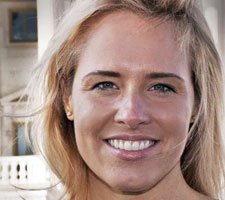
Harris: I’m Marci Harris, co-founder and CEO of POPVOX, and I’m not going to talk about POPVOX. I’m going to talk about a challenge to this group and ask you, "What would you do if for the day you were put in charge of the federal government?" A $3.5 trillion budget, 500,000 physical buildings, 2.5 million civilian employees. You would say, “Show me the data,” and you would get a lot of PDFs. And you would find a lot of really weird things, like a crazy conversion rate in the value of a statistical life, if you happen to be talking about the EPA versus the DOT versus OSHA. And this, in a time when we can measure and pinpoint and see cause and effect more than ever before in human history, this is how we govern.
We do this because of the way we allocate our resources and our priorities. You may have noticed that a lot of money was just recently spent in the congressional midterms. Now, when those members get to Congress they’re going to have considerably fewer resources to use when it comes to governing. That’s the difference or the focus we put on politics versus policy, electing versus governing. It would be like a company spending all of its money on marketing and very little on R&D and product development. But that’s where we are today.
I love this quote from DJ Patil, a nice bit of Silicon Valley wisdom: “If you can’t measure it you can’t fix it.” And for the longest time the U.S. Government has just been too big to measure, and some would say too big to fix, but that’s not the case anymore. We are 10 years into what is known as the open data movement, and the data exists. There are datasets out there left and right on the White House webpage. There are nonprofit organizations like the Sunlight Foundation who’ve been doing brilliant work to pull these datasets together. Now it’s time for something like what we just heard about—an open, collaborative, public, private, commercial academic movement to sequence the human genome that made it possible for advances there to benefit humanity. It’s time for something like that for government.
So this is a call and a challenge and an opportunity to all get on board with the idea of mapping the policy genome, so that we can do things like we do with weather, when models use NOAA data to measure where the storm is going to go, and then as soon as the storm passes through we go back and we calibrate the model so that we learn and get smarter every time. Just as a startup has found—some of you recognize waterfall versus agile—that using data to find out how you’re going along the development cycle and to avoid the big fail of getting to the end and not having tested along the way, so data can transform the way that we govern—right now we legislate and implement in waterfall—and along the way we can start with a fact-based assessment of where we are, a common understanding of where we want to go, and eventually revolutionize our governing practices with a fact-based governing model that contributes and saves the health of our democracy.
Participants
 Business + Innovation
Rudy Sahay: The Generational Wealth Shift Wall Street Isn’t Ready For
Rudy Sahay, Managing Partner of Aquarian Holdings, joins Josh Kampel at the Milken Institute Global Conference 2026 to discuss how insurance, asset management, and retirement-focused investing are converging into a single powerful platform. Sahay explains how Aquarian Holdings was built around a dual structure of insurance operations and asset management, and how that model aligns […]
Business + Innovation
The Future of Money Will Look Nothing Like Today with Milken Institute’s Nicole Valentine
Nicole Valentine of the Milken Institute joins Dan Costa at the Milken Global Conference 2026 to discuss the rapid evolution of fintech, stablecoins, AI, and digital assets. The conversation explores the impact of the GENIUS Bill, why major institutions are embracing crypto infrastructure, and how AI-powered “agentic commerce” could transform payments and financial services over […]
Business + Innovation
Milken Institute’s Rachel Reilly: The Hidden Economic Crisis Facing Main Street America
Rachel Reilly, Senior Director, Milken Institute Finance joins Dan Costa at the Milken Global Conference to discuss inclusive capitalism, economic mobility, and the growing need for place-based investment across America. The conversation explores financial literacy, Opportunity Zones, HBCU talent pipelines, and the coming ownership transition facing small businesses as millions of owners near retirement without […]
Business + Innovation
KKR’s Pete Stavros: Why Employee Ownership Could Fix Corporate America
At the 2026 Milken Institute Global Conference, Dan Costa speaks with Pete Stavros, Co-Head of Global Private Equity at KKR, about employee ownership, AI-driven inequality, and why corporate America may need a completely new relationship with workers. Pete explains how KKR has rolled out ownership programs across 85 companies and 200,000+ employees — leading to […]