
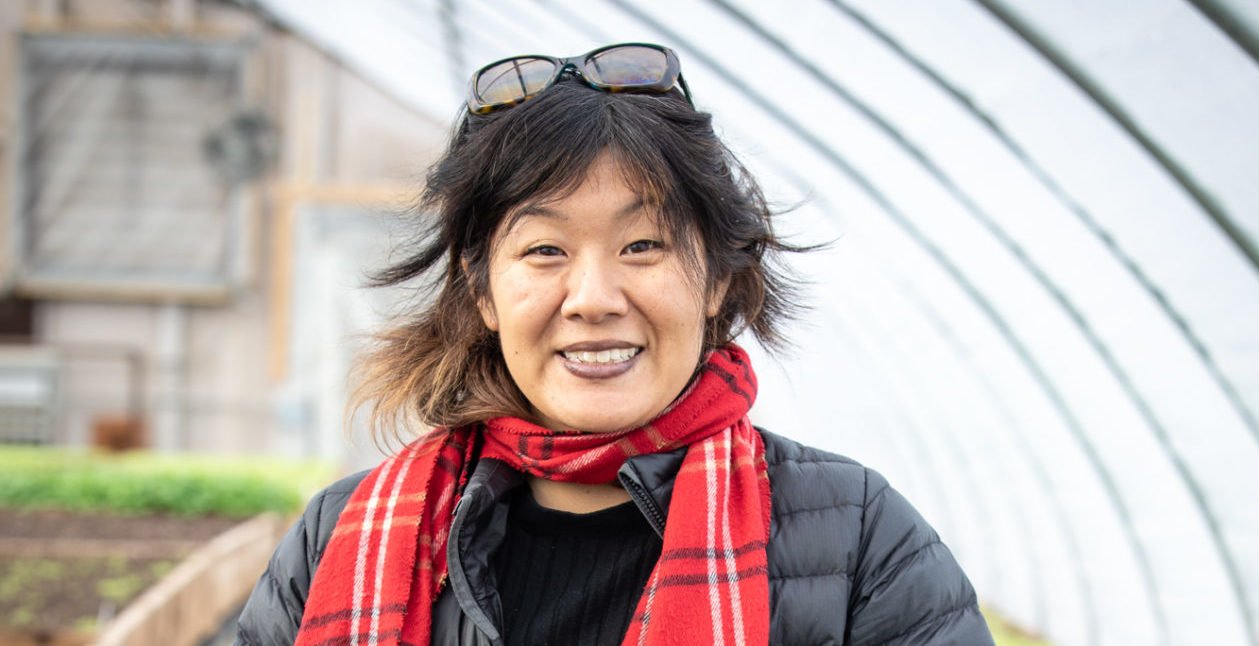
A self-proclaimed “big city person” from New York’s Westchester County, Amy Wu makes an unlikely agricultural hero. But since 2015, she’s turned her attention to ag tech in Salinas, Calif., and specifically to telling the stories of women and underrepresented minorities working in the burgeoning industry.
Expanding beyond her documentary From Farms to Incubators: Telling the Stories of Minority Women Entrepreneurs in the Salinas Valley and Beyond, Wu’s on a mission to chronicle their lives.
“I see From Farms to Incubators not as an official company or nonprofit, but as a bit of a movement,” says Wu, who splits her time between Salinas and New York’s Hudson Valley, where she works in communications for a nonprofit farm. Photographs from her book, From Farms to Incubators: Telling the Stories of Women Innovators in Agtech (Linden Publishing, early 2021) will be showcased in an October 2020 exhibit at Salinas’ National Steinbeck Center.

Q: What prompted you to found From Farms to Incubators?
A: It started with journalism. I was sent to Salinas to cover agriculture. Agriculture doesn’t run in my family at all, but in Salinas it was a bell weather beat. It’s a $9 billion industry there. Eighty percent of the United States’ leafy greens are grown there.
I looked around at meetings of the Monterey County Farm Bureau, the city council and different local associations and I noticed I was one of the few women, and women of color. There was an overall aura that wasn’t very open or welcoming. There were other associations and individual growers who were a lot more welcoming and open, including EcoFarm, where I sit on the diversity committee.
As I prodded further, I found that there were not a lot of women leaders in ag in Salinas Valley. There was one female CEO at the time.
On a separate track, the city was trying to beef up its ag tech sector to boost the local economy.
I started to wonder how many ag tech startups were led or launched by women.
I ended up getting two grants, one from the International Center for Journalists and one from the International Women’s Media Foundation, to make my documentary.
What were the challenges to making the film?
I pitched the idea not yet having found any women, frankly. After I got the grant, I started to search and went to conferences and any time I saw a woman of color, I’d ask what she did in ag tech and I eventually found a few others. The documentary profiles four women from China, India, Vietnam and one who is Mexican American. The basic questions were what got them to start a company in ag tech? A lot of them don’t come from farming families.
I always saw it not just as a film, but as a vehicle and a platform for discussion as to why there aren’t more women in agriculture and technology, and why it’s important to have more women leaders in the space.
What have you learned from interviewing these women and their colleagues?
Farmers and growers are increasingly facing challenges: There’s a clear labor shortage, and they can’t find enough pickers. There’s a water shortage and water management problem, and the weather fluctuations are forcing farmers to change how they farm. They’re increasingly looking for technology as a solution. If they can’t find enough workers to pick lettuce, there are robots.
Women are starting some of these companies. One, Miku Jha, a computer scientist from India, started a company called AgShift. She worked at IBM and moved from New York to California to use her skills and background helping farmers with problems like food waste.
These women are hoping to make a difference. They have the talent, creativity and innovation to create solutions for farmers and solve problems like food waste and labor shortages. They’re also relentless as entrepreneurs. They want to make money and be successful.
You describe the women as relentless. Why?
In farming in general it’s traditionally been family to family, passed down, and most farmers remain white and male. The sector itself, at least in Salinas Valley, is passed down generation to generation, but now young people are not as interested in taking over. It’s hard work, the cost is increasing and profit margins are really thin. It’s also been tough for women, particularly outsiders, to get into that industry.
These women innovators have a hard time. On the positive side, there are incubators and business programs targeted to connect people with innovations to farmers, but fundraising is a challenge.
It’s still an old boy’s network in the VC world. You can’t see the results of return as you can in other sectors, and the results are still determined by harvest time and Mother Nature.
Some of the problem is lack of mentors and women not being able to connect with each other.
What are some of the most frequent misconceptions you encounter about the agriculture industry in general, and about women working in it specifically?
That people who don’t come from an agricultural background don’t know anything and are there just to make money.
There is still a stigma in the industry that farming is white, it’s male, it’s tractors and overalls, but there’s also a great interest from women, young people and people of color. They want to own land and to farm, but it’s a question of access and fundraising and money. They don’t come from families that passed the land down, so the industry needs to embrace them.
I’ve also talked to growers who say we don’t care what gender and race you are, we just want a product that works. There are people who are really open-minded. But if you go to cattle ranching conferences, a lot of the speakers and moderators are white men, and I don’t know if that’s on purpose. Some of it comes down to calling it out.
What surprised you the most about working in Salinas?
I thought I’d only find a handful of stories, but the more I asked, the more stories I found.
I’m a woman, and a woman of color, and I also now work in the agriculture sector myself. There’s a lot of work to be done in accepting the opportunity of bringing in different voices in agriculture and technology. We need enough people to be interested. Otherwise we won’t be able to produce enough food.
What’s next for you?
My goal is to have a space where women can convene and connect with each other and to highlight their innovation and the work they’re doing. A lot of the problem is the stories have been undertold. It’s not that it’s not happening. It’s just that nobody’s told their stories.
You’ve spoken about bringing an outsider’s view to Salinas when you arrived in 2015. Do you still have an outsider’s perspective, and has your viewpoint shifted?
For me it’s a bit of a surprise that I fell into this. I never farmed, and my friends laughed when I moved to Salinas and was interested in farming. I don’t feel as much of an outsider now, because I’ve made connections. A lot of it is showing farmers that you’re showing up, that you’re relentless and not just parachuting in and out. This project has been a passion project, and I’ve continued with it because I truly believe in it, and I believe that ag tech is going to continue to grow
How is technology changing California farming?
It’s not just in California, but the amount of arable land is decreasing because of pesticides harming the soil. There’s a focus on soil health, from testing it, to finding healthier herbicides and insecticides. Some farmers are shifting from the traditional way they’ve been farming to a more organic practice or to minimum tillage, rather than really uprooting the soil. They’re not panicking, but they realize if they keep depleting the soil health, they won’t have as much land to farm.
Growers are increasingly open to AI or drones for pest management or testing soil health.
Farmers are acknowledging problems with water shortage, labor shortage and soil health, but they’re also seeing technology and innovations can provide a solution. The challenge will be for smaller farms, because technology and equipment cost money. Where will growers get the money for the software and hardware?
I’m curious also about the intersection of women and immigrants in farming communities. How do these different identities inform women’s experiences in agriculture?
There are common threads: These women have strong STEM backgrounds and degrees in math, science, engineering or computer science. A lot of them are first generation Americans or are themselves immigrants. Some of them are more educated than their families. They are very ambitious and wanting to make a difference and be successful. They’re really out there to create amazing products and wanting to find investors.
How many women have you chronicled?
I’ve come across dozens, and I’ve had to think carefully about the intersections between ag tech, bio tech and food tech, not just in the U.S., but in India, China, Israel. It’s not just California, it’s really global.
What are your thoughts about the 2020 presidential race? Do you think any candidates would make particularly strong supporters/leaders for agricultural communities like Salinas?
I don’t think I have an answer. 2020 is a really special year because of the election and the 100th anniversary of women’s suffrage. I hope that whoever ends up winning this election will truly adopt agriculture and innovation as a key priority. Everybody needs to eat, and innovation is just critical for all industries. I hope that they will adopt this as a potential paradigm shift in terms of the number of women leading agriculture and technology.
Florida and California, two big ag states, have women agriculture commissioners. It trickles down to agencies too, not just the president, but the USDA. Some people might ask why should race and gender be an issue in any of this, but if you look at the demographics of this country, having diverse voices for those in decision making capacity is really important. The real foundation of agriculture is being driven by Spanish speakers, and it’s really important to include them in conversation, not just field workers but also farmers.