

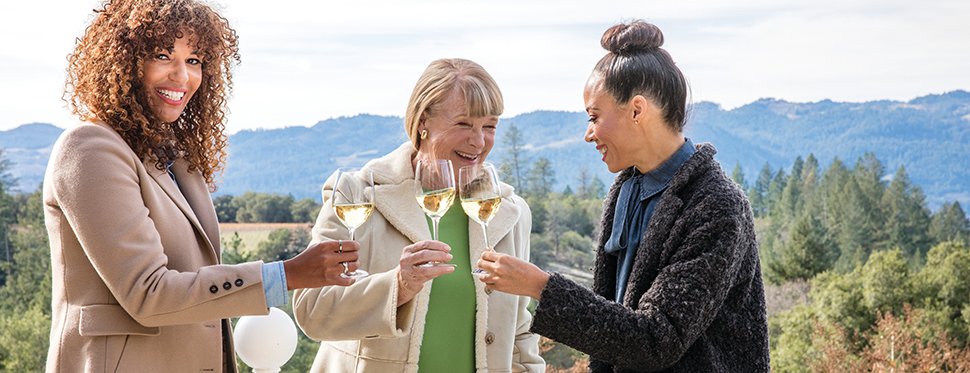
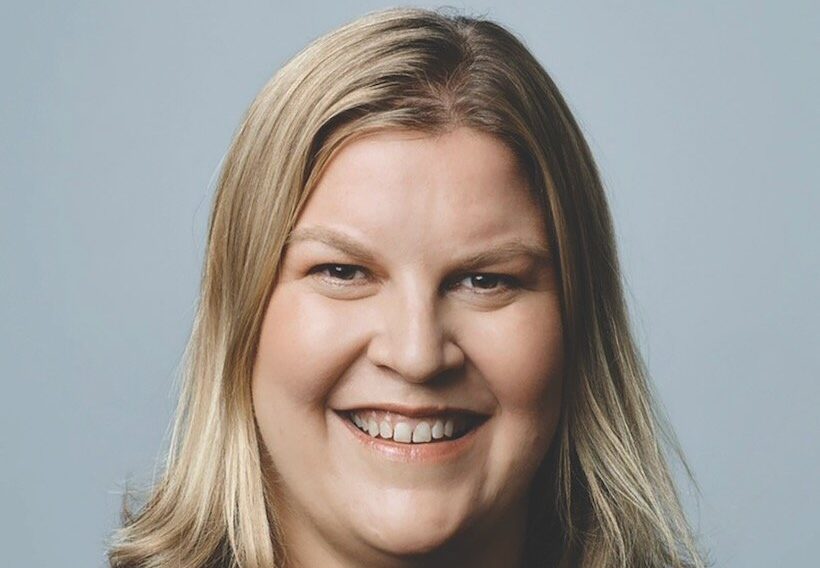
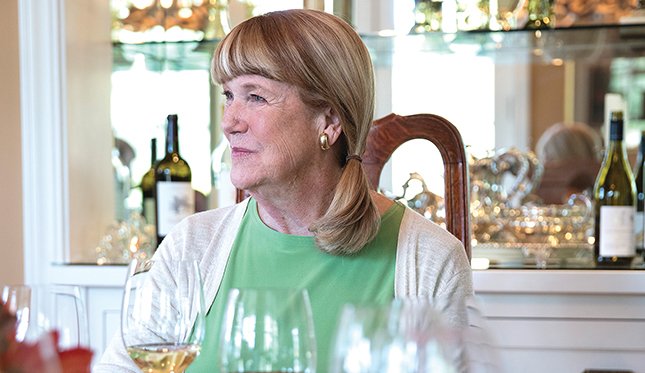
Robin Daniel Lail, 78, should have been heir to Napa Valley’s first grand winery, Inglenook—her great-granduncle, Gustave Niebaum, founded it in 1879. But in 1964, two years after Lail graduated from Stanford, her father, John Daniel Jr., sold the winery. (Today it is owned by filmmaker Francis Ford Coppola.) That, however, didn’t keep Lail from entering the wine business. Starting as Robert Mondavi’s personal assistant in 1977, she worked her way up, eventually owning wineries in partnerships with Napa Valley’s Bill Harlan and with Bordeaux’s Christian Moueix. In 1995, she established Lail Vineyards.
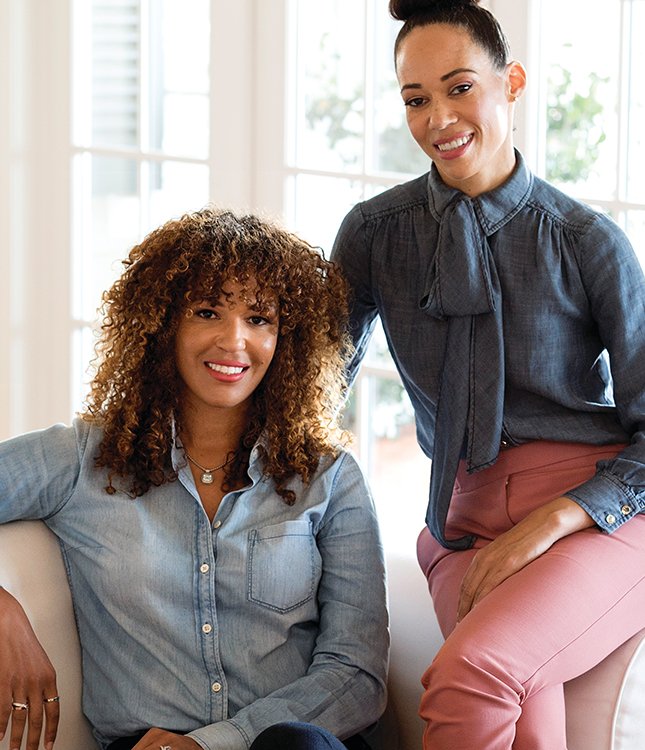
Robin and Andréa McBride’s journey into wine making was more unorthodox. The sisters, aged 35 and 44, grew up in different countries, not knowing of each other’s existence. Born to different mothers, the girls shared a father—a struggling actor whom they came to think of as “a rolling stone.” His deathbed wish that the sisters find each other led to their first meeting in 1999. It turned out that both had been raised in major wine regions: Andréa spent her childhood in New Zealand, near Marlborough, and Robin in Monterey, Calif. Their shared passion for wine led first to a wine importing business, and later to their own wine-making company, the McBride Sisters Collection.

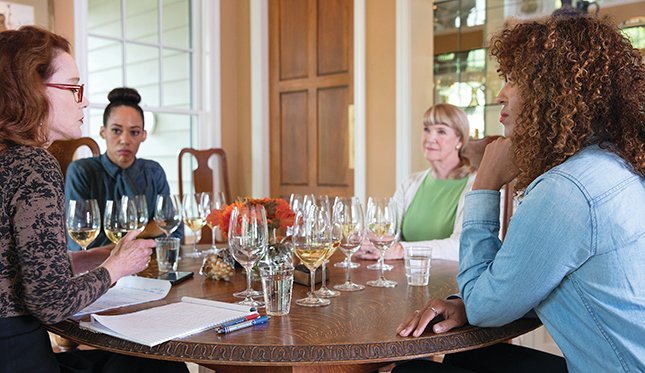
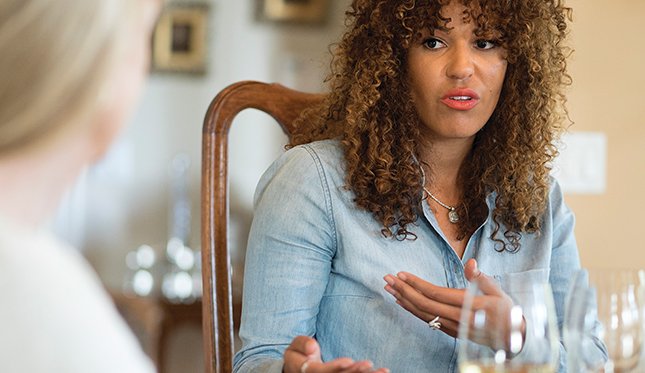
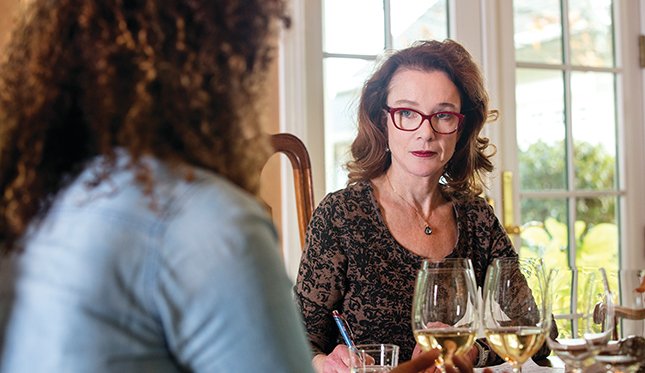
These women represent different generations as well as opposite ends of the wine market, but all three have built successful companies in a historically male-dominated business. On behalf of Worth, I sat down with them at Lail’s estate on Howell Mountain in Napa Valley to get their take on diversity, gender differences and the future of wine making.
Karen MacNeil: When you began in the wine industry, what was the climate like for women?
Robin Daniel Lail: When I started in 1977, I went to work at the Robert Mondavi Winery. The only positions available for women in the industry were in public relations, accounting, hospitality and secretarial work. There were two university-trained women winemakers at the time. It was very obvious that it was a male-dominated business.
Andréa McBride: We started in 2005. At trade tastings, there were not a lot of women and no people of color. It has begun to change in a positive way, but in our opinion, we don’t think it’s changed quite enough yet.
Robin McBride: It shocked us that we were still being questioned about our abilities, our skills and the fact that we owned our own winery. We were absolutely naïve about how far behind the industry was.
Why hasn’t there been more evolution over the last 30 years? This, after all, has been the time of the women’s movement, of feminism.
AM: I think maybe it goes back to the wine industry’s farming roots, and to the fact that women simply were not as present.
RM: We are definitely not in the club. We can’t call our buddy Jack, whom we’ve been playing golf with for 30 years.
AM: Recently, we went to Cincinnati for a business meeting. The night before we went to a restaurant and sat at the only table, which was a communal table. There were three gentlemen there, and the conversation went like this:
Them: Hi, are you from around here?
Us: No, we just flew in from California.
Them: Oh, are you flight attendants?
Us: No, we have a meeting with Kroger [the grocery store chain] in the morning.
Them: We had a meeting with Kroger today. Who do you represent?
Us: We own a wine company.
Them: Really? You guys own the company?
Us: Yes.
Them: Well, good luck with your meeting tomorrow. We know it’s difficult for small companies to get into Kroger.
Us: Actually, we’ve sold our wines to Kroger for many years.
And then there was this awkward silence. The assumptions that were made by these gentlemen were just astonishing.
RDL: I think that women in general are still pushing to find our way, to understand what we bring to the party. I’m not a feminist, but I am a woman who really believes in the nuances that women bring to any situation.
“For, us feminism is simply equality—equal pay for equal work.” —Andréa McBride
Why don’t you consider yourself a feminist?
RDL: Because for me, feminism is the raw side, the jagged edge of what we’re trying to achieve. It’s pushy and overblown. I’m working for consensus so that each gender has something to bring to the table.
AM: For us, feminism is simply equality—equal pay for equal work. So you don’t believe in equality?
RDL: Of course, I do. But from my point of view, starting back when I did so long ago, I’m approaching it in a different way. I want our daughters to have a broader playing field. But I don’t feel angry about the situation women are in. I feel determined, and that’s the way I’ve approached my whole life and business.
What are the most important skills a woman in the wine industry needs?
RM: Tenacity.
AM: Passion. As we said, there’s a boys’ club dynamic in the industry. And what gets you through those days is your passion.
RDL: Also stamina. And vision, and an awareness of those who will follow you and the importance of what you’re trying to do.
We aren’t too far from Hollywood. With the allegations against Harvey Weinstein and so many other men, I’m wondering where the wine industry stands? There are lots of late nights, lots of dinners, lots of wine.
RM: I’d say women should keep up their guards. But I don’t think we’ve had any standout issues of inappropriate behavior.
AM: It helps to be 6-foot-1. And then wear stilettos.
At the top enology program in the U.S., 65 percent of the graduating class are women, yet the number of women who actually go on to be winemakers is very low. Why is that?
RM: I suspect that it’s probably the lack of opportunity for women to have a leadership role. Those women are probably employed in other areas like hospitality.
AM: People aren’t starting families younger, so I don’t understand it either.
RDL: It’s a shame because the women who are in the industry are making great wine.
Have any of you had trouble being taken seriously?
RM: Maybe, wearing stilettos and all, we didn’t fit the persona of what people thought about people in the industry. But it’s always interesting when you get the comment, “Oh, your wines are actually good,” which to me is such a backhanded compliment.
AM: Hopefully we can keep on shocking people.

Robin [Daniel Lail], you in particular worked for some powerful, well-known men. Did all of you have mentors?
RDL: Boy, did I ever with Robert Mondavi. He made everything possible for me. He insisted I get back into the wine business, as part of my family’s legacy.
AM: The internet democratized a lot of information. So we were able to self-teach at first. And then, just by luck, we were introduced to Alain Barbet, former chairman and CEO of the Americas for Pernod Ricard, and we realized that our goal was to own our own company. Alain taught us the basics—creating a P&L, how to raise money, understanding distribution and good business practices like not expanding too quickly. He downloaded to us decades of knowledge. If it weren’t for him, we would have had to spend decades ourselves trying to learn the industry. Without his insight and discipline, I’m not sure where we’d be today.
RM: We call him our Fairy Godfather.
“The most simple, basic maxim in the world of wine is: If you like it, it’s good.” —Robin Daniel Lail
Let’s talk about critics. For the last 30 years, the most powerful wine critics have been men. What’s your take on wine criticism?
AM: During the time we have built our business, we’ve found that the way people share and talk about wine is much different than it was even 15 years ago. And so for us, it’s more important to have validation by consumers through social media and digital media.
RDL: I’ve always found it fascinating that for a very long period of time, the wine business in the world was controlled by male palates. Scores are still powerful in terms of selling wine, but I, personally, hope more people will become their own critics. The most simple, basic maxim in the world of wine is: If you like it, it’s good.
Why do you think so few women have wine cellars?
RM: I think of a wine cellar as a status symbol.
RDL: It’s such an easy thing to show off.
RM: Right? You don’t even have to say much. Just stand back.
RDL: But I also think it’s a good thing because we can help those men fill their cellars.
RM: It reminds me of Instagram. When women are posting pictures about wine, it’s usually a group of women together. They’re smiling, they’re drinking and hanging out. When guys post, they line up the bottles and show the labels. It’s, Look at what we had tonight. It’s a status thing.
RDL: But I also think it’s a genuine thrill. I don’t want to discount people with cellars. And thank God people genuinely have love affairs with wine. After all, isn’t that what we’re guilty of too?
I’ve heard female chefs say that you can always tell if a dish has been made by a woman chef. Do you think that wines made by women have a different sensibility?
RM: I think women are better at wine tasting than men. And because of that, we get a lot more of the nuances that are already present in a grape. I also think women use less heavy-handed wine-making techniques when they make wine.
RDL: I would say a sensibility about wine is not gender specific. But supposedly women are better at tasting. I’ve never personally been a woman who could tell you that there are strawberries and bananas and mangoes in this wine and in that one there are peaches and melons and leather. I just can’t do that. But I can also assure you that wine is very suggestible. If you tell me this smells like tennis balls, I’m sure I’ll smell it. We all will.

You are in different parts of the business. Robin [Daniel Lail], you’re in the luxury wine business, and McBride sisters, you’re more in what we might call the every night beverage business. What would be the hardest thing about being in the other’s business?
AM: I think the pressure for perfection. Just think about what it takes to get a 100-point score, as one of your [Lail’s] wines did.
RM: I think for me it would be having a limited volume. Andréa and I are so driven by being able to give people our wines to try. That’s a big thrill for us.
RDL: It’s hard for me to comprehend going to massive production. I’m kind of like the diamond cutter who’s struggling over just this one gem. But I love the fact that you can give some wine away and share it with so many people because that’s what helps the industry grow.
What piece of advice would you give the next generation of females in the wine industry?
RDL: Take it seriously. Never believe you’ve arrived.
AM and RM (simultaneously): That’s a good one.