

How Her Parents Influenced Her
I grew up in Los Angeles, one of four girls. My father was a cardiologist. My mother, when I was growing up, was a full-time mom. Very involved with the PTA, nonprofits. I didn’t think there was any difference between girls and boys. I mean, we didn’t have any boys in our family. We could do anything we could imagine. I could throw a perfect spiral. Swish a three-pointer.
My father always said that if he left us money when he died, we didn’t live life. Every other year before he died, we would take mandatory family trips. We chased eclipses all over the world. We would receive a letter in the mail from my father a year and a half in advance telling us on this day we were to be in this airport at this time. We would have airline tickets sent to us, and then be in the Galápagos chasing an eclipse together.

After my sisters and I left the house, my mother started working for [California governor] Pete Wilson. In 1992, she created the first conference for [corporate] women in the state. I remember going to that conference and thinking, I’ve never seen anything like this. I remember a woman standing up and asking a question in front of all these other women: “How do you still find your identity when you’re no longer working?”
I thought to myself, What a vulnerable question—I don’t want to be that person. I thought that once I had children I was not going to work.

The Purpose of a College Degree
Zalis traveled to New York for college because, she says, “Your parents want you to marry a nice Jewish boy, and in Los Angeles, all you know is all the Jewish boys are in New York.” Though she had a sister at Barnard, she started college at New York University. But after realizing that Barnard students could actually be a part of Columbia, she transferred.


The Beginning of an Accidental Career
Though Zalis didn’t particularly plan on having a career—she still expected to be a full-time mother—she did want a job upon graduation in 1983. So she interviewed with a company called Video Storyboards that tested advertising animatics with shoppers in malls. Hired on the spot, Zalis loved the work—even though the pay was minimal for her and the three other women who worked for the firm’s male owner.
I remember asking him one time how much money the firm made, because there was no overhead—we had this tiny little office and it was him and four girls, and I was making $24,000 a year. And I think he told me $3 million. And so if all the women and I were getting paid all in like $200,000, he was making about $2 million a year. But I never thought about it—I didn’t care. I wasn’t thinking about savings, the future. I was just thinking about paying my rent in New York and dating and having a good time.
Learning That There’s No Such Thing as Trying
After Zalis had been at Video Storyboards for about six years, a headhunter called and asked her to interview at a company called Applied Science International Market Research, better known as ASI. She met with CEO and president Gerry Lukeman, a leading figure in the still relatively small market-research industry. In the interview, Lukeman asked her to watch two spots for Domino’s Pizza and tell him which one consumers liked more. “I said, ‘Oh, this one,’” says Zalis, and told him why. “And he said, ‘You’re hired.’” Lukeman would become her mentor and close friend.
When Zalis Helped Create Online Advertising
Zalis worked in business development for ASI; she loved building long-term relationships with clients and came to feel that she did it differently than her male coworkers. “I didn’t do deals,” she says. “I created relationships.” In the early 1990s, she sensed that things in the marketing world were about to change profoundly. In the internet’s infancy, companies that wanted to promote their products weren’t placing ads because internet advertising as we now know it didn’t really exist. Instead, they simply built their own websites. Zalis’ epiphany was that marketers should be creating ads to be placed on other companies’ websites. “Which is when,” she says, “we started creating split screens and banners and interstitials.” One problem? There were no industry standards defining the ads’ specifications, as there were for TV. “We don’t have a 30 [-second spot] on NBC and a 32 on ABC,” Zalis recalls. “We needed standard units.” So she pulled together a consortium of 10 noncompeting advertisers, including IBM and Levi Strauss, which created a database of online advertisements they then used to devise technical standards. “No one else was doing it,” Zalis says. “We pioneered game-changing methodologies.”
A Roadblock Becomes an Opportunity
The problem was that other colleagues, including her immediate boss at ASI, weren’t showing much support for the project. And that led to an employment review from that boss that changed Zalis’ trajectory—and consciousness. Today, talking about that 20-year-old review, Zalis actually pulls it out of a file cabinet in her office to read excerpts. Including:
And that’s when I realized I needed to break the rules and create my own. Because following other people’s rules didn’t always work well for me. Why were the men always right?

How a Bad Review Changed Her Life
The episode pushed Zalis to leave ASI. “They were trying to keep me in this place,” she says. She aimed to pursue another idea that she had: migrating consumer research from in-person surveys like the ones she had done in malls to internet-based testing. Zalis wanted to build a website to conduct market research, something that seems obvious now but was radical at the time. However it was clear after her review that the men at ASI didn’t see things the same way.

The Urgency of Risk
So I called this young guy, Trevor Kaufman, who used to do all my website-visibility testing. I said, “I have this great idea to migrate testing from offline to online—would you build me a website? I have no money, but the second someone says they want to do this, I’ll give you a million dollars.” He took that offer and we built the platform in my basement.
My husband and my father each said, “We’ll give you half a million dollars to start your company.” I was afraid to take their money. My husband was a surgical resident—he had no money. Half a million, that would have been everything of ours. I knew that I would not take risks with my husband’s and my father’s money. I thought I would lose it, and then we would have nothing left.
So I brought it to [market-research company] Nielsen and said, “I have this crazy idea,” and I showed them the prototype…They said, “What do you need?” I said, “A million dollars.” And I handed it to this 21-year-old. Made him a millionaire. And that is how I started online research.

An Increasing
Now married with children and back in Los Angeles, Zalis decided to look for clients in the film business. Her premise: If you could build a site that could handle testing two-and-a-half-minute trailers—this was the internet in 2000, remember, when for most people fast download speeds were still years away—you could easily test 30-second advertisements. The business, which she called OTX, for Online Testing Exchange, did well, but her partnership with Nielsen did not. “As it started getting bigger and bigger, all the divisions at Nielsen started fighting over who was going to own this online business,” Zalis says.
So Zalis left in 2000 to bring OTX to a video startup for user-generated content called iFilm—basically, YouTube before YouTube. Again, iFilm struggled—but Zalis’ OTX (now called iFilm OTX) did well, eventually hitting $20 million a year in revenue. After discovering that iFilm was considering allowing pornography on its site—a no-no for the Fortune 500 firms she worked with—Zalis moved her company to a partnership headed by media entrepreneurs Bob Pittman and Strauss Zelnick. In 2010, she and her partners sold OTX for $80 million to a research company called Ipsos. Zalis agreed to stay for five years. And that led to another pivot point for Zalis: the almost accidental realization that she wanted to do something about gender inequality in business.
While I was at Ipsos, in 2013, I wanted to go to CES, the Consumer Electronics Show. I’d heard that there were something like 150,000 people there, and fewer than 5 percent were women. I’d never been to CES, I didn’t know anyone there…Who wants to go to a trade show by themselves?
So I decided to invite four girlfriends. “Let’s go to CES in Vegas together. And if you know other women going, invite them.” Fifty women showed up, and we walked the floor together. And every guy’s head turned—where did all these women come from? By day two, there were 100 women. By day three, I have the penthouse suite of the Four Seasons and we were all having the best time hanging out together and doing business. And that’s when the Girls’ Lounge was born: The place where the minority acts like the majority.
Initially backed by Ipsos, Zalis’ Girls’ Lounge would be a place for women (though men are welcome) to gather at conferences to network and do business and, really, have a space of their own. The name came from Zalis’ feeling that the business world had always been a boys’ club, and since “women never felt comfortable in the boys’ club, we’ll create our own girls’ lounge.” Now you can find the FQ Lounge—renamed to avoid the word “girl,” a stumbling block for some, and to emphasize inclusion—at Davos, South by Southwest, the NBA All-Star Game and other high-profile events. At Davos in January, the Lounge hosted panels on topics ranging from “Male Champions of Change” to “Women Changing the Trajectory of Distrust in the World Through Tech.”
The Imperative of Going Solo
Zalis left Ipsos when her five-year deal expired; she wasn’t confident the company would continue to support the Girls’ Lounges. “The men there were like, ‘If we’re going to have a girls’ lounge, we need a man cave,’” she says. She knew she’d reached a turning point in her life. “I’ve made my money,” she thought. “I don’t want to be in research anymore. The Girls’ Lounge was very empowering to me.”
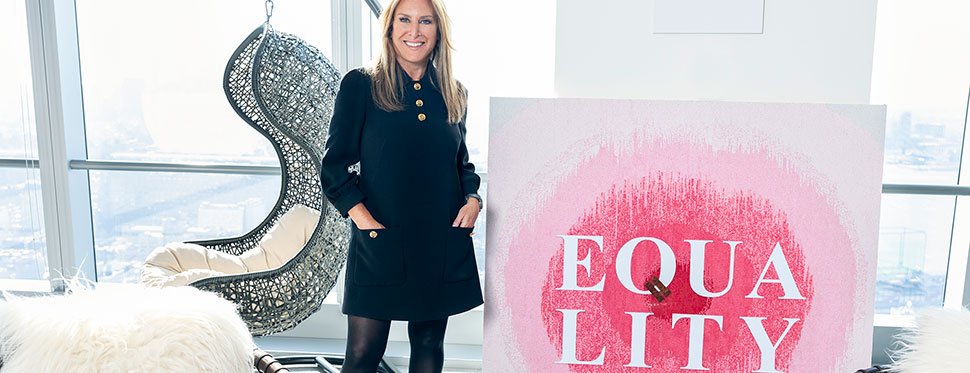
In 2015 Zalis launched the Female Quotient. “First came the intelligence quotient—IQ,” she says. “Then came the emotional quotient—EQ. Now comes the female quotient.” Naturally—Zalis is a marketer, after all—FQ has a slogan: “When you add women to any equation, the equation gets better.” In addition to the FQ Lounges, the Female Quotient consults for companies on “the practice of equality”—things like closing the wage gap and recruitment. It also has an impact arm, supporting female-centric nonprofits ranging from the Girl Scouts to an organization that builds schools for girls in Rwanda. The company generated about $9 million in revenue in 2018, and Zalis says she had an offer to sell it for $45 million. “I’m not looking to sell,” Zalis explains. “I want to be in the business of equality.